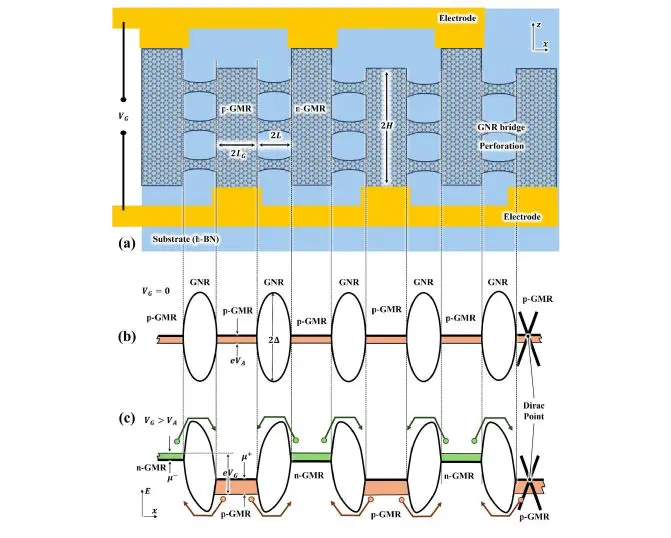
The phenomenon of hot-carrier thermal breakdown limits the performance of nanoscale electronic devices, and researchers are now investigating how to control it in advanced materials. M. Ryzhii, V. Ryzhii, and C. Tang, alongside colleagues including T. Otsuji and M. S. Shur, have demonstrated how doping significantly alters this breakdown process in perforated graphene metasurfaces. Their work reveals that by carefully controlling the concentration of electrons and holes within these structures, it becomes possible to manipulate the flow of energy and current, effectively preventing catastrophic failure. This discovery offers a pathway towards designing more robust and efficient nanoscale devices, including ultra-fast switches, efficient light emitters, and highly sensitive terahertz detectors, by optimising the interplay between electrical and thermal effects at the nanoscale.
This research focuses on understanding how varying the doping level affects the stability of these characteristics, which are critical for device performance and reliability. Researchers explored the relationship between doping concentration and the onset of electrical breakdown, aiming to identify conditions that enhance the resilience of PGMs. This detailed analysis provides insights into the fundamental mechanisms governing electrical breakdown in these materials and contributes to the development of more robust and efficient electronic devices.
Graphene Terahertz Detection and Thermal Limits
Researchers are actively developing graphene-based detectors for terahertz (THz) radiation, focusing on the physics of hot carrier generation, cooling, and thermal breakdown within graphene structures. These devices rely on absorbing THz radiation, which creates energetic electrons and holes (hot carriers) in the graphene. The change in carrier concentration or temperature is then measured to detect the radiation. Various graphene structures are being explored, including perforated graphene, graphene nanoribbons, and engineered metasurfaces. Efficiently managing heat dissipation is crucial, as excessive heating can damage the device. The team investigates several cooling mechanisms, including electron-phonon interactions and plasmon excitation. The goal is to create more sensitive and efficient THz detectors for applications in imaging, spectroscopy, and security screening.
Electrically Induced Breakdown in Graphene Metasurfaces
Scientists have achieved a detailed understanding of electrical breakdown in perforated graphene metasurfaces (PGMs), revealing how doping significantly influences their current-voltage characteristics. The research focuses on structures comprising graphene micro-ribbons (GMRs) and nano-ribbon (GNR) bridges, where the GNRs act as energy barriers governing the flow of electrons and holes between adjacent GMRs. Experiments demonstrate that applying a bias voltage establishes distinct electron and hole populations within the GMRs, leading to localized heating and a positive feedback loop between carrier heating and current amplification. This feedback can trigger an electrothermal breakdown, transforming a typical current-voltage relationship into an S-shaped characteristic exhibiting negative differential resistance. Crucially, the degree of asymmetry between electron and hole populations strongly modifies the overall current-voltage response. These findings provide a framework for optimizing PGM-based devices, including fast voltage-controlled switches, incandescent emitters, and terahertz bolometric detectors, by carefully controlling doping levels and voltage biases to manipulate the electrothermal feedback mechanisms.
Metasurface Breakdown via Hot-Carrier Feedback Loop
Researchers have demonstrated a robust hot-carrier-induced electrical breakdown within perforated metasurfaces, structures incorporating arrays of interconnected microribbons and nanobridges. The team discovered that the interplay between electron and hole populations, influenced by doping levels and applied voltage, generates a positive feedback loop, amplifying current and ultimately leading to a distinct S-shaped current-voltage characteristic. This effect arises because the nanobridge constrictions act as energy barriers, controlling the flow of current between the microribbons and impacting the overall electrical response of the material. These findings establish a framework for optimizing the design of perforated metasurface devices, potentially leading to advancements in fast voltage-controlled switches, efficient incandescent light sources, and sensitive terahertz bolometers.
🗞 Effect of doping on hot-carrier thermal breakdown in perforated graphene metasurfaces
🧠 ArXiv: https://arxiv.org/abs/2511.10960