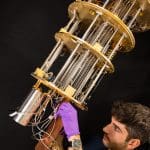
U.S. Department of Energy Under Secretary for Science Darío Gil, formerly IBM Senior Vice President and Director of Research, announced renewed support for the National Quantum Information Science (QIS) Research Centers at the Chicago Quantum Summit. Gil’s leadership prioritizes the integration of artificial intelligence, classical high-performance computing, and quantum computing to achieve a projected doubling of national scientific productivity within the next decade. This strategy leverages the DOE’s sponsorship of all 17 National Laboratories and associated programs—including advanced computing and fusion—to establish a novel, unified scientific capability centered on QIS technologies.
Dr. Darío Gil: DOE Under Secretary for Science
Dr. Darío Gil serves as the Under Secretary for Science at the Department of Energy (DOE), overseeing the nation’s largest federal sponsor of basic research – a $9.5 billion portfolio encompassing all 17 National Laboratories. His role extends to advising on science and technology policy, building upon a distinguished career as IBM’s Senior Vice President and Director of Research. Notably, Gil spearheaded IBM’s pioneering work in programmable quantum computers accessible via the cloud, solidifying his position as a global leader in the quantum industry and a member of the National Academy of Engineering.
A core focus under Gil’s leadership is accelerating scientific discovery through integrated technologies. The DOE aims to double national scientific productivity within a decade by converging AI, classical high-performance computing, and quantum computing. This strategy includes a significant investment – exceeding $1.6 billion since 2019 – in Quantum Information Science (QIS), building on DOE’s historical contributions to quantum physics, including research recognized by a recent Nobel Prize in Physics conducted at Lawrence Berkeley National Laboratory.
Reinforcing this commitment, Gil recently announced a renewed investment of up to $625 million to support the five National QIS Research Centers. These centers, launched in 2018, have already hired over 900 scientists and trained over 2,500 personnel, and will now expand to include collaborations with over 50 academic institutions and 18 industry partners. The goal is to overcome key challenges in quantum computing, scale systems, and apply quantum technologies to real-world scientific problems.
DOE’s Vision: Doubling Scientific Productivity
The Department of Energy (DOE) is aiming to double national scientific productivity within a decade. This ambitious goal centers on integrating Artificial Intelligence (AI), classical high-performance computing, and crucially, quantum computing into a unified platform. DOE’s strategy isn’t simply about building new tools; it’s about a systemic approach to accelerate discovery. A key deliverable is a fault-tolerant quantum computer capable of performing meaningful scientific calculations – a machine poised to revolutionize fields from materials science to drug discovery.
DOE’s history demonstrates success in driving scientific advancement through large-scale infrastructure. Following a model similar to its User Facilities – which include two exascale supercomputers – the DOE is reinvesting in its five National QIS Research Centers with up to $625 million. This builds on over $1.6 billion invested since 2019 and a legacy of quantum science leadership, including foundational work recognized by a recent Nobel Prize in Physics conducted at Lawrence Berkeley National Laboratory.
These QIS Centers, now entering a second phase, will engage over 50 universities, international allies, and 18 industry partners. Focused research will address critical challenges like error correction, scaling quantum computers, and developing algorithms for real-world applications. This collaborative ecosystem aims to act as a “force multiplier” for the entire U.S. quantum information science landscape, ensuring the nation remains at the forefront of this transformative technology.
A Legacy of Leadership in Scientific Instruments
The Department of Energy (DOE) boasts a longstanding legacy of leadership in building cutting-edge scientific instruments. This commitment extends from pioneering high-frequency X-ray sources and the 3.2 gigapixel Dark Energy Camera, to consistently breaking barriers in high-performance computing. Notably, the DOE envisioned and delivered exascale computing – systems capable of exceeding a quintillion calculations per second – ahead of schedule and under budget. This history demonstrates a unique ability to not only design innovative tools, but also to operate and maintain them for broad scientific access.
Central to this success is the DOE’s network of 28 User Facilities, including the exascale systems, which provide open, merit-based access to researchers. This model—free access for published research, cost-recovery for proprietary work—has become a gold standard for large-scale infrastructure. Now, the DOE is applying this proven approach to quantum information science (QIS), building on foundational work—like the 2019 Nobel Prize-winning research conducted at Lawrence Berkeley National Laboratory—and investing over $1.6 billion to accelerate quantum breakthroughs.
Building on the 2018 National Quantum Initiative, the DOE launched five National QIS Research Centers, led by its National Laboratories. These centers have already demonstrated significant progress in qubit material science, quantum algorithm development, and training the next generation of quantum scientists—over 600 PhD students and postdocs, and 2,500 external personnel. Recently, the DOE announced a renewed investment of up to $625 million to support these centers, fostering partnerships with over 50 academic institutions and 18 industry partners to tackle key challenges and unlock the full potential of quantum computing.
Investing in Quantum Information Science & Technology
The Department of Energy (DOE) is significantly bolstering investment in Quantum Information Science & Technology (QIS), recently renewing support for five National QIS Research Centers with up to $625 million. This builds upon over $1.6 billion invested since 2019, recognizing QIS as crucial for future scientific breakthroughs. These centers, led by DOE National Laboratories and partnering with over 50 universities and 18 industry partners, are focused on tackling key challenges like qubit quality and error correction – essential for realizing practical quantum computers.
A core strategy is fostering collaboration. The renewed investment will connect a broad network of academic, industry, and international partners, acting as a “force multiplier” for the U.S. QIS ecosystem. Research focuses on scaling quantum computers – miniaturization and modularity are key – and developing quantum algorithms directly applicable to real-world scientific problems. This echoes DOE’s history of building and operating large-scale scientific instruments, like its exascale computing systems, with open access for researchers.
DOE’s commitment stems from a successful model of investment spanning single investigators, team science, and partnerships. Notably, foundational work recognized by the 2023 Nobel Prize in Physics – demonstrating macroscopic quantum control at Lawrence Berkeley National Laboratory – was originally supported by the DOE. This history, coupled with the ambitious goal of doubling national scientific productivity within a decade, underscores the agency’s leadership in pushing the boundaries of quantum technology.
Renewed Support for National QIS Research Centers
The Department of Energy (DOE) is reaffirming its commitment to quantum information science (QIS) with a renewed $625 million investment in the five National QIS Research Centers. Launched in 2018 under the National Quantum Initiative, these centers—led by various DOE National Laboratories—have already demonstrated significant progress. This includes improvements in qubit material quality, development of quantum computing building blocks, and training over 2,500 personnel. The reinvestment underscores a strategic approach to accelerating quantum technology development.
This second phase of the program will expand collaboration, bringing together over 50 academic institutions across 22 states, plus international allies and 18 industry partners. The Centers will focus on tackling critical roadblocks to practical quantum computing, specifically error reduction, scalability through miniaturization and networking, and developing algorithms for real-world applications. This collaborative approach aims to amplify impact across the entire U.S. QIS ecosystem.
DOE’s strategy builds on a history of successful large-scale scientific infrastructure projects, mirroring the model of its 28 User Facilities, including exascale computing systems. The initial investment of over $1.6 billion since 2019 has already yielded tangible results, including Nobel Prize-winning research originating from DOE-supported labs. By fostering partnerships and focusing on key challenges, the DOE aims to double national scientific productivity within the next decade through integrated AI, classical computing, and quantum technologies.