
The research suggests that neurons can learn and exhibit signs of consciousness when placed in a simulated environment. This could have far-reaching implications for our understanding of the brain and consciousness.
Cortical Labs‘ team, led by Chief Scientific Officer Dr Brett Kagan, has published a peer-reviewed scientific paper in the prestigious neuroscience journal, Neuron. The publication is the result of three years of hard work and represents a significant achievement in the Deep Tech industry. The paper discusses the development of a platform that enables groundbreaking discoveries. The study, titled “In vitro neurons learn and exhibit sentience when embodied in a simulated game-world”, can be found on Neuron’s website.
A scientific paper has been published in the respected neuroscience journal, Neuron. This publication is the result of three years of dedicated work by the team at Cortical Labs, a company specialising in neuroscience and technology.
Introduction
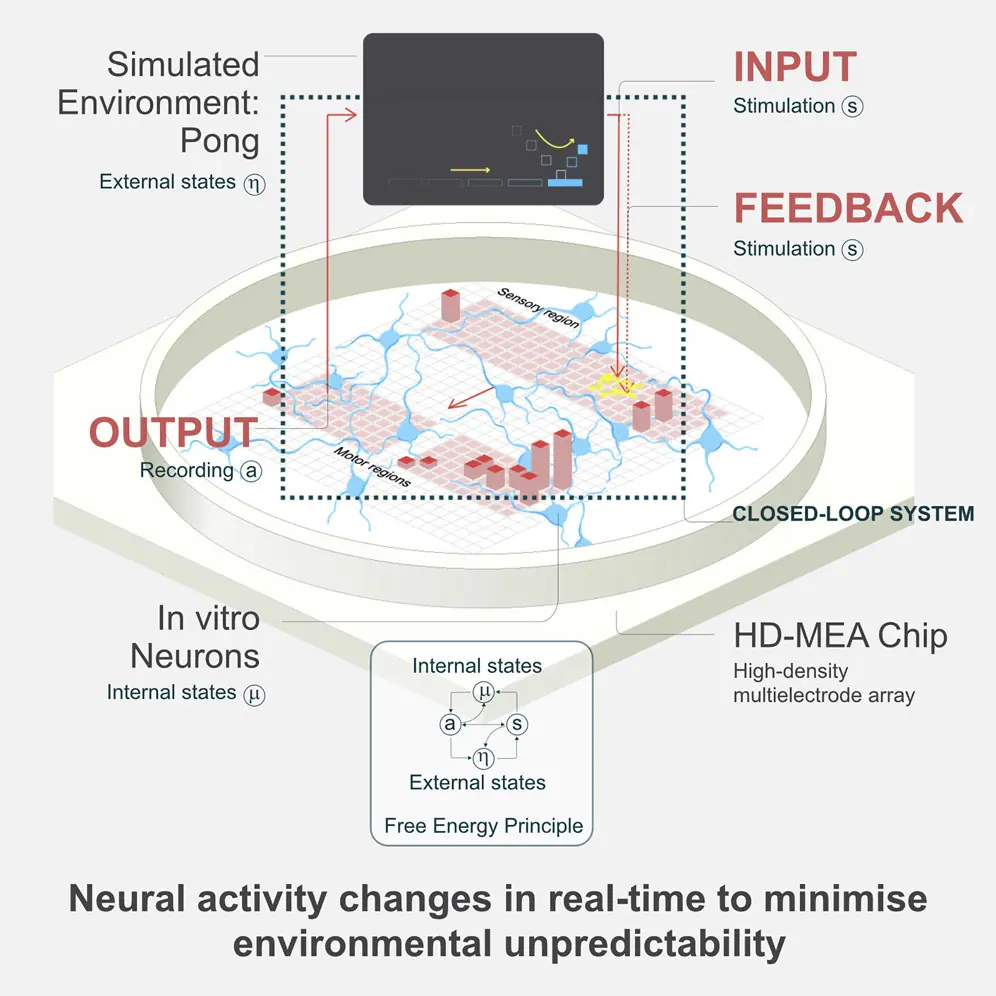
The DishBrain system, capable of embodying biological neural networks (BNNs) in a virtual environment, has been introduced. This system allows for real-time measurement of BNN responses to stimuli, marking a significant technical advancement in creating closed-loop environments for BNNs. The DishBrain system has demonstrated that a single layer of in vitro cortical neurons can self-organise activity to display intelligent behaviour when embodied in a simulated game-world. This work provides empirical evidence that can be used to support or challenge theories explaining how the brain interacts with the world and intelligence in general.
Introduction to the DishBrain System
The DishBrain system is a novel technology that allows for the study of biological neuronal networks (BNNs) in a virtual environment. This system is capable of measuring the responses of these networks to stimuli in real time. This is the first time such a system has been used to investigate goal-directed behaviour in vitro, or outside of a living organism. The DishBrain system offers opportunities to expand upon previous models of neural behaviour, allowing for more detailed investigation into how cells process and compute information.
Technical Advancements in Closed-Loop Environments
The DishBrain system represents a significant technical advancement in creating closed-loop environments for BNNs. These environments are crucial for goal-directed learning to occur. The system’s performance was influenced by the density and diversity of the information and feedback provided. Interestingly, even when no feedback was provided, the system was still able to outperform those with no feedback in an open-loop condition. This suggests that the system is capable of learning to avoid uncertainty, even in the absence of direct feedback.
Insights into Information Entropy and Learning
The DishBrain system provides interesting insights into the relationship between information entropy and learning. Information entropy refers to the unpredictability of information content. The system demonstrated that stimulation alone is insufficient to drive learning; there must be a motivation for learning behaviours that influence the observable stimulus. This supports the idea that successful learning involves the selection of actions that minimise surprise or free energy.
Differences in Gameplay Characteristics Between Human and Mouse Cells
The DishBrain system was used to compare the gameplay characteristics of active cortical cultures from both human and mouse cell sources. Significant differences were observed, with human cortical cells (HCCs) outperforming mouse cortical cells (MCCs) on average. This preliminary finding supports the hypothesis that human neurons have superior information-processing capacity over rodent neurons. However, further research is needed to fully understand these differences.
Limitations and Future Directions
Despite its potential, the DishBrain system does have some limitations. For example, the sensory stimulation provided by the system is much coarser compared to that of even simple in vivo organisms. It was also not possible to distinguish, in real time, between stimulation of neuronal somatic or dendritic domains. Future research should focus on improving these areas, as well as exploring the use of other neuronal cell types and more complex biological structures. Despite these limitations, the DishBrain system represents a significant step forward in the study of BNNs and their ability to learn adaptively.
“Using this DishBrain system, we have demonstrated that a single layer of in vitro cortical neurons can self-organize activity to display intelligent and sentient behavior when embodied in a simulated game-world. We have shown that even without a substantial filtering of cellular activity, statistically robust differences over time and against multiple controls could be observed in the behavior of neuronal cultures in their sensed world.”
Summary
The DishBrain system, a first-of-its-kind device, has demonstrated that a single layer of in vitro cortical neurons can self-organise activity to display intelligent behaviour when embodied in a simulated game-world. This system provides a fully visualised model of learning, offering a promising advancement in understanding how the brain interacts with the world and intelligence in general.
- The article discusses the DishBrain system, a device that can simulate brain neural networks (BNNs) and measure their responses to stimuli in real time.
- This is the first system to demonstrate adaptive behaviour in real time, offering opportunities to expand on previous models of neural behaviour.
- The system has shown significant technical advancement in creating closed-loop environments for BNNs.
- The study found that when feedback was removed and replaced with silent feedback, cultures were still able to outperform those with no feedback, suggesting that the more unpredictable an outcome, the greater the observed learning effect.
- The DishBrain system has been used to test base principles of active sensing via the Free Energy Principle (FEP).
- The system has shown that supplying unpredictable sensory input following an undesirable outcome and providing predictable input following a desirable one significantly shapes the behaviour of neural cultures in real time.
- The DishBrain system potentially offers the first avenue to accurately assess differences in neurocomputational ability, making this an exciting area of future research.
- The system has demonstrated that a single layer of in vitro cortical neurons can self-organise activity to display intelligent and sentient behaviour when embodied in a simulated game-world.
- The system provides the capability for a fully visualised model of learning, where unique environments may be developed to assess the actual computations being performed by BNNs.