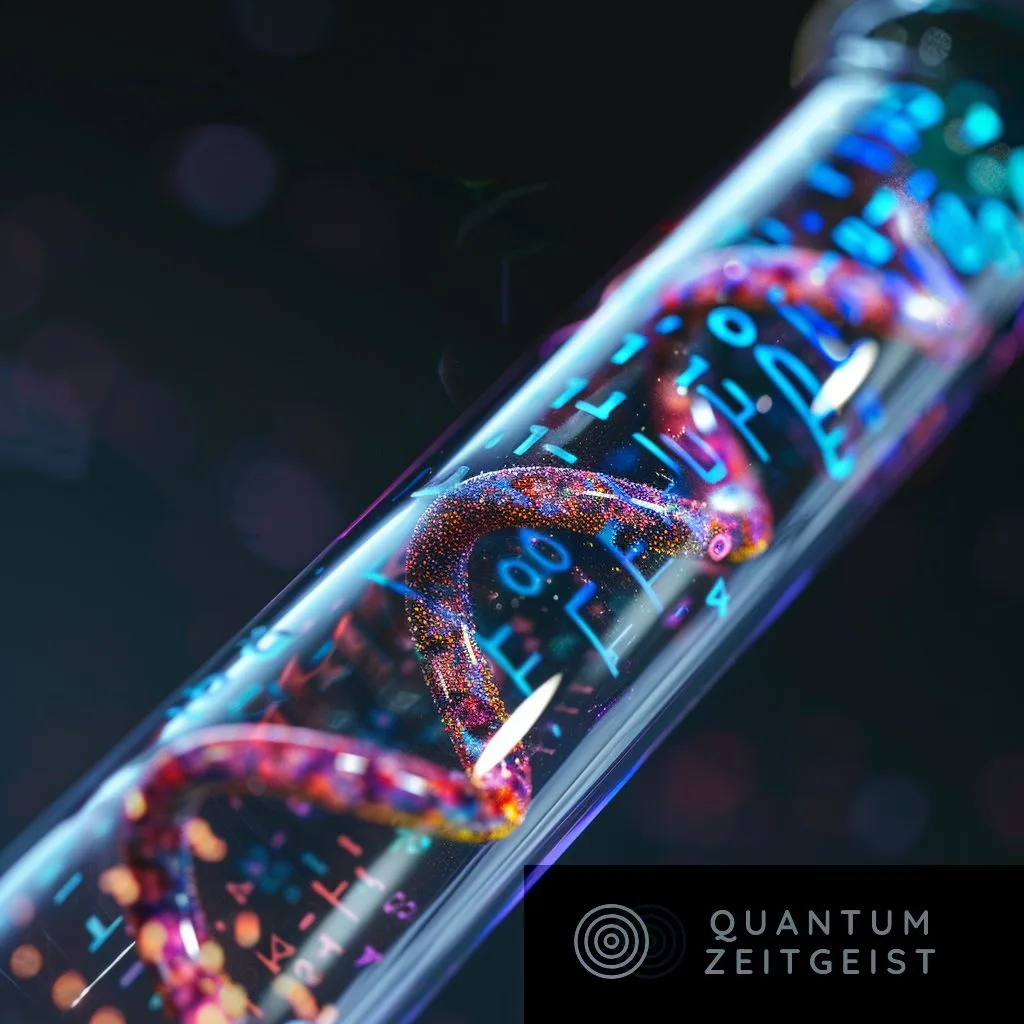
DNA’s structure and function make it a perfect quantum computer, according to theoretical studies. The aromaticity in DNA is due to the oscillatory resonant quantum state of correlated electron and hole pairs, which form a supercurrent in the nitrogenous bases. The central Hydrogen bond in DNA functions like a Josephson Junction, a quantum mechanical device that allows supercurrents to pass between two superconductors. This understanding of DNA’s structure and function, along with the genetic code based on four nitrogen heteroaromatic compounds, solidifies DNA’s role as a quantum computer.
What Makes DNA a Perfect Quantum Computer?
DNA, or deoxyribonucleic acid, is a complex molecule that has been the subject of extensive scientific study. Its intricate structure and function have been a challenge to understand, requiring the application of both chemistry and quantum physics. The molecule’s multiscale nature necessitates the use of quantum informatics to explain its operation as a perfect quantum computer.
The theoretical study of DNA has yielded results that provide a better understanding of its structure and the process of transmitting, coding, and decoding genetic information. One of the key findings is the explanation of aromaticity, which is attributed to the oscillatory resonant quantum state of correlated electron and hole pairs. This state is due to the quantized molecular vibrational energy acting as an attractive force.
These correlated pairs form a supercurrent in the nitrogenous bases in a single band π-molecular orbital (πMO). The MO wave function is assumed to be the linear combination of the n constituent atomic orbitals. This understanding of DNA’s structure and function is crucial in explaining its operation as a quantum computer.
How Does the Central Hydrogen Bond Function in DNA?
The central Hydrogen bond between Adenine (A) and Thymine (T) or Guanine (G) and Cytosine (C) in DNA functions like an ideal Josephson Junction. The Josephson Junction is a quantum mechanical device that allows supercurrents to pass between two superconductors, and it is this mechanism that is mirrored in the DNA molecule.
The approach of a Josephson Effect between two superconductors is correctly described, as well as the condensation of the nitrogenous bases to obtain the two entangled quantum states that form the qubit. A qubit, or quantum bit, is the basic unit of quantum information. It is a two-state quantum-mechanical system, one of the simplest quantum systems displaying the peculiarity of quantum mechanics.
Combining the quantum state of the composite system with the classical information, RNA polymerase teleports one of the four Bell states. This process further solidifies DNA’s role as a perfect quantum computer.
What are the Natural Processes Based on DNA?
Natural processes are based on codes that establish the laws and principles governing physics, chemistry, biology relationships, and interactions, and the concepts of matter, space, and time. For instance, our decimal number system has numbers from zero to ten. With these ten numbers, the set of all Real numbers is constituted.
Similarly, the instructions in a gene that tells a cell how to make a specific protein are enclosed in our genetic code. The protein-coding gene alphabet is based on four nitrogen heteroaromatic compounds: Adenine (A), Guanine (G), Thymine (T), and Cytosine (C). These compounds are classified into two types: the purines (A and G) and the pyrimidines (C and T).
The two complementary Deoxyribonucleic Acids (DNA) strands constituted by nucleotides linked by a 3-5 phosphodiester bond are held together. This structure and function of DNA are what make it a perfect quantum computer.
How Does DNA Function as a Quantum Computer?
The theoretical study of DNA has revealed that it functions as a perfect quantum computer. This is due to its structure and the process of transmitting, coding, and decoding genetic information. The aromaticity in DNA is explained by the oscillatory resonant quantum state of correlated electron and hole pairs due to the quantized molecular vibrational energy acting as an attractive force.
These correlated pairs form a supercurrent in the nitrogenous bases in a single band π-molecular orbital (πMO). The MO wave function is assumed to be the linear combination of the n constituent atomic orbitals. This understanding of DNA’s structure and function is crucial in explaining its operation as a quantum computer.
The central Hydrogen bond between Adenine (A) and Thymine (T) or Guanine (G) and Cytosine (C) in DNA functions like an ideal Josephson Junction. The Josephson Junction is a quantum mechanical device that allows supercurrents to pass between two superconductors, and it is this mechanism that is mirrored in the DNA molecule.
What is the Role of the Josephson Junction in DNA?
The Josephson Junction plays a crucial role in the functioning of DNA as a quantum computer. The central Hydrogen bond between Adenine (A) and Thymine (T) or Guanine (G) and Cytosine (C) in DNA functions like an ideal Josephson Junction. This quantum mechanical device allows supercurrents to pass between two superconductors.
The approach of a Josephson Effect between two superconductors is correctly described, as well as the condensation of the nitrogenous bases to obtain the two entangled quantum states that form the qubit. A qubit, or quantum bit, is the basic unit of quantum information. It is a two-state quantum-mechanical system, one of the simplest quantum systems displaying the peculiarity of quantum mechanics.
Combining the quantum state of the composite system with the classical information, RNA polymerase teleports one of the four Bell states. This process further solidifies DNA’s role as a perfect quantum computer.
How Does the Genetic Code Relate to Quantum Computing?
The genetic code, which instructs a cell on how to make a specific protein, is based on four nitrogen heteroaromatic compounds: Adenine (A), Guanine (G), Thymine (T), and Cytosine (C). These compounds are classified into two types: the purines (A and G) and the pyrimidines (C and T).
The two complementary Deoxyribonucleic Acids (DNA) strands constituted by nucleotides linked by a 3-5 phosphodiester bond are held together. This structure and function of DNA are what make it a perfect quantum computer.
The theoretical study of DNA has revealed that it functions as a perfect quantum computer. This is due to its structure and the process of transmitting, coding, and decoding genetic information. The aromaticity in DNA is explained by the oscillatory resonant quantum state of correlated electron and hole pairs due to the quantized molecular vibrational energy acting as an attractive force.
Publication details: “DNA as a perfect quantum computer based on the quantum physics principles”
Publication Date: 2024-05-21
Authors: Raul Riera Aroche, Yveth Marlene Ortiz-García, Meylín Aymeé Martínez Arellano, Annie Riera Leal, et al.
Source: Scientific reports
DOI: https://doi.org/10.1038/s41598-024-62539-5