

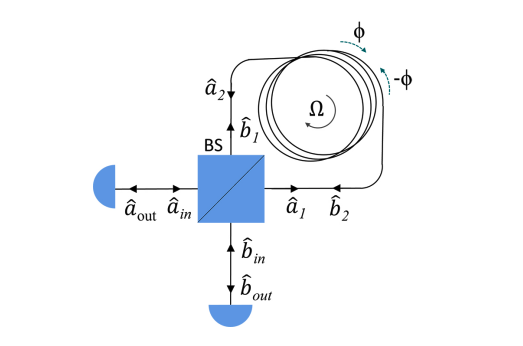
The pursuit of increasingly precise measurements of rotation drives advances in inertial navigation and metrology, and a new study demonstrates a significant leap forward in optical gyroscope technology. Priyanka M. Kannath from the Indian Institute of Space Science and Technology, Girish S. Agarwal from Texas A and M University, and Ashok Kumar, also from the Indian Institute of Space Science and Technology, detail a method for linking multiple gyroscopes in a distributed network to enhance sensitivity. Their research introduces bright two-mode squeezed light, a special state of light with strong correlations, to improve the estimation of angular velocity across spatially separated devices. The team’s analysis reveals that this approach achieves a sensitivity improvement of over 9 decibels beyond the standard quantum limit, even with realistic levels of photon loss, paving the way for more accurate inertial navigation systems and precision measurement networks.
Entangled and Separable States for Precision Gyroscopes
This research explores how to improve the precision of gyroscopes, devices that measure angular velocity, by carefully controlling the properties of light. The team investigates using special states of light, known as two-mode squeezed states, to enhance sensitivity. These states reduce uncertainty in certain properties of light, allowing for more accurate measurements. The core idea is to determine whether sharing entanglement between multiple gyroscopes offers a significant advantage over using independent, yet equally precise, light sources. By comparing configurations with entangled and independent light, they aim to identify the optimal strategy for maximizing the precision of the gyroscope network.
Two-mode squeezed states are created by manipulating the quantum properties of light, reducing uncertainty in one aspect of the light wave while increasing it in another. This “squeezing” is a crucial technique for enhancing the precision of measurements beyond the limitations of classical light. The researchers use mathematical tools to calculate the ultimate limits on measurement precision for each configuration, guiding the experimental design. The analysis considers realistic imperfections, such as photon loss, which can degrade performance, assessing the robustness of their approach and determining tolerable loss levels.
The ultimate goal is to develop gyroscopes with significantly improved sensitivity, with potential applications in navigation, inertial sensing, and fundamental physics research. The research demonstrates that entanglement can indeed enhance the precision of gyroscope networks, allowing for more accurate measurements of angular velocity. However, the benefits of entanglement are not unlimited, and the optimal configuration depends on factors such as the number of gyroscopes and the level of photon loss. These findings contribute to the broader field of quantum metrology, seeking to exploit quantum effects to enhance measurement precision, and pave the way for more accurate and reliable sensors.
Squeezed Light Improves Gyroscope Network Precision
Researchers are developing new techniques to improve the precision of optical gyroscopes, devices used to measure angular velocity. Their approach focuses on distributing the benefits of quantum entanglement across a network of gyroscopes, rather than simply enhancing a single sensor. This is achieved by using bright two-mode squeezed states, a special form of light with enhanced quantum properties, to create correlations between photons. These states are generated using parametric amplification, boosting the number of photons and enhancing their quantum properties, then carefully distributed to each gyroscope, creating a shared quantum state.
The researchers explored two distinct configurations for distributing these states: a single entangled beam split to all gyroscopes, creating a unified quantum state, and independent, equally bright, squeezed states sent to each gyroscope. By comparing these approaches, they aim to identify the optimal strategy for maximizing sensitivity. To account for real-world imperfections, the team incorporates the effects of photon loss, modeling its impact on the quantum states to assess the robustness of their approach and determine tolerable loss levels. The ultimate goal is to develop a system capable of achieving sensitivity beyond the limitations of conventional methods, with potential applications in advanced navigation systems and precision metrology. This new approach utilizes bright two-mode squeezed states, a special form of light with enhanced quantum properties, to achieve greater sensitivity than conventional methods. Unlike traditional systems that focus on improving a single sensor, this technique distributes the benefits of quantum entanglement across multiple spatially separated gyroscopes. The core innovation lies in leveraging the correlations within these squeezed states to estimate a global phase shift, representing the average angular rotation across the entire network of gyroscopes.
The team analyzed different configurations of these squeezed states, finding that using states with strong entanglement provides the greatest advantage. The results demonstrate a sensitivity enhancement of approximately 9. 3 decibels beyond the standard quantum limit, even with a 5% loss of photons in each channel. This improvement is achieved with an initial squeezing of 9. 8 decibels, indicating a substantial reduction in measurement uncertainty.
Importantly, the system’s performance does not significantly improve with the addition of more gyroscopes, meaning the sensitivity remains consistent regardless of network size. This enhanced sensitivity opens doors for applications in high-precision inertial navigation systems, allowing for more accurate tracking of position and orientation, and in precision metrology, where extremely accurate measurements are crucial. The ability to distribute the sensing across a network also offers potential benefits for emerging technologies that rely on interconnected sensors and data processing. The research represents a significant step towards realizing the full potential of quantum-enhanced sensing in real-world applications.
Entangled States Enhance Gyroscope Sensitivity Significantly
This work demonstrates a novel configuration for distributed optical gyroscopes, leveraging mode-entangled bright two-mode squeezed states to improve the estimation of angular velocity. By distributing unknown phase shifts across multiple gyroscopes and utilizing quantum entanglement, the researchers show that the average phase shift can be estimated with enhanced sensitivity compared to systems using separate, individual squeezed states. Analysis confirms that the proposed scheme achieves a sensitivity enhancement of approximately 9. 3 dB beyond the standard quantum limit, even with realistic photon losses of 5% per channel.
The researchers observed that the performance gain increases with the number of gyroscopes, peaking at an optimal number depending on the system’s transmissivity. While acknowledging that a more complex configuration could further enhance sensitivity, they note its increased sensitivity to phase fluctuations. These findings pave the way for quantum-enhanced inertial navigation systems within networked sensor architectures, offering improved precision for a range of applications.
🗞 Quantum Sensing with Bright Two-Mode Squeezed Light in a Distributed Network of Gyroscopes
🧠 ArXiv: https://arxiv.org/abs/2508.01447


