

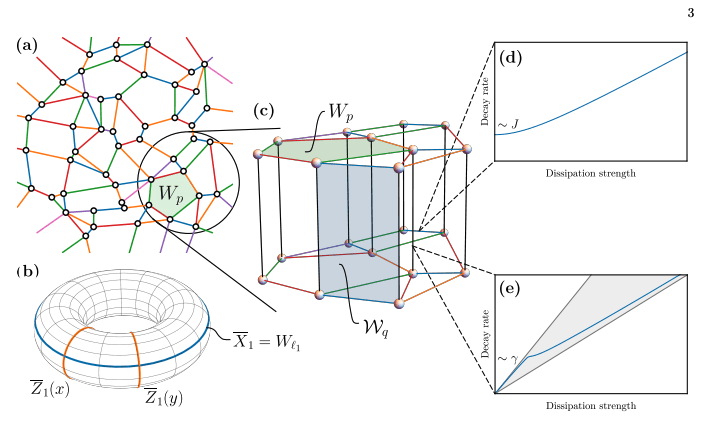
Research demonstrates that interacting spin models subject to dissipation exhibit steady states and relaxation dynamics largely independent of the network structure connecting the spins. These states exemplify mixed-state topological order, arising from spontaneous symmetry breaking of a one-form symmetry, despite encoding only classical information. Numerical analysis of relaxation rates reveals finite decay, except in specific symmetry sectors where dissipation can be eliminated. This work provides an analytical framework for understanding non-equilibrium phases of matter and the mechanisms governing their relaxation.
The behaviour of interacting quantum systems far from equilibrium remains a significant challenge in condensed matter physics. Researchers are now detailing a novel, analytically solvable model demonstrating how dissipation – the loss of energy from a system – influences the emergence of order and symmetry breaking in two-dimensional spin systems. This work reveals that the steady states of these systems, even when encoding only classical information, can exhibit long-range correlations and a form of topological order arising from the spontaneous breaking of a one-form symmetry – a symmetry related to loops and cycles within the system. Lucas Sá and Benjamin Béri, both affiliated with the TCM Group and the Cavendish Laboratory at the University of Cambridge, alongside Béri’s additional affiliation with the Department of Applied Mathematics and Theoretical Physics (DAMTP) at Cambridge, present their findings in a paper entitled “Exactly solvable dissipative dynamics and one-form strong-to-weak spontaneous symmetry breaking in interacting two-dimensional spin systems”.
The study of interacting gamma-matrix spin models coupled to a Markovian environment reveals surprising behaviour and connections to topological order, establishing a tractable analytical framework for exploring non-equilibrium phases of matter. Researchers construct a Lindbladian for spins on an arbitrary graph that maps to a non-Hermitian model of free Majorana fermions hopping on the graph with a background classical gauge field, allowing for detailed investigation of the system’s properties. Through analytical and numerical methods, they demonstrate that the steady states and relaxation dynamics remain qualitatively independent of the underlying graph structure, a significant departure from the behaviour observed in Hamiltonian systems, and establish that the exponentially many steady states exemplify mixed-state topological order.
Researchers specifically demonstrate strong-to-weak spontaneous symmetry breaking of
Researchers specifically demonstrate strong-to-weak spontaneous symmetry breaking of a one-form symmetry, revealing that despite encoding only classical information, these steady states exhibit long-range correlations. They examine the relaxation processes toward the steady state by numerically calculating decay rates, generally finding them to be finite, even in the dissipationless limit, and identify symmetry sectors where fermion-parity conservation is enhanced to fermion-number conservation. This enhancement allows researchers to analytically bound the decay rates and prove their vanishing in both the infinitely weak and infinitely strong dissipation limits, providing crucial insight into the conditions under which the system maintains coherence and avoids energy loss.
Recent research investigates the dissipative dynamics of gamma-matrix spin models coupled to a Markovian environment, revealing surprising behaviour and connections to topological order, and establishes a tractable analytical framework for exploring non-equilibrium phases of matter. Researchers construct a Lindbladian – a mathematical operator describing the evolution of open quantum systems – that maps onto a non-Hermitian model of free Majorana fermions hopping on a graph with a background classical gauge field, allowing for analytical and numerical investigation of the system’s properties. Through analytical and numerical methods, they demonstrate that the steady states and relaxation dynamics remain qualitatively independent of the underlying graph structure, a significant departure from the behaviour observed in Hamiltonian systems.
The study constructs a Lindbladian for spins on an arbitrary graph that maps to a non-Hermitian model of free Majorana fermions hopping on the graph with a background classical gauge field, enabling both analytical and numerical investigation of the system’s properties. Researchers demonstrate that the steady states and relaxation dynamics remain qualitatively independent of the underlying graph structure, a significant departure from the behaviour observed in Hamiltonian systems, and establish that the exponentially many steady states exemplify mixed-state topological order. They specifically demonstrate strong-to-weak spontaneous symmetry breaking of a one-form symmetry, revealing that despite encoding only classical information, these steady states exhibit long-range correlations.
Researchers examine the relaxation processes toward the steady
Researchers examine the relaxation processes toward the steady state by numerically calculating decay rates, generally finding them to be finite, even in the dissipationless limit, and identify symmetry sectors where fermion-parity conservation is enhanced to fermion-number conservation. This enhancement allows them to analytically bound the decay rates and prove their vanishing in both the infinitely weak and infinitely strong dissipation limits, providing crucial insight into the conditions under which the system maintains coherence and avoids energy loss. The work establishes an analytically tractable framework for exploring non-equilibrium phases of matter and the relaxation mechanisms that govern their approach to equilibrium.
🗞 Exactly solvable dissipative dynamics and one-form strong-to-weak spontaneous symmetry breaking in interacting two-dimensional spin systems
🧠 DOI: https://doi.org/10.48550/arXiv.2505.11501


