Engineered dissipation actively prepares complex quantum states. Recent advances demonstrate reliable preparation of ground and thermal states for specific quantum systems. Protocols extend to excited and resonance states, potentially enabling quantum computation on emerging fault-tolerant hardware through controlled system-environment interactions and algorithmically constructed Lindblad generators.
Harnessing Decay for Quantum Control
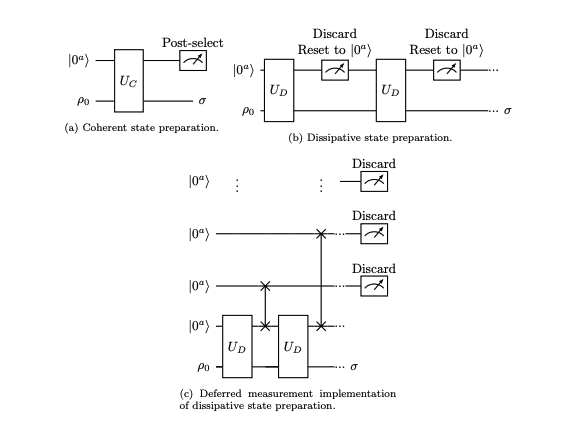
The pursuit of practical quantum computation necessitates innovative approaches to state preparation, moving beyond the limitations imposed by maintaining delicate quantum coherence. Recent work demonstrates a counterintuitive strategy: deliberately introducing dissipation – the loss of energy from a quantum system – to engineer desired many-body states. Lin Lin, working independently, details a method utilising specifically designed interactions between a quantum system and its environment, termed ‘Lindblad generators’ (mathematical descriptions of how a system evolves due to interaction with its surroundings), to reliably create both ground and thermal states, even for complex quantum systems where traditional methods fail. This research, titled ‘Dissipative Preparation of Many-Body Quantum States: Towards Practical Quantum Advantage’, extends these protocols to encompass excited and resonance states, potentially offering a viable route to achieving computational benefits on nascent quantum devices.
Harnessing Dissipation in Quantum Systems
Recent research demonstrates a shift in quantum control, actively employing dissipation – traditionally considered a source of decoherence – as a resource for state preparation and simulation. Investigations focus on utilising engineered interactions between a quantum system and its environment, specifically through Lindblad generators, to drive systems towards desired states, circumventing limitations inherent in purely coherent quantum computation. Researchers are developing protocols that leverage algorithmically constructed Lindblad generators to prepare both ground and thermal states for non-commuting Hamiltonians, offering guaranteed performance and addressing a key challenge in quantum simulation.
These methods effectively ‘sculpt’ the quantum state by selectively dissipating unwanted components, leading to the stabilisation of target states and broadening the scope of achievable simulations. The ability to prepare states with rigorous performance guarantees represents an advance, potentially unlocking new avenues for achieving quantum advantage on nascent fault-tolerant platforms. Specifically, accessing excited states is crucial for simulating dynamic processes and exploring quantum phenomena beyond equilibrium, expanding the possibilities for quantum technologies.
Current work extends these protocols beyond ground and thermal states, exploring the preparation of excited and resonance states, which broadens the potential applications of dissipative quantum engineering. This expansion enables new avenues for achieving practical quantum advantage on early fault-tolerant platforms, particularly when dealing with complex quantum systems where interactions between constituents are not easily separable.
Investigations highlight a growing trend towards harnessing open quantum system dynamics, where researchers systematically design and implement dissipative protocols to ensure predictable and reliable performance. The focus on algorithmically constructed Lindblad generators provides a framework for designing these protocols, offering a systematic approach to quantum state control. This approach offers a pathway to overcome limitations imposed by traditional coherence-based methods, particularly in the context of near-term, noisy intermediate-scale quantum (NISQ) devices.
Experimental validation, such as the demonstration of dissipative state preparation in superconducting qutrit arrays, confirms the feasibility of these techniques and supports the development of more robust and efficient quantum technologies.
Future work should concentrate on scaling these dissipative protocols to larger systems and exploring their resilience to realistic noise environments, which is crucial for realising the full potential of dissipative quantum engineering. Investigating the interplay between dissipation and quantum error correction could yield hybrid strategies that combine the strengths of both approaches.
A key area for advancement lies in extending these techniques beyond specific Hamiltonian structures, requiring novel theoretical frameworks and algorithmic innovations to accommodate a wider range of quantum systems and interactions. Simultaneously, exploring the use of alternative dissipation mechanisms, such as those arising from engineered reservoirs or driven-dissipative systems, could unlock new possibilities for quantum state control and manipulation.
Moreover, developing automated methods for designing optimal Lindblad generators for arbitrary target states represents a crucial step towards advancing the field of quantum information processing. The focus on non-commuting Hamiltonians is particularly noteworthy, as it addresses a critical challenge in simulating complex quantum systems where interactions between constituents are not easily separable.
👉 More information
🗞 Dissipative Preparation of Many-Body Quantum States: Towards Practical Quantum Advantage
🧠 DOI: https://doi.org/10.48550/arXiv.2505.21308