The dispersive readout scheme in quantum computing allows for the measurement of superconducting qubits without destroying them, a process known as quantum non-demolition measurement. This method is crucial for implementing error correction codes in quantum computing. However, when the number of photons exceeds a threshold value, measurement-induced state transitions (MIST) occur, limiting the measurement rate and complicating qubit reset. Researchers Konstantin N Nesterov and Ivan V Pechenezhskiy have theoretically investigated the onset of MIST during the dispersive readout of superconducting qubits, providing insights that could lead to significant advancements in quantum computing.
What is the Dispersive Readout Scheme in Quantum Computing?
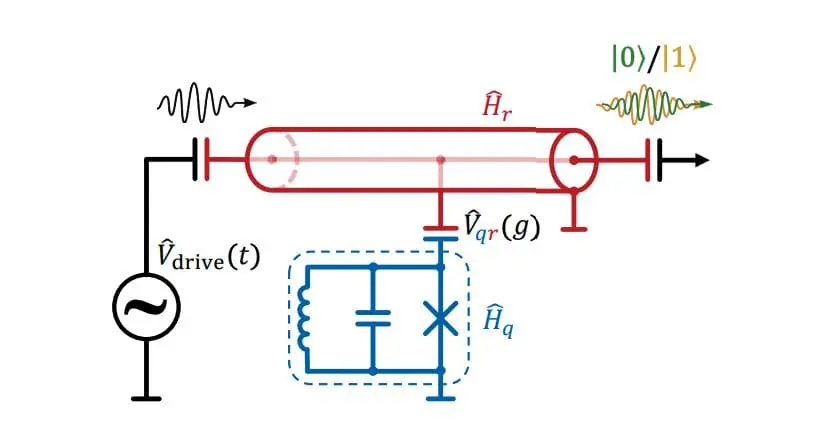
The dispersive readout scheme is a method used in quantum computing to measure superconducting qubits without destroying them, known as quantum non-demolition measurement. This scheme is realized by probing the qubit-state-dependent frequency of a linear resonator coupled to the qubit. This allows for a fast and high-fidelity single-shot measurement. A short measurement duration is crucial for implementing error correction codes such as the surface code, in which the data qubits must idle during the readout of the measure qubits and thus unavoidably accumulate errors due to intrinsic lifetime limitations.
Preserving the quantum non-demolitionness of the dispersive readout guarantees that a qubit remains in a computational state after the measurement, allowing straightforward reset protocols. Several parameters determine the measurement rate, with the discussions typically framed in terms of the resonator dispersive shift, the photon decay rate, and the average photon number. Numerical simulations can easily predict the first two quantities for a given qubit design.
The optimal readout condition is often stated as a ratio of the photon decay rate to the square of the resonator dispersive shift, which maximizes the signal-to-noise ratio for a fixed average photon number in a linear resonator. Naively increasing the average photon number should directly result in a higher signal-to-noise ratio and thus in a better readout. However, in addition to a stronger resonator nonlinearity at larger average photon numbers, the qubit undergoes measurement-induced state transitions when the number of photons exceeds a threshold value.
What are Measurement-Induced State Transitions?
Measurement-induced state transitions (MIST) occur when the number of photons exceeds a threshold value. These transitions, sometimes referred to as qubit ionization in the context of transmon qubits escaping the Josephson potential well, limit the measurement rate, degrade readout fidelity, and complicate qubit reset.
In a study by Konstantin N Nesterov of Bleximo Corp and Ivan V Pechenezhskiy of Syracuse University, they theoretically investigate the onset of MIST during the dispersive readout of superconducting qubits by focusing on two metrics that exhibit clear signatures of MIST. The first metric, the qubit purity, quantifies the qubit-resonator entanglement and was used in the past in numerical studies of qubit transitions and structural instabilities of the system dynamics.
Time-domain simulations reveal that the qubit purity remains very close to unity unless a state transition occurs as the number of readout photons increases. Their explanation of this sensitivity is based on the notion that away from MIST, the state of a driven qubit-resonator system would be close to a dressed coherent state.
What are Dressed Coherent States?
Dressed coherent states are a concept in quantum mechanics that describe the state of a driven qubit-resonator system. Surprisingly, such a state and its squeezed modifications were shown to be almost unentangled. Further exploring this picture, Nesterov and Pechenezhskiy propose another metric that characterizes deviations in the drive matrix elements computed for the dressed coherent states.
This metric, which is also very sensitive to MIST, bypasses time-domain simulations and only requires accurate identification of the interacting qubit-resonator states. Throughout their paper, they focus on the case of a fluxonium qubit capacitively coupled to a resonator, although the analysis applies to the dispersive readout of any qubit type with a limited number of internal degrees of freedom.
How Does the Jaynes-Cummings Hamiltonian Apply to Qubit Readout Analysis?
The Jaynes-Cummings Hamiltonian provides the starting point for the readout analysis of an ideal two-level qubit coupled to a resonator. In the dispersive regime, when the qubit-resonator coupling is much smaller than the qubit-resonator detuning, the resonator frequency is pulled by approximately the square of the coupling, with the sign determined by the qubit state.
The dispersive approximation breaks down when the photon number gets comparable to a critical value, which corresponds to significant hybridization of the bare qubit-resonator states and the onset of resonator nonlinearity. While this critical value is often quoted as a characteristic of a qubit-resonator system, it does not set a hard limit on resonator occupation in a readout, even when generalized for realistic multilevel qubits.
What is the Future of MIST in Dispersive Readout Schemes?
MIST in dispersive readout schemes are poorly understood and have been only studied in the context of transmon qubits. The explanation of MIST in transmons is based on the resonances between energy levels of the interacting qubit-resonator system corresponding to different transmon states.
The rotating wave approximation simplifies the analysis for this qubit type with two distinct regimes defined by the transmon and resonator frequencies. When the transmon frequency is greater than the resonator frequency, the level resonances within the same rotating wave approximation strip are responsible for MIST due to the bending of the strip over itself, which can result in a resonance between one of the two lowest qubit levels and a level near the edge of transmons’ cosine potential.
The onset of MIST often happens at relatively small photon numbers, depends strongly on the qubit-resonator detuning, and is highly sensitive to the transmon offset charge. This suggests that further research and understanding of MIST in dispersive readout schemes could lead to significant advancements in quantum computing.
schemes”
Publication Date: 2024-02-11
Authors: Konstantin Nesterov and Ivan Pechenezhskiy
Source: arXiv (Cornell University)
DOI: https://doi.org/10.48550/arxiv.2402.07360