In a recent study published on April 10, 2025, researchers led by Trevyn F. Q. Larson explored the behavior of localized quasiparticles in fluxonium qubits using quasi-two-dimensional amorphous kinetic inductors. Their findings revealed that disorder significantly increases loss in these superconducting devices, shedding light on the challenges of maintaining coherence in quantum systems.
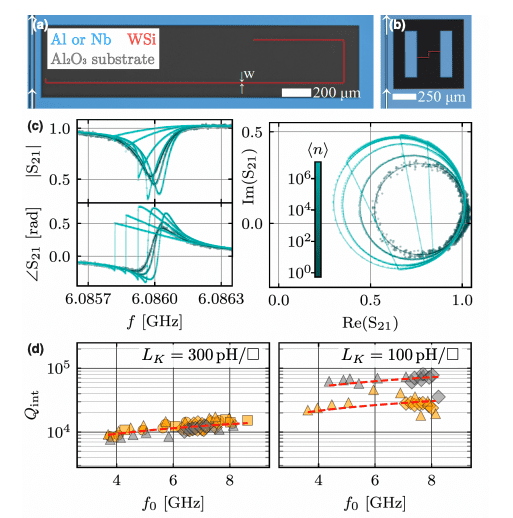
The study investigates disordered superconductors with high kinetic inductance, focusing on tungsten silicide wires embedded in microwave resonators and fluxonium qubits. The research demonstrates that disorder enhances kinetic inductance but also increases circuit loss, primarily due to localized quasiparticles trapped in the superconducting gap variations. The loss depends on frequency, disorder level, and device geometry, with higher disorder leading to greater losses. These findings highlight challenges in harnessing disordered superconductors for coherent devices while providing insights into their behavior near the superconductor-insulator phase transition.
At the heart of these advancements lies a deeper exploration into the properties of superconducting materials. Researchers have been examining how quasiparticles—excitations that behave like individual particles—affect the performance of superconducting qubits. These studies reveal that quasiparticles can degrade qubit coherence, a critical factor in maintaining quantum states necessary for computation.
Scientists have developed new methods to reduce quasiparticle relaxation to mitigate this issue. By understanding the mechanisms behind these relaxations, particularly in the presence of magnetic flux, researchers have identified strategies to enhance qubit stability. This involves optimizing circuit designs and materials processing techniques to minimize energy loss pathways.
Additionally, advancements in manufacturing processes have led to improved superconducting resonators and coplanar waveguide structures. Techniques such as deep etching of silicon substrates and using high-quality dielectrics reduce parasitic losses, thereby improving signal integrity and qubit performance.
These innovations hold significant implications for quantum computing. Enhanced qubit coherence times mean more reliable quantum operations, essential for error correction and fault-tolerant quantum computing. Moreover, reducing noise in quantum systems brings us closer to achieving practical, large-scale quantum processors capable of solving complex problems beyond classical capabilities.
The development of low-loss superconducting circuits also supports the scalability of quantum systems. By improving energy efficiency and reducing crosstalk between qubits, these advancements enable the construction of more compact and efficient quantum chips, which are crucial for academic research and industrial applications.
In conclusion, progress in quantum materials is a testament to the relentless pursuit of excellence in quantum technology. Researchers are laying the groundwork for a new era of quantum computing by addressing fundamental challenges such as quasiparticle relaxation and noise reduction. As these innovations evolve, they promise to unlock unprecedented computational power, transforming industries and scientific research.
👉 More information
🗞 Localized quasiparticles in a fluxonium with quasi-two-dimensional amorphous kinetic inductors
🧠 DOI: https://doi.org/10.48550/arXiv.2504.07950