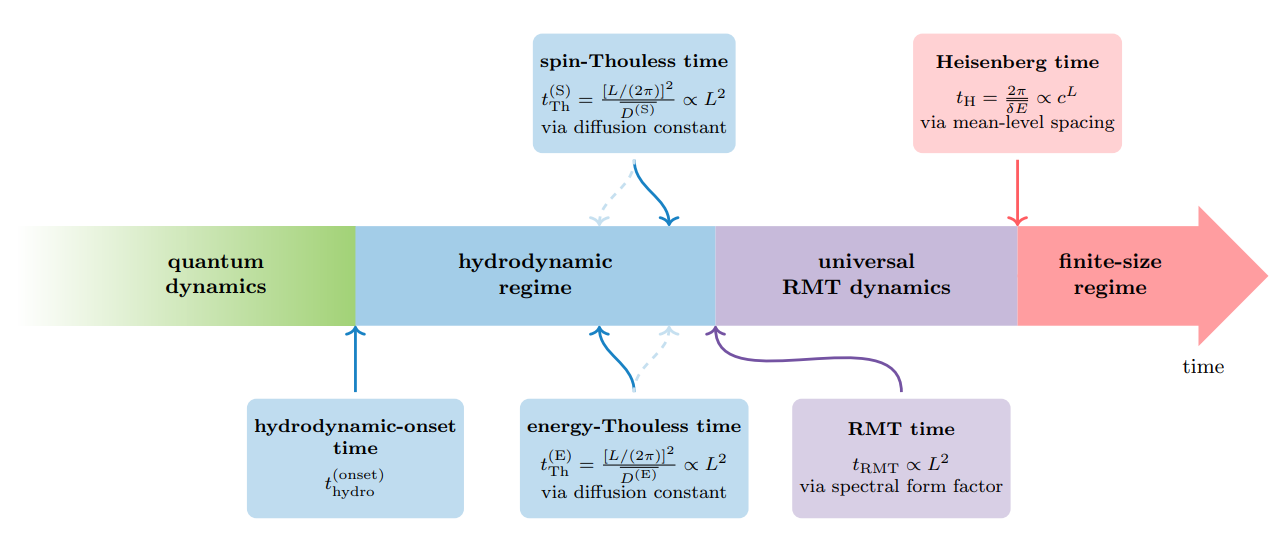
The behaviour of complex systems as they settle into equilibrium remains a fundamental question in physics, particularly when disorder plays a key role. Kadir Çeven, Lukas Peinemann, and Fabian Heidrich-Meisner, all from Georg-August-Universität Göttingen, investigate this phenomenon in a disordered spin-XX ladder, a model system with dynamics relevant to experimental observations. Their work reveals a hierarchy of timescales governing relaxation, connecting how quickly energy and spin diffuse through the system to fundamental properties of its energy levels. By analysing these timescales, the researchers demonstrate a clear relationship between transport properties and the underlying chaotic nature of the system, and surprisingly find that spin diffusion occurs more rapidly than energy diffusion, a result that challenges expectations for similar complex systems.
Thermalization and Breakdown of Ergodicity in Chains
A comprehensive body of research explores how one-dimensional quantum systems, particularly spin chains, evolve towards equilibrium and whether they fully reach a state of thermalization. Investigations center on understanding the conditions under which systems reach equilibrium, and how interactions between particles influence this process, with a recurring theme being typicality, the idea that most initial states will eventually evolve towards a thermal state. A significant area of study focuses on many-body localization (MBL), a phenomenon where strong disorder prevents thermalization. Researchers explore the transition between thermal and localized phases, examining the strength of disorder required to induce localization and identifying the characteristics of MBL through measurements of spectral properties and conductivity.
Understanding transport properties, such as the movement of spin and energy, is also central, with scientists calculating current autocorrelations and investigating whether transport is diffusive or subdiffusive. Many studies bridge the gap between disorder and quantum chaos, investigating how disorder affects the statistical properties of energy levels and the dynamics of the system. Researchers aim to determine whether disordered systems exhibit characteristics of quantum chaos, analyzing spectral properties, focusing on the distribution of energy levels and the spectral form factor, to probe quantum chaos and the transition to MBL. Investigations also explore dynamical typicality and its implications for efficiently calculating quantum dynamics.
Recent work has expanded to include studies of dual-unitary circuits, examining their spectral properties. The vast majority of these investigations focus on one-dimensional spin systems, particularly the Heisenberg and XXZ models, often incorporating disorder through random potentials or couplings. Some studies extend to two-dimensional spin ladders and explore dynamics within the context of quantum circuits. A central theme is the interplay between the Eigenstate Thermalization Hypothesis (ETH) and MBL, with researchers striving to understand the conditions under which the ETH breaks down and MBL emerges.
Understanding transport in the MBL phase, and whether it is truly absent or merely subdiffusive, is a key goal. These systems are often sensitive to finite-size effects, requiring careful consideration of how these effects influence results. The concept of a hierarchy of timescales is crucial for understanding the dynamics of MBL systems, and the spectral form factor serves as a powerful tool for probing quantum chaos and the transition to MBL. The study of MBL and quantum chaos has implications for quantum information processing and the development of robust quantum computers. Exploring the interplay between disorder and quantum chaos in quantum circuits is a promising avenue for future research.
Relaxation Timescales and Spectral Form Factor Analysis
Scientists investigated the dynamics of relaxation towards equilibrium in disordered spin-1/2 XX ladders, a system known for diffusive behavior and experimental realizability. The study focused on establishing connections between transport properties and spectral measures, specifically relaxation timescales, to understand the system’s non-equilibrium dynamics. Researchers analyzed the spectral form factor to determine the RMT time, identifying the point at which the system’s spectral statistics align with random matrix theory predictions. This time scale serves as an upper bound for the Thouless times, which quantify the average time for a local excitation to propagate across the entire system.
To calculate the Thouless times, scientists employed linear-response theory for both spin and energy transport, enabling precise determination of the timescales for excitation diffusion. Numerical simulations were performed on disordered XX ladders, introducing disorder to overcome non-self-averaging behavior and enhance the accuracy of the spectral form factor analysis. The team meticulously computed diffusion constants using linear-response theory, a method refined through ongoing methodological development in numerical simulations. Results confirmed that the RMT time scales quadratically with system size, providing a clear upper limit for the Thouless times.
Interestingly, the study revealed that spin diffusion proceeds faster than energy diffusion in the XX ladder, a surprising result compared to other non-integrable models. To investigate this phenomenon, scientists compared the relaxation timescales obtained from spectral measures with those from direct transport calculations. They established that both the RMT time and the Thouless times scale linearly with the square of the system length, indicating diffusive hydrodynamic behavior. Furthermore, the RMT time consistently exceeded both the energy and spin Thouless times, confirming its role as the slowest physical relaxation timescale. By comparing the XX ladder to a disordered spin-1/2 XXZ chain, researchers demonstrated that the faster spin diffusion in the ladder model is not a universal characteristic of non-integrable systems, providing valuable insight into the interplay between system geometry and transport properties.
Relaxation Times Bound Diffusive Dynamics in Spin Ladders
This work investigates the timescales governing relaxation to equilibrium in a disordered spin-XX ladder, an experimentally realizable model exhibiting diffusive dynamics. The team explored the connection between transport properties and spectral measures, focusing on how quickly excitations spread through the system and when universal random matrix theory (RMT) behavior emerges. By analyzing the spectral form factor and employing linear-response theory, they determined both the RMT time, which indicates the onset of RMT statistics, and the Thouless times, representing the average time for a local excitation to diffuse across the system. The results demonstrate that the RMT time and Thouless times scale quadratically with system size, confirming expectations for diffusive systems.
Notably, the study found that spin diffusion proceeds more rapidly than energy diffusion, a result differing from observations in integrable one-dimensional spin-1/2 systems where energy transport is typically faster. The authors acknowledge that their findings are specific to the disordered spin-1/2 XX ladder and may not universally apply to all quantum systems. Future research could extend this analysis to explore other disordered systems and investigate the impact of different types of disorder on relaxation timescales, potentially revealing broader principles governing non-equilibrium dynamics in quantum materials.
🗞 Hierarchy of timescales in a disordered spin- XX ladder
🧠 ArXiv: https://arxiv.org/abs/2509.20078