

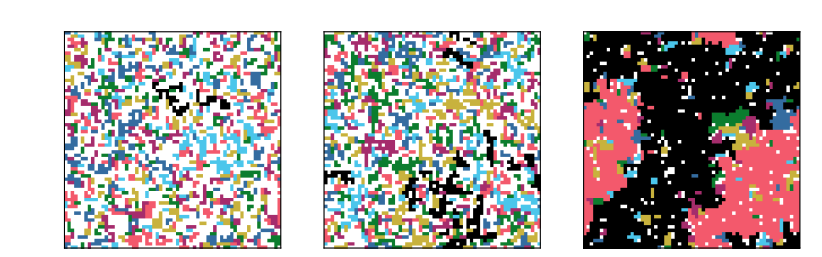
The behaviour of quantum entanglement within materials exhibiting disorder, such as disordered magnets, provides valuable insight into the fundamental nature of phase transitions and critical phenomena. Understanding how entanglement responds to the geometry of the system is crucial for characterising these transitions, particularly as conventional methods struggle with the complexities introduced by disorder. Natalie Love and István A. Kovács, alongside colleagues from Northwestern University, investigate this relationship in a new study titled ‘Universal shape-dependence of quantum entanglement in disordered magnets’. Their research, utilising the strong disorder renormalization group method, demonstrates that the shape of a subsystem significantly influences the measurement of entanglement, offering a novel approach to probing phase transitions in these complex materials. The team’s analysis of the random transverse-field Ising model reveals distinct behaviours across different universality classes, suggesting that subsystem geometry can serve as a versatile tool for uncovering universal information about disordered systems.
Research into the random transverse-field Ising model (RTFIM), a representative example of a disordered quantum system, establishes that disorder markedly shapes entanglement within quantum systems, revealing universal behaviours. The RTFIM consists of interacting quantum spins subject to both a local magnetic field and a random transverse field, creating a complex energy landscape. Researchers employ a sophisticated implementation of the strong disorder renormalization group to analyse entanglement properties across the model’s phase diagram, which exhibits three distinct infinitely disordered fixed points (IDFPs). These fixed points represent the long-term behaviour of the system under repeated transformations, and are crucial for understanding its properties.
The study quantifies how the corner contribution to entanglement varies with the shape of the region under consideration, revealing that while the corner contribution itself remains universal across the different IDFPs, its dependence on shape distinguishes each universality class. Entanglement entropy, a measure of the quantum correlation between different parts of a system, is used to characterise this behaviour. The researchers meticulously calculate entanglement entropy using advanced numerical techniques, allowing them to characterise the behaviour of the RTFIM with high precision and establish a clear connection between the corner contribution and the underlying universality class of the system.
Analysis of both square and line segment subsystems
Analysis of both square and line segment subsystems reveals distinct behaviours that correlate with the different IDFPs, confirming that the shape-dependence of corner entanglement is consistently distinguishable across the different universality classes. This work highlights the power of entanglement as a probe of critical phenomena in disordered systems, contributing to a deeper understanding of these materials and providing a framework for future investigations into the role of entanglement. The findings contribute to a refined methodology for characterising phase transitions in complex quantum systems and demonstrate that the geometry of the region under investigation provides valuable insights into the underlying physics of the disordered system.
Further investigation into line segment subsystems, a specific case of skeletal entanglement where entanglement is measured along a one-dimensional cut, corroborates these findings. Skeletal entanglement focuses on the entanglement between the boundary of a region and its interior. The analysis confirms that the shape-dependence of corner entanglement remains consistently distinguishable across the different universality classes. This work reinforces the power of entanglement as a probe of critical phenomena in disordered systems, contributing to a deeper understanding of these materials and providing a framework for future investigations into the role of entanglement.
This research establishes that entanglement in disordered quantum systems exhibits behaviours significantly influenced by the presence of disorder, particularly concerning the geometry of the region under investigation. The study confirms the robustness of corner entanglement, where entanglement concentrates at the corners of defined regions within the system, even under strong disorder. The infinite disorder fixed point (IDFP) governs the entanglement properties of the RTFIM, and the authors demonstrate that entanglement entropy and negativity exhibit scaling behaviours consistent with this fixed point.
The researchers establish that the corner contribution to
The researchers establish that the corner contribution to entanglement remains universal across these phases, providing a reliable indicator of the system’s behaviour and a potential tool for locating phase transitions. They meticulously quantify how the shape of the region impacts corner entanglement, revealing that while the corner contribution remains universal, the specific shape-dependence varies qualitatively between the different universality classes defined by the IDFPs. This work provides a refined methodology for characterising phase transitions in complex quantum systems and demonstrates that the geometry of the region under investigation provides valuable insights into the underlying physics of the disordered system.
🗞 Universal shape-dependence of quantum entanglement in disordered magnets
🧠 DOI: https://doi.org/10.48550/arXiv.2507.04557


