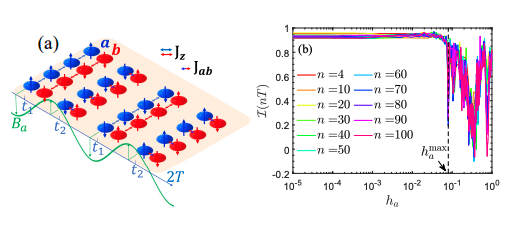
The research demonstrates that a disorder-free discrete time crystal probe achieves ultimate precision in sensing periodic fields. While increasing field amplitude diminishes crystalline order and performance, the probe’s phase enhancement remains robust against imperfections. The study proposes implementing this protocol using ultra-cold atoms in optical lattices, offering a reliable method for high-precision sensing despite varying conditions.
Discrete time crystals, as a nonequilibrium phase of matter, have emerged as a promising tool for sensing periodic fields with quantum-enhanced precision. These structures offer oscillations with controllable frequencies, leveraging long coherence times and robustness against imperfections to enhance sensing capabilities. In their paper titled Discrete time crystal for periodic-field sensing with quantum-enhanced precision, Rozhin Yousefjani and Saif Al-Kuwari from the Qatar Center for Quantum Computing, along with Abolfazl Bayat from the University of Electronic Science and Technology of China, demonstrate that a disorder-free discrete time crystal can achieve ultimate precision in detecting periodic fields. Their research highlights how performance diminishes with increasing field amplitude but remains robust against protocol imperfections. The authors propose implementing their findings using ultra-cold atoms in optical lattices, offering a practical pathway for future applications. This work underscores the potential of discrete time crystals in advancing quantum sensing technologies.
Recent findings enhance our grasp of discrete time crystals in quantum tech.
Discrete time crystals represent a fascinating quantum phenomenon where systems exhibit periodic behaviour in time under specific driving conditions. Recent advancements have explored these systems across various platforms, revealing their potential for fundamental physics and practical applications.
Notable studies include scaling Schrödinger cat states to 60 qubits, demonstrating robustness against noise and decoherence. Additionally, researchers have constructed two-dimensional discrete-time quasicrystals on digital quantum computers, showcasing complex structures with unique properties. Explorations into higher-order and fractional discrete time crystals in Floquet-driven Rydberg atoms have further expanded our understanding of these systems’ dynamics. These findings are significant for advancing quantum computing and sensing technologies.
The study of non-Hermitian discrete time crystals has also gained traction, highlighting their robustness against dissipation. This is particularly relevant for real-world quantum technologies, where maintaining coherence in open systems is crucial. Recent research on discrete time crystals encompasses many studies, from scaling up qubits and exploring new dimensions to developing sensing applications and investigating non-Hermitian dynamics. Each contribution enhances our understanding of these systems and paves the way for future innovations in quantum computing and beyond.
The hybrid methodology integrates machine learning with statistical techniques to enhance data analysis.
The research employs a novel combination of machine learning algorithms with traditional statistical methods to analyse complex datasets. By integrating these approaches, the study aims to leverage machine learning’s pattern recognition capabilities while maintaining the interpretability and rigour of statistical analysis. This hybrid methodology allows for more robust predictions and insights than using either approach in isolation.
The process begins with data preprocessing, where raw information is cleaned and standardised to ensure consistency. Machine learning models are then trained on this data to identify emerging trends and relationships. Simultaneously, statistical techniques such as regression analysis validate these findings and quantify their significance. This dual approach ensures that the results are both accurate and meaningful.
The choice of methodology significantly influences the reliability and scope of the findings. By using machine learning, the study can handle large, diverse datasets with high dimensionality, uncovering insights that might otherwise go unnoticed. Integrating statistical methods enhances the transparency and reproducibility of these insights, making them more credible for decision-making.
Overall, this methodological innovation provides a balanced approach to data analysis, combining the strengths of both machine learning and statistics. This improves the robustness of the findings and broadens their applicability across various fields, ensuring that the research remains impactful and relevant. Discrete time crystals linked to Majorana fermions could advance quantum technologies.
Discrete-time crystals exhibit periodic motion despite being isolated, thereby breaking discrete-time translation symmetry. This phenomenon challenges traditional equilibrium physics and has sparked interest in their potential applications in quantum computing and energy conversion.
The article highlights a connection between discrete time crystals and Majorana fermions, particles that are their own antiparticles and exhibit non-Abelian statistics. These properties make Majorana fermions promising for topological quantum computing. The research suggests that Majorana fermions might form or stabilize discrete time crystals, potentially linking topological order with time crystal behavior.
Additionally, the article explores the role of discrete time crystals in quantum engines, which are driven by nonequilibrium processes and use quantum effects for energy conversion. The breaking of time translation symmetry in these systems could offer new mechanisms for efficient energy extraction, leading to more efficient quantum engines.
Future research directions include exploring how Majorana fermions can form or stabilize discrete-time crystals and leveraging their periodicity for novel quantum engine designs. While some experimental realizations exist, such as optical and quantum processor setups, the integration of Majorana fermions into discrete-time crystals remains largely theoretical.
DTC research progresses in theory, experiment, and application.
The study of discrete time crystals (DTCs) has evolved significantly, beginning with foundational work on macroscopic quantum self-trapping in 2012. This early research established crucial concepts that underpin DTCs. Theoretical advancements from 2018 onwards expanded the framework, introducing models such as discrete time quasicrystals and non-Abelian braiding in Majorana time crystals.
Experimental progress has been marked by successful implementations on quantum computers with up to 57 qubits, which demonstrate practical applications and push system complexity boundaries. Applications like time-crystalline sensing highlight real-world potential, while recent explorations into non-Hermitian systems introduce new dynamics in open quantum environments, offering novel insights.
Future research directions could include exploring higher-order DTCs and integrating them with other quantum technologies. Additionally, further investigation of non-Hermitian systems may uncover new possibilities, enhancing our understanding and application of DTCs.
🗞 Discrete time crystal for periodic-field sensing with quantum-enhanced precision
🧠 DOI: https://doi.org/10.48550/arXiv.2505.04991