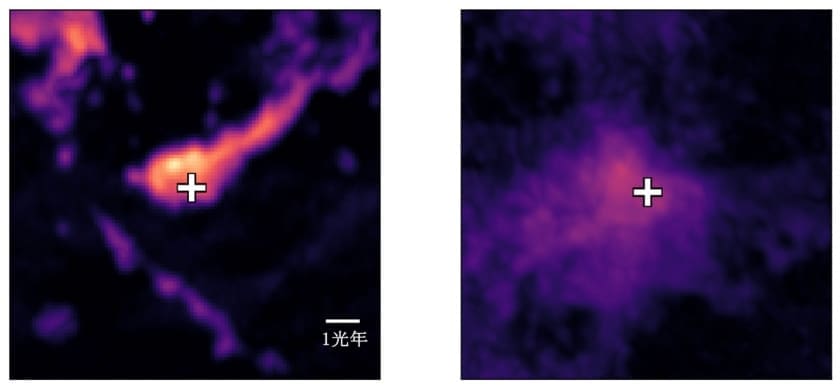
A new perspective on star formation is emerging in the vast cosmic landscape. Researchers from Kyushu University, in collaboration with Osaka Metropolitan University, have discovered that some stars may have been born in “fluffy” molecular clouds in the early universe. This finding, published in The Astrophysical Journal, challenges our understanding of stellar nurseries and could reshape our comprehension of star formation throughout cosmic history.
The team’s observations focused on the Small Magellanic Cloud (SMC), a dwarf galaxy near the Milky Way that closely resembles the early universe’s cosmic environment. Using the ALMA radio telescope, they found that approximately 40% of the observed molecular clouds in the SMC had a “fluffy” shape, contrasting with the filamentary structure typically seen in our galaxy. This discovery suggests that the environment, particularly the abundance of heavy elements, may play a crucial role in maintaining the filamentary structure and potentially shaping planetary systems.
The implications of this research extend beyond the SMC, as future studies comparing observations from low-metallicity environments like the SMC with those from heavier-element-rich regions such as the Milky Way could provide valuable insights into the formation and evolution of molecular clouds and the universe at large.
Stellar Beginnings: Unraveling the Mysteries of Star Formation
The birth of stars remains one of the most captivating phenomena in the vast cosmic canvas. Astronomers have sought to understand this process for centuries, and recent findings from Kyushu University shed new light on the early universe’s star-forming environments.
Ancient Stellar Nurseries: A Closer Look
Stars are born in stellar nurseries, colossal regions of space teeming with gas and dust. These molecular clouds can span hundreds of light-years, birthing thousands of stars. While much is known about a star’s life cycle, its birth’s intricacies remain elusive. In particular, did stars form in this manner during the early universe?
Fluffy Clouds: A New Perspective on Star Formation
Researchers from Kyushu University and Osaka Metropolitan University published their findings in The Astrophysical Journal. They discovered that some stars may have formed in “fluffy” molecular clouds in the early universe. To explore this hypothesis, they focused on the Small Magellanic Cloud (SMC), a dwarf galaxy near our Milky Way.
The SMC contains only about one-fifth of the heavy elements found in the Milky Way, making it an ideal proxy for studying the cosmic environment of the early universe. However, observing molecular clouds within the SMC posed a challenge due to its distance and low metallicity.
Filamentary vs. Fluffy: A Tale of Temperature
The researchers observed molecular clouds within the SMC using the Atacama Large Millimeter/submillimeter Array (ALMA). They found that some clouds exhibited a filamentary structure while others appeared fluffy. This difference in shape was attributed to temperature variations within the clouds.
Initially, all clouds were filamentary due to collisions with other clouds, resulting in high temperatures and weak turbulence. As the temperature dropped, the kinetic energy of incoming gas caused more turbulence, smoothing the filamentary structure and creating fluffy clouds. If a cloud retains its filamentary shape, it is likelier to break up and form multiple stars like our Sun.
The Role of Environment in Star Formation
The study suggests that an adequate supply of heavy elements plays a crucial role in maintaining the filamentary structure, which may be essential for the formation of planetary systems. Future research will compare these findings with observations of molecular clouds in heavy-element-rich environments, such as the Milky Way galaxy, to gain further insights into the formation and evolution of molecular clouds and the universe.
A Glimpse into the Cosmic Past
By unraveling the mysteries of star formation in the early universe, we gain a deeper understanding of our cosmic origins. As we continue to explore the vastness of space, these findings will undoubtedly pave the way for discoveries and a more comprehensive understanding of the universe’s intricate tapestry.
External Link: Click Here For More