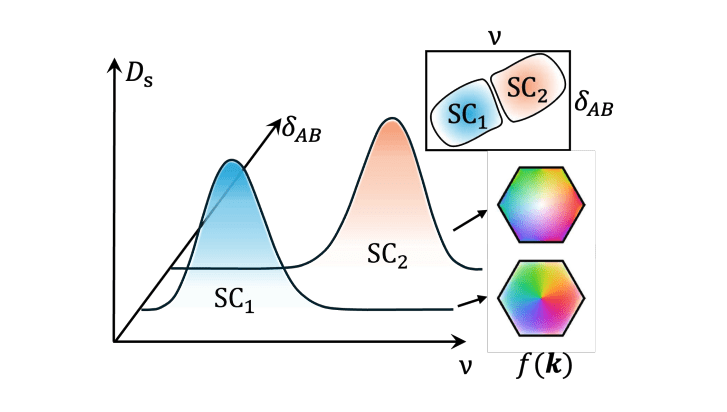
The recent discovery of superconductivity in unusual materials with nearly flat bands has challenged conventional understanding, prompting researchers to explore new theoretical models, and Zhaoyu Han, Jonah Herzog-Arbeitman from Princeton University, and Qiang Gao now present a particularly insightful approach. They develop exact models demonstrating how superconductivity arises in these flat bands, revealing that a simple attractive interaction between specific orbitals can create a superconducting state, and this is significant because it offers a clear mechanism for understanding the phenomenon. Their work further suggests that even with additional complexities, such as repulsive interactions between electrons, superconductivity can persist if these interactions promote a separation of electron flavours, leaving an underlying attractive force. Importantly, the team finds that the strength of this superconductivity is strongly linked to the material’s quantum geometry and can be optimised by controlling the material’s electron density, potentially paving the way for the design of new, high-temperature superconductors.
Exact models of chiral flat-band superconductors Recent experiments reveal surprising superconductivity in rhombohedral graphene, within nearly flat bands of electrons. Motivated by these findings, researchers introduce models for these flat bands with specific symmetry properties. These models demonstrate a local attractive interaction between electrons with opposite characteristics, crucial for enabling superconductivity. This work establishes exact solutions for these models, allowing detailed analysis of the superconducting state and its properties, ultimately contributing to the development of novel superconducting materials.
The research investigates the emergence of superconducting ground states within a specific model, focusing on systems with multiple electronic flavours. It proposes that this model remains relevant even when considering realistic systems with repulsive interactions, because these interactions primarily induce flavour polarization. This polarization potentially leaves an attractive interaction between the different flavourless electrons, allowing for superconductivity.
Topological Superconductivity in Layered Materials
This research explores topological superconductivity, flat bands, and quantum geometry in layered materials like graphene. The core goal is to understand and engineer superconducting states with unique topological properties, characterized by protected edge states robust against disorder and potentially hosting Majorana fermions, particles with intriguing quantum properties relevant for quantum computing. Flat bands, where electrons have constant energy across a range of momenta, are crucial because they enhance interactions and promote correlated electronic states, including superconductivity and magnetism. The research focuses on engineering flat bands through layer stacking and manipulating quantum geometry, which describes the geometric properties of the electronic band structure beyond simple energy dispersion.
Controlling and exploiting quantum geometry is key to enhancing superconductivity. Layered materials, particularly graphene, serve as a model system, as stacking layers can create flat bands and tune electronic properties. The overarching goal is to develop a theoretical framework for designing and understanding topological superconductors in layered materials by controlling flat bands and quantum geometry, identifying solvable models to guide experimental efforts. The authors present a multi-faceted approach, building from simpler models to more realistic ones. They focus on finding exactly solvable models, a powerful technique allowing analytical results and deep insights into the physics.
They develop a general construction method for building these solvable models, identifying key parameters and constraints. They start with continuous models and then regularize them onto a lattice, necessary for numerical simulations and connecting the theory to real materials. They demonstrate how to tune the quantum geometry by controlling layer stacking and lattice parameters. They identify degenerate ground states with different characteristics, a signature of topological order, and use the Weierstrass function to compactify momentum space, creating a realistic lattice model with tunable quantum geometry.
The research progresses through a series of models, increasing in complexity, starting with a simple two-band model capturing the essential physics of flat bands and superconductivity. This model generalizes to L layers, capturing the effects of multiple layers, and culminates in a lattice model incorporating lattice structure and tunable quantum geometry. Key concepts include the Chern number, a topological invariant characterizing the band structure, the Fubini-Study metric and Berry curvature, describing the curvature of the band structure, and the solvable Hamiltonian, allowing analytical results. The existence of degenerate ground states with different Chern numbers is a signature of topological order.
This work has the potential to significantly advance the field of topological superconductivity. By developing a theoretical framework for designing and understanding topological superconductors in layered materials, the authors can guide experimental efforts to create new materials with novel properties, potentially leading to breakthroughs in quantum computing, materials science, and condensed matter physics. This is a highly theoretical and mathematically rigorous paper presenting a novel approach to understanding and engineering topological superconductivity in layered materials.
Flat Bands Drive Topological Superconductivity Emergence
The research demonstrates that superconductivity can emerge in systems with nearly flat bands of electrons, specifically in rhombohedral materials, through a local attractive interaction between electrons with opposite properties. Researchers constructed theoretical models showing that this attraction leads to a superconducting state, even when repulsive interactions are present, as long as flavour polarization is induced. The pairing of electrons, responsible for superconductivity, is influenced by both the geometry of the flat bands and the strength of the interaction, and can exhibit topological properties. Interestingly, the models reveal the existence of two nearly equivalent superconducting states, differing in the way electrons pair, which can be tuned by altering the electronic properties of the material or the electron density. Calculations show that the strength of the superconducting state, measured by superfluid stiffness, is maximized when specific points in the electronic structure, known as hot spots, are partially filled with electrons. This work provides a pathway for understanding and potentially designing novel superconducting materials based on the principles of flat band physics and tailored electronic interactions.
👉 More information
🗞 Exact models of chiral flat-band superconductors
🧠 ArXiv: https://arxiv.org/abs/2508.21127