

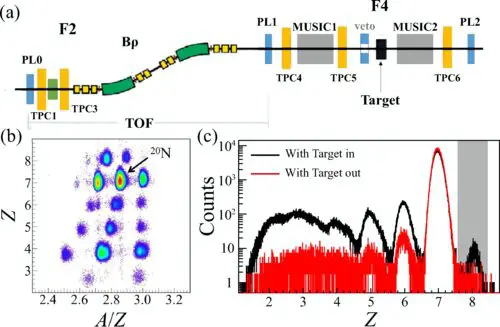
This research investigates charge-pickup reactions, a process occurring during heavy-ion collisions where a nucleus loses protons. The team focused on understanding how these reactions behave in nuclei containing a large excess of neutrons, crucial for determining nuclear structure, improving models of nuclear forces, and refining predictions used in astrophysics and nuclear physics. The study also explores the role of the Δ resonance, an excited state of nuclear particles, in this process. Experiments were conducted at GSI, a leading facility for heavy-ion research in Germany. Researchers bombarded targets, including liquid hydrogen, with beams of various neutron-rich nuclei, such as carbon isotopes.
A sophisticated detection system, including fragment separators, silicon detectors, and time projection chambers, was used to identify and characterize the fragments produced during the collisions, allowing measurement of charge-pickup probabilities. The researchers observed significantly enhanced charge-pickup probabilities for certain neutron-rich carbon isotopes, correlating with their proton radii and the distribution of protons within them. The study suggests the Δ resonance plays a significant role in facilitating this charge-pickup process, enabling determination of the size of the proton distribution within these neutron-rich nuclei. These results provide valuable data for refining models of nuclear structure, particularly for neutron-rich nuclei, and contribute to a better understanding of the nuclear forces governing these reactions. The findings have implications for understanding astrophysical environments, such as supernovae and neutron star mergers, where neutron-rich nuclei are abundant, and validate existing theoretical models of charge-pickup reactions.
Neutron Conversion Rate Scales with Neutron Number
Researchers have discovered a new relationship governing the conversion of neutrons to protons during nuclear reactions, challenging existing models and improving the accuracy of predictions in nuclear physics and astrophysics. Experiments reveal that the rate of this conversion increases exponentially with the number of neutrons present in the nucleus, significantly improving the precision of reaction predictions. The team developed a new empirical formula to describe this phenomenon, demonstrating a reduced dependence on the overall size of the nucleus, decreasing the exponent in a key calculation from 2 to 1. This formula accurately predicts charge-pickup reaction probabilities, exhibiting strong sensitivity to isospin asymmetry, the difference between the number of neutrons and protons, and accurately reflecting the impact of increasing neutron numbers on reaction rates.
The improved formula provides a better fit to experimental data, demonstrating a reduced level of discrepancy compared to previous models. The team’s formula successfully separates the dependence of the reaction probability on both the size of the nucleus and isospin asymmetry, accurately replicating experimental data across various isotopes and reaction conditions. This breakthrough delivers a more precise understanding of nuclear reactions and provides a valuable tool for advancing research in nuclear physics and astrophysics, allowing for more accurate predictions and a deeper understanding of nuclear processes.
Neutron Number Drives Charge Pickup Reactions
This research presents new measurements of charge-pickup reaction probabilities for a range of light isotopes, including lithium, beryllium, boron, carbon, and nitrogen. The experiments reveal that the probability of neutron-to-proton conversion during these reactions increases exponentially with the number of neutrons present in the nucleus, providing a more accurate basis for predicting reaction rates in exotic neutron-rich nuclei. The team developed an empirical formula to estimate charge-pickup probabilities, demonstrating the significant role of isospin asymmetry in driving these reactions. This formula, validated against a broad dataset of isotopes, offers a precise method for evaluating production rates of neutron-rich nuclides, which are important in astrophysics and nuclear physics.
While the current formula achieves a good fit to the data, the authors acknowledge that its exact form may evolve with the addition of measurements from other isotopes. Future research could focus on correlating charge-pickup probabilities with energy-level densities to further refine the empirical formula. This research provides a more accurate understanding of charge-pickup reactions and offers a valuable tool for predicting reaction rates in neutron-rich nuclei, advancing the fields of nuclear physics and astrophysics.
🗞 Charge Pickup Reaction Cross Section for Neutron-Rich $p$-Shell Isotopes at $900A\text{ }\text{ }\mathrm{MeV}$
🧠 DOI: http://link.aps.org/doi/10.1103/k9tj-jq8s


