

The interplay between superconductivity and magnetism represents a long-standing puzzle in condensed matter physics, and recent experiments reveal surprising connections in layered materials. Hyeok-Jun Yang and Yi-Ting Hsu, both from the University of Notre Dame, investigate how external forces can drive transitions between these seemingly opposing states in two-dimensional materials. Their theoretical work proposes a general mechanism where an applied displacement field controls the shift from superconductivity to a unique form of magnetism called valley ferromagnetism, even in materials with simplified electronic structures. This discovery is significant because it identifies a pathway to engineer these transitions, potentially leading to novel electronic devices and a deeper understanding of correlated electron systems within the broader family of layered van der Waals materials.
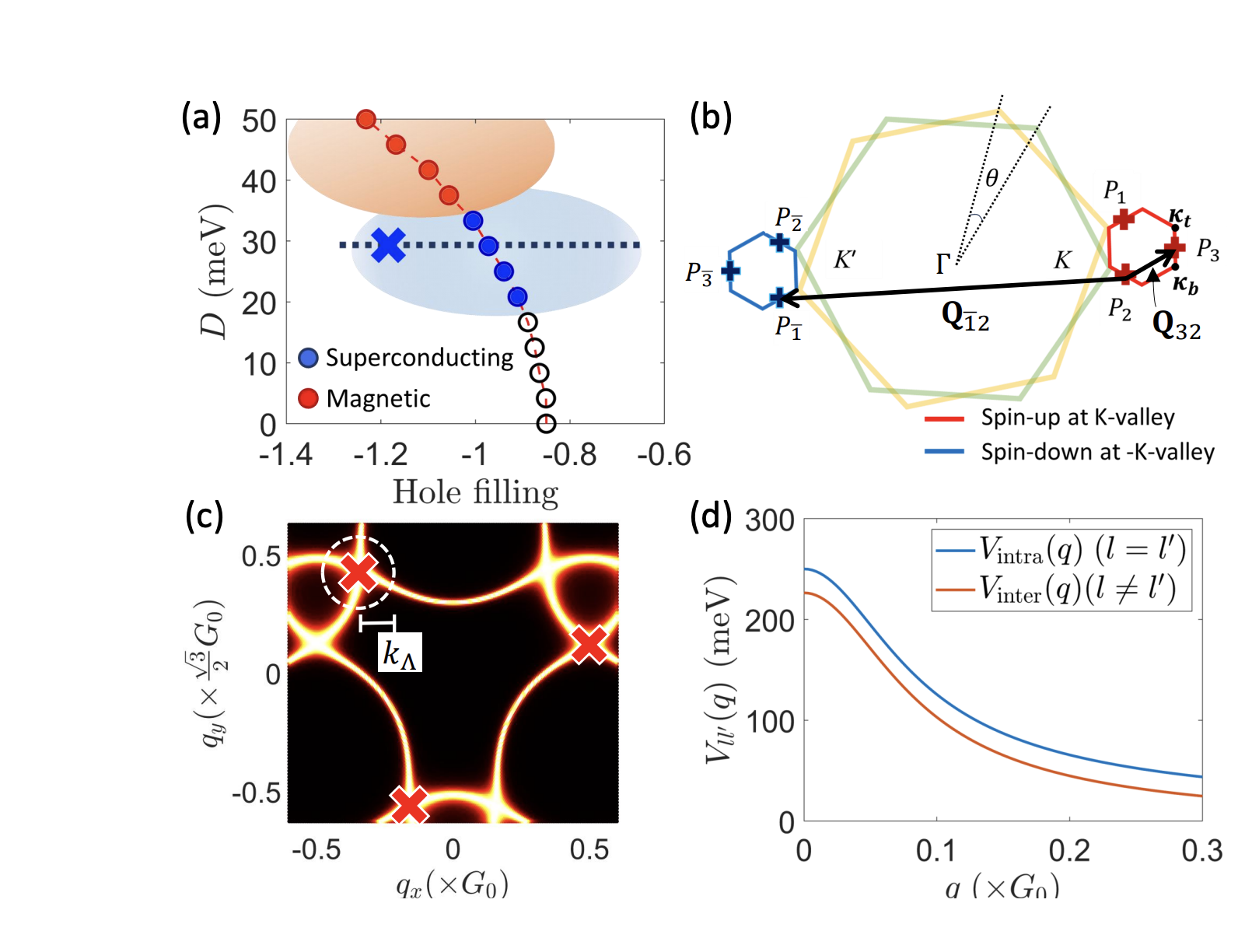
Displacement-Field-Driven Transition between Superconductivity and Valley Ferromagnetism in Transition Metal Dichalcogenides Recent experiments demonstrate transitions between superconductivity and correlated magnetism in twisted bilayer WSe2 when subjected to an applied displacement field, particularly near specific energy levels known as van Hove fillings. Researchers propose a general mechanism explaining how this displacement field controls a transition between superconductivity and ferromagnetism in two-dimensional materials with specific atomic arrangements. This mechanism centres on the role of van Hove singularities, points of high electron density, in mediating the transition, offering a potential pathway to manipulate these correlated electronic states. The theoretical framework explains how an applied displacement field can tune the electronic structure, shifting the system between superconducting and ferromagnetic phases, and providing insights into the interplay between these competing orders.
The research shows that such a transition can be understood with a simplified model focusing solely on the van Hove singularities, without needing detailed information about the entire electronic structure. By employing renormalization group techniques, researchers find that chiral d/p-wave superconductivity naturally dominates under a weak displacement field. At a stronger displacement field, a valley ferromagnetic phase emerges, exhibiting spatially non-uniform magnetization patterned by the material’s valleys. This study identifies the generic conditions for this superconductivity-to-ferromagnetism transition to occur within a broad family of layered materials.
Tunable Superconductivity and Magnetism in Twisted Bilayer WSe2
Researchers have discovered a remarkable connection between superconductivity and magnetism in twisted bilayer WSe₂, a material exhibiting unique electronic properties. Experiments reveal that applying a displacement field allows precise control over a transition between these two distinct states of matter, occurring near specific energy levels known as van Hove fillings. This control stems from the material’s electronic structure, where the arrangement of electrons allows tuning interactions with an external field. Using renormalization group techniques, they find that a chiral superconducting state dominates at weak displacement fields, meaning electrons pair up and flow without resistance in a specific, twisting pattern.
However, as the displacement field increases, the material undergoes a transition to a spatially non-uniform “valley ferromagnetic phase,” where magnetic moments align in a patterned way modulated by the material’s valleys. This discovery reveals a pathway to engineer transitions between superconductivity and magnetism using a simple, external parameter. The research demonstrates that the strength of interactions between electrons, governed by the displacement field, dictates which state prevails. The findings have significant implications for the design of novel electronic devices, potentially enabling the creation of materials where superconductivity and magnetism can be switched on or off as needed. Furthermore, the principles established in this study extend to a broader family of layered van der Waals materials, suggesting a versatile route to control electronic properties in these systems.
Twisted Bilayer WSe2 Exhibits Correlated Insulating Behaviour
This research investigates the complex behaviour of electrons in twisted bilayer WSe2, a material formed by stacking two layers of tungsten diselenide with a slight rotational twist. This twist creates a moiré pattern, dramatically altering the material’s electronic properties and leading to correlated electron phenomena, including superconductivity and magnetism. A key concept is the presence of van Hove singularities in the electronic band structure, points where the density of electrons is particularly high, enhancing electronic interactions and potentially leading to novel phases of matter. Researchers employ renormalization group analysis, a powerful technique for understanding how physical systems behave at different length scales, to investigate these interactions.
This analysis focuses on understanding how these interactions drive the system towards different ordered phases, such as superconductivity or magnetism. The research demonstrates that electronic interactions are essential for understanding the behaviour of twisted bilayer WSe2. The findings build on earlier discoveries in twisted bilayer graphene and draw parallels to the theoretical understanding of iron-based superconductors, offering insights into the complex interplay of interactions and emergent phenomena in these materials.
🗞 Displacement-Field-Driven Transition between Superconductivity and Valley Ferromagnetism in Transition Metal Dichalcogenides
🧠 ArXiv: https://arxiv.org/abs/2508.21119


