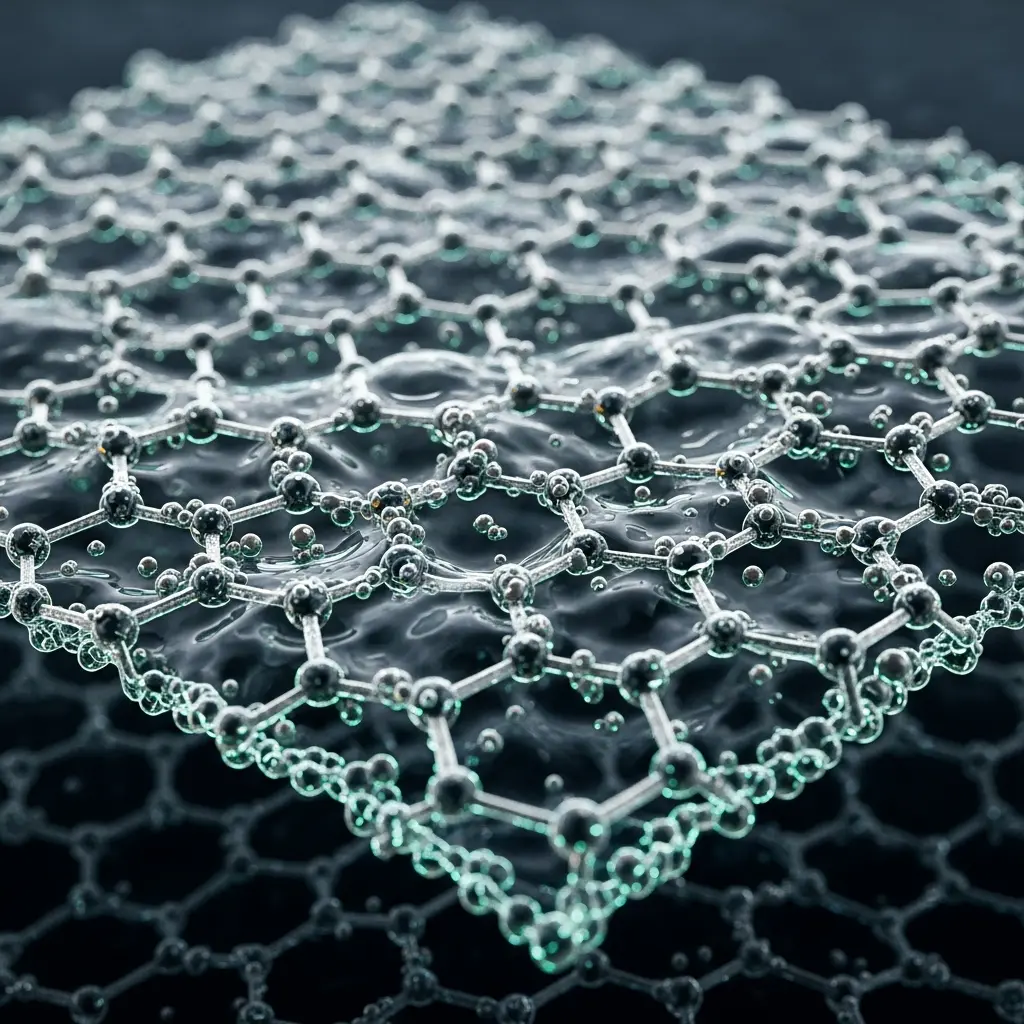
Graphene, a single-atom-thick layer of carbon, holds immense promise for the future of electronics due to its potential for creating incredibly small devices, but its unique electronic properties require highly accurate simulations. Giovanni Nastasi from the University of Enna “Kore” and Vittorio Romano from the University of Catania have developed a new computational method to model electron flow within these graphene-based devices, addressing the challenges posed by graphene’s unusual behaviour. Their approach utilises the semiclassical Boltzmann transport equation, coupled with the Poisson equation, and solves it using a discontinuous Galerkin method, offering a robust and accurate way to simulate charge transport. This work generates benchmark solutions for suspended monolayer graphene and graphene field-effect transistors, enabling rigorous testing and refinement of simpler, more commonly used models for these advanced materials and paving the way for improved device design and performance.
Modeling Graphene Using Discontinuous Galerkin Method
Advanced Modeling Using Discontinuous Galerkin Method
The study focuses on a Discontinuous Galerkin (DG) method, capable of accurately predicting the behavior of graphene-based transistors and accounting for complex factors like substrate interactions, high electric fields, and quantum mechanical phenomena. This approach moves beyond simpler models, offering a more realistic simulation of electron behavior within these materials. The research systematically explores different levels of modeling complexity, starting with basic drift-diffusion models and progressing to more accurate hydrodynamic and quantum-corrected approaches.
The framework accurately accounts for the significant impact of the substrate on graphene’s electronic properties, recognizing how interactions can affect carrier mobility and induce band bending. At high electric fields, where graphene deviates from simple Drude model behavior, the simulations incorporate non-equilibrium carrier distributions and velocity saturation. Furthermore, the method considers crucial quantum mechanical effects, such as quantum capacitance and tunneling, which become important in nanoscale devices. The authors rigorously validated their simulations by comparing them with analytical results, experimental data, and other established simulation methods, demonstrating the accuracy and reliability of the approach.
This detailed modeling capability provides valuable insights into the performance of graphene transistors, including their current-voltage characteristics and transconductance. This work represents a significant contribution to the field of graphene device modeling, offering a versatile simulation framework for investigating a wide range of graphene devices and optimizing their performance. Future research directions include extending the simulations to three dimensions, investigating the impact of device variability, incorporating thermal effects, and exploring advanced device architectures. Combining the framework with machine learning techniques could further accelerate simulations and optimize device designs.
Discontinuous Galerkin Solves Graphene Charge Transport
Solving Electron Transport via Boltzmann Equation
Solving Charge Transport via Boltzmann Equation
Scientists have developed a sophisticated numerical method to model charge transport in graphene, addressing limitations in existing simulations of this promising material for next-generation electronics. The study directly solves the semiclassical Boltzmann transport equation, coupled with the Poisson equation to account for electric fields within the graphene device. This approach captures more complex charge dynamics inherent to graphene-based transistors. The core of the method involves a discontinuous Galerkin (DG) approach, a powerful technique for solving partial differential equations, employing linear elements and a polar mesh to accurately represent the graphene structure.
A key innovation lies in preserving the physically correct range for the electron distribution function, achieved through a maximum-principle-satisfying scheme that ensures numerical stability and accuracy. To validate the method, scientists simulated both suspended monolayer graphene and a graphene field-effect transistor (GFET), incorporating realistic electron-phonon scattering and impurity scattering to accurately model how electrons interact with the graphene lattice and imperfections. The resulting numerical results provide benchmark solutions for assessing the validity of simpler macroscopic models, such as drift-diffusion and hydrodynamic approaches, offering a rigorous test of their accuracy. This method demonstrates robustness and accuracy, paving the way for more detailed and reliable simulations of graphene-based electronic devices. The ability to accurately model electron behavior will be crucial for designing and optimizing future graphene-based technologies.
Graphene Electron Transport Solved with Discontinuous Galerkin Method
Confirming Device Performance and Modeling Accuracy
Confirming Device Performance and Simulation Accuracy
Scientists have achieved a robust and accurate solution to the semiclassical Boltzmann equation for electron transport in graphene, employing a discontinuous Galerkin method. This work directly addresses electron dynamics within the two-dimensional material, extending previous studies that often relied on simplified conditions. The team successfully coupled the Boltzmann equation with the Poisson equation, accurately modeling the interplay between charge carriers and the electrostatic potential within graphene devices. The research demonstrates a numerical scheme capable of simulating both suspended monolayer graphene and graphene field-effect transistors (GFETs), preserving the correct physical range for the electron distribution function.
The team addressed a major challenge in numerical simulation, defining fluxes at element interfaces, with a generalized approach building upon existing piecewise constant flux methods. Simulation results for suspended monolayer graphene and GFETs confirm the robustness and accuracy of the proposed scheme. The method accurately captures complex charge transport dynamics, providing benchmark solutions for assessing the validity of macroscopic models, such as drift-diffusion and hydrodynamic approaches. This achievement delivers a powerful tool for investigating graphene-based electronics and paves the way for more accurate device modeling and optimization. The developed scheme accurately models electron-phonon scattering, including interactions with acoustic, optical, and K phonons, as well as scattering from impurities. This work represents a significant advancement in the field of graphene device simulation, providing a reliable and accurate method for predicting the behavior of these promising materials.
Graphene Transistor Simulation via Discontinuous Galerkin Methods
Scientists have developed a new numerical method for simulating charge transport in graphene field-effect transistors, employing a discontinuous Galerkin approach to solve the semiclassical Boltzmann transport equation. The researchers developed a robust and accurate scheme, incorporating a maximum-principle-satisfying technique to ensure physically realistic solutions for the electron distribution function. By accurately modelling the complex charge dynamics within these devices, the method generates benchmark solutions for evaluating the validity of simpler, macroscopic models commonly used in transistor design. The authors acknowledge that the current model relies on the semiclassical Boltzmann transport equation, which may not fully capture quantum effects that become significant at very small scales. Future work could explore incorporating these quantum effects to further refine the accuracy of the simulations and provide even more detailed understanding of graphene-based electronics. This work provides a significant step forward in the field of graphene device simulation, offering a powerful tool for designing and optimizing future graphene-based technologies.
🗞 A discontinuous Galerkin approach for simulating graphene-based electron devices via the Boltzmann transport equation
🧠 ArXiv: https://arxiv.org/abs/2512.03205