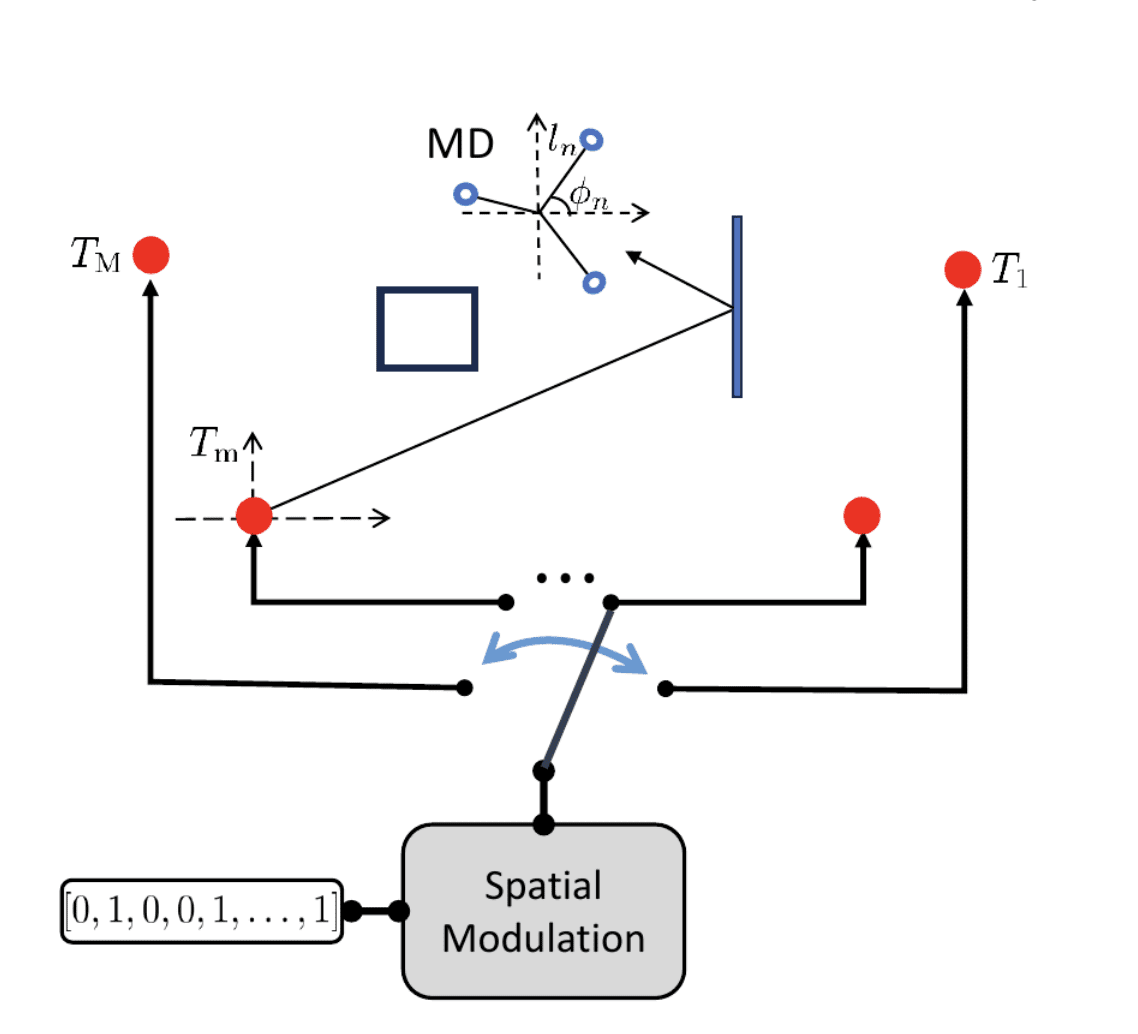
Millimeter-wave communications promise significantly increased data rates, but are hampered by the rapid fading of signals and sensitivity to imperfections in the transmitting and receiving equipment. Mohaned Chraiti, Ozgur Ercetin, Ali Ghrayeb, and Ali Gorcin investigate a promising technique called Direction-Shift Keying (DSK) which encodes information not in the strength or phase of a signal, but in the direction from which it arrives. Their work demonstrates that DSK dramatically extends the usable signal duration, achieving coherence times over four orders of magnitude longer than conventional methods, and crucially, cancels out the effects of phase noise without requiring complex compensation. By developing a detailed analytical framework and validating it with simulations, the researchers establish fundamental laws governing DSK’s performance and confirm its potential to deliver robust and scalable high-frequency mobile communications.
Direction-Shift Keying Extends Coherence in Wireless Channels
Researchers have developed Direction-Shift Keying (DSK), a novel communication technique that dramatically extends coherence time in millimeter-wave and sub-Terahertz systems, overcoming limitations imposed by rapid channel variations and phase noise. The study pioneers the use of directional encoding of information using a distributed antenna system, rather than relying on traditional amplitude or phase modulation. This method extends coherence time by up to four orders of magnitude, a significant improvement over existing techniques. To rigorously evaluate DSK’s performance, scientists derived the optimal detector for a mobile device equipped with an antenna array and established a governing law for DSK’s coherence time, termed the Direction Coherence Time (DCT).
The team demonstrated that DCT scales with the ratio of transmitter-receiver distance to velocity, contrasting with the Channel Coherence Time (CCT), which scales linearly, revealing a substantial coherence time gain. Experiments employing analytical modeling and simulations validated these predictions, confirming the robustness and scalability of DSK in high-frequency mobile environments. Furthermore, the research demonstrates that DSK inherently cancels phase noise, eliminating the need for additional compensation mechanisms, a major advantage over existing systems. This cancellation arises from the directional encoding of information, effectively mitigating the impact of phase fluctuations.
Direction-Shift Keying Extends Millimeter-Wave Coherence Time
Data confirms that doubling the carrier frequency incurs only a 6 dB Signal-to-Noise Ratio (SNR) loss, while transitioning from 9 GHz to 150 GHz results in up to 24 dB degradation, a substantial improvement over conventional systems. Researchers analytically proved that DSK’s performance is not limited by phase noise, a critical factor in achieving reliable high-frequency transmissions. DSK utilizes the Direction-of-Arrival (DoA) of the signal for communication, effectively acting as a spatial discriminator and matching observed signal arrival directions to known reference directions. This approach offers increased resilience to channel fluctuations and mobile device movement compared to traditional channel coefficient-based detection methods.
Simulations and analytical results validate the robustness and scalability of DSK in high-frequency mobile environments, paving the way for more efficient and reliable wireless communication in the future. The team’s work provides a theoretical foundation for understanding and optimizing DSK’s performance, enabling further advancements in this promising technology. While offering an innovative solution, the approach necessitates a shift in system design, specifically requiring transmitting antennas to be positioned around the perimeter of a coverage area rather than centrally located. Future research will focus on system planning, particularly in densely deployed networks, to optimise performance in these configurations.
Directional Shift Keying Extends Coherence Times
This work presents the first detailed analytical characterisation of Direction-Shift Keying (DSK), a modulation technique designed to address key challenges in millimetre-wave and sub-Terahertz communications, namely, oscillator phase noise and short channel coherence time. Researchers derived the optimal detector for DSK in mobile environments and established the concept of Direction Coherence Time (DCT), demonstrating its scaling with antenna separation over velocity. This contrasts with conventional channel coherence time, which scales with wavelength over velocity, resulting in a substantial coherence gain, several orders of magnitude in practical scenarios. The findings demonstrate that DSK enables coherent detection over significantly longer timescales and inherently resists phase noise, eliminating the need for channel tracking or phase correction. These properties reduce pilot overhead and improve spectral efficiency in high-mobility, high-frequency environments, establishing a theoretical foundation for DSK as a promising candidate for robust and hardware-efficient communication systems.
👉 More information
🗞 On the Resilience of Direction-Shift Keying Against Phase Noise and Short Channel Coherence Time at mmWave Frequencies
🧠 ArXiv: https://arxiv.org/abs/2509.01103