The behaviour of directed paths within complex networks forms a fundamental question in diverse fields, from understanding neural connections to modelling the spread of information, and recent work by Jacopo Borga from MIT and Ewain Gwynne from the University of Chicago sheds new light on this problem. They investigate directed distances within a specific type of network, known as a bipolar-oriented triangulation, and demonstrate how these distances scale as the network grows infinitely large. Their research establishes precise mathematical relationships governing the lengths of both the longest and shortest directed paths, revealing they follow predictable patterns linked to a concept called stable Lévy processes. This achievement not only defines the scaling dimensions of these networks, but also provides a crucial step towards understanding more complex, hypothetical geometric structures known as directed Liouville metrics, offering a powerful new tool for analysing connectivity in a wide range of systems.
Interface in the UIBOT reveals that, for longest directed paths, the Busemann function converges in the scaling limit to a 2/3-stable Lévy process, and for shortest directed paths, it converges to a 4/3-stable Lévy process. The team also proves bounds for directed distances in finite bipolar-oriented triangulations and for size-n cells in the UIBOT, demonstrating that in a typical subset of the UIBOT with n edges, longest directed path lengths are of order n3/4 and shortest directed path lengths are of order n3/4.
Stochastic Convergence and Limit Theorems Explored
This body of work encompasses a wide range of research areas, including probability theory, random surfaces, combinatorics, and statistical physics. Foundational results in probability and stochastic processes underpin the study of random surfaces like Brownian maps and Liouville quantum gravity, which explore geometric properties and connections to theoretical physics. Combinatorial methods are used to enumerate and generate planar maps, while statistical physics provides tools for analyzing growing interfaces and related phenomena. This interconnected research builds upon each other, offering insights into complex mathematical structures and their applications.
Directed Distances Converge to Stable Lévy Processes
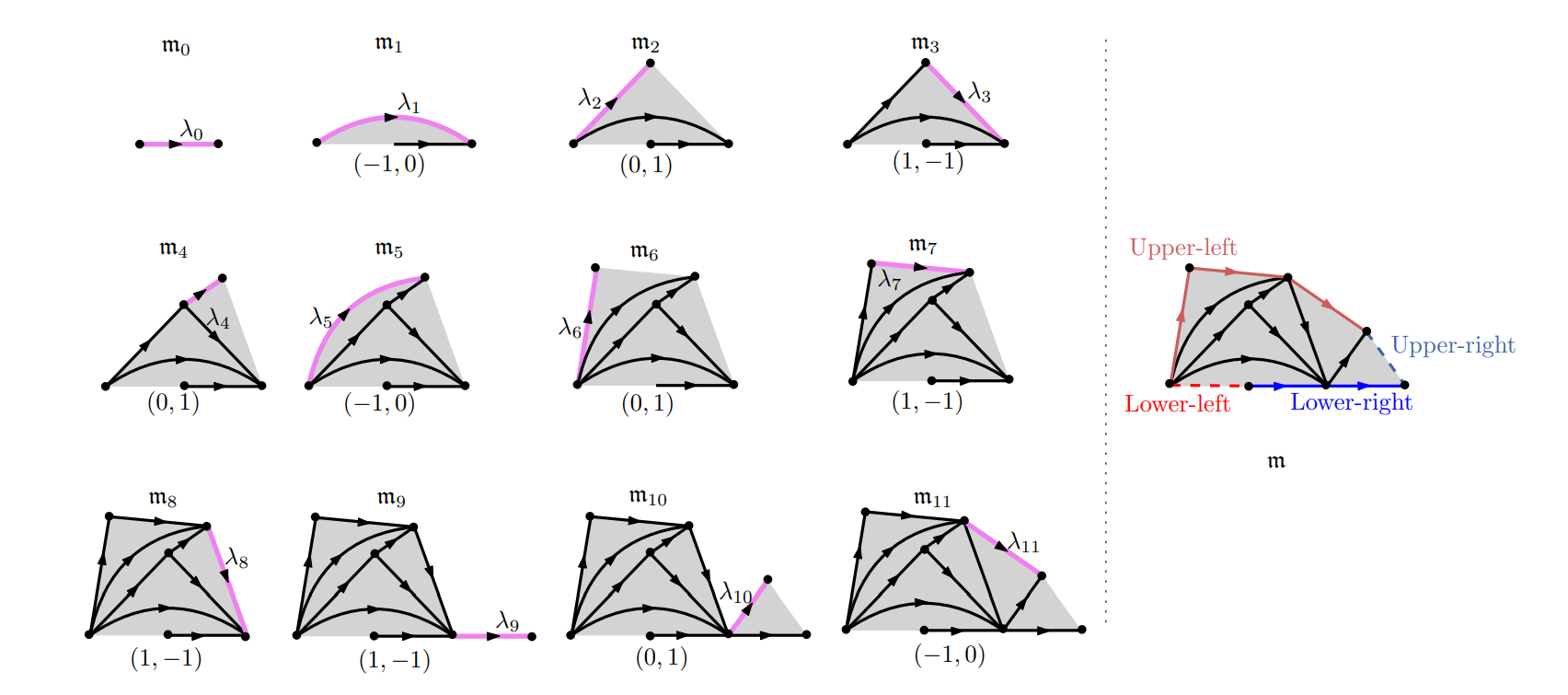
This work presents a detailed analysis of directed paths within the uniform infinite bipolar-oriented triangulation (UIBOT), a model of directed random planar maps. Scientists constructed the Busemann function to measure directed distance, revealing its behavior in the scaling limit. Results demonstrate that, for longest directed paths, this function converges to a 2/3-stable Lévy process, while for shortest directed paths, it converges to a 4/3-stable Lévy process. The team proved bounds for directed distances in finite bipolar-oriented triangulations and for size-n cells in the UIBOT, establishing that in a typical subset of the UIBOT containing n edges, longest directed path lengths are of order n3/4, and the lengths of shortest directed paths are of order n3/4. These precise measurements define the scaling dimensions for discretizations of the hypothetical p 4/3-directed Liouville quantum gravity metrics. The convergence results rely on a specific bijection and do not require continuum theory, offering a rigorous mathematical framework for understanding directed distances in these complex planar maps and providing new insights into their geometric properties.
Lévy Scaling of Directed Path Lengths
This research establishes connections between discrete and continuous models of directed paths in random planar maps, specifically focusing on the uniform infinite bipolar-oriented triangulation. The team demonstrates that the lengths of longest and shortest directed paths within these maps exhibit scaling behavior consistent with Lévy processes, offering insights into the discrete approximations of continuous directed Liouville metrics. The findings reveal that longest directed path lengths scale with order one, while shortest directed path lengths scale with order one, providing precise characterizations of these path lengths in typical subsets of the map. These results build upon a specific bijection and do not rely on continuum theory, offering a self-contained analysis of the discrete structures. The authors acknowledge that their work currently focuses on specific parameters and map models, and further research is needed to extend these findings to broader contexts. They suggest that their techniques may be applicable to other random planar map models and to the study of longest increasing subsequences in permutations, opening avenues for future investigation into related combinatorial structures and their continuous limits.
🗞 Directed distances in bipolar-oriented triangulations: exact exponents and scaling limits
🧠 ArXiv: https://arxiv.org/abs/2510.26123