Exciton-polaritons, quasiparticles formed from coupled light and matter, offer exciting possibilities for future optoelectronic devices, but achieving stable and controllable light emission from these systems remains a significant hurdle. Junxing Dong, Si Shen, Jingzhuo Wang, and colleagues now report the first direct observation and optical manipulation of a process called parametric scattering lasing in exciton-polaritons at room temperature. The team demonstrates a method for resonantly exciting specific polariton states within a nanobelt microcavity using a femtosecond laser, which stimulates the emission of signal and idler light waves. This achievement not only confirms the potential for creating polariton-based lasers driven by two-photon absorption, but also establishes a pathway for ultrafast optical modulation with a measured response time of just 0. 4 picoseconds, paving the way for novel polaritonic devices.
Nanobelt Microcavity Amplifies Polariton Parametric Scattering
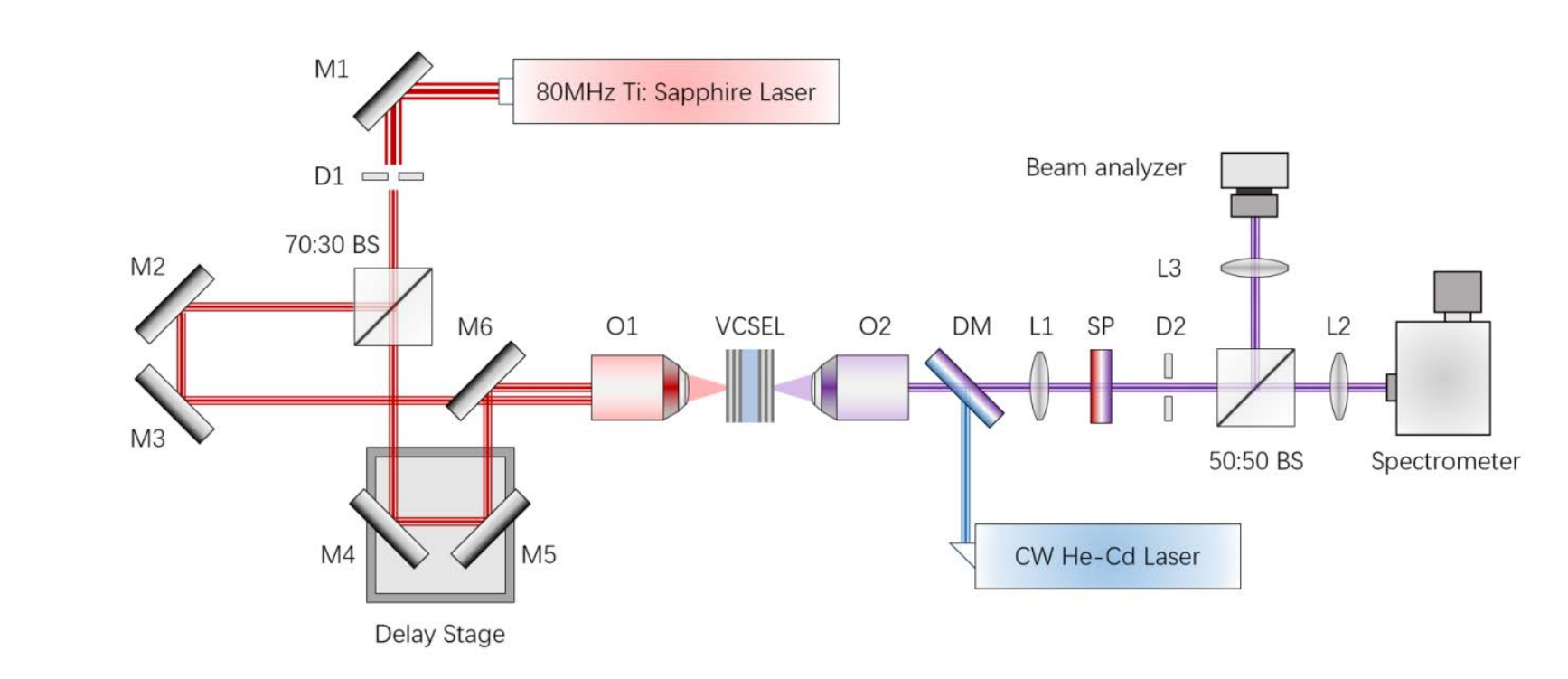
Scientists engineered a planar microcavity incorporating a zinc oxide nanobelt to directly observe and amplify non-degenerate intermode polariton parametric scattering (PPS) at room temperature. This device, a vertical-cavity surface-emitting laser (VCSEL) structure formed by symmetric distributed Bragg reflectors (DBRs), provides a platform for studying light-matter interactions at the nanoscale. Scanning electron microscopy revealed the nanobelt possesses a well-defined rectangular cross-section, crucial for achieving strong exciton-photon coupling. To initiate PPS, the team employed a mode-locked titanium-sapphire femtosecond laser emitting at 810 nanometers, harnessing a two-photon absorption (TPA) scheme to excite the polaritons.
The laser’s photon energy, approximately half that of the ground state, selectively activates the polaritons via resonant TPA, minimizing excitation of the DBR regions. A k-space modulation unit focused the laser onto the microcavity, selectively exciting the pump-state and enabling the generation of signal and idler states based on energy and momentum conservation. Efficient detection of PPS involved a near-ultraviolet objective collecting transmitted spectra from the microcavity. Researchers meticulously characterized the microcavity, confirming a prominent near-band emission peak and demonstrating high reflectivity across the exciton emission peak, fostering strong exciton-photon coupling.
Angle-resolved dispersion patterns revealed the emission of distinct branches, demonstrating well-distributed energy bands and polariton population in momentum space. Experiments at low excitation density showed injected quasi-particles primarily residing in the pump-state, with minimal scattering into signal and idler states. As particle density increased to threshold, the signal-state emission dramatically increased, indicating stimulated PPS lasing. Notably, the PPS process occurred at a momentum position satisfying both energy and momentum conservation, forming a robust scattering triad. The team validated their experimental observations with simulations using the generalized Gross-Pitaevskii equation, confirming the physical mechanism of TPA-driven intermode PPS.
Quantitative analysis of emission intensity, linewidth, and energy shift revealed a nonlinear coefficient consistent with the expected value for a TPA process. The linewidth of the signal and idler states narrowed with increasing excitation power, demonstrating enhanced coherence and particle correlation within the system. These results establish a platform for direct probing of signal and idler states in non-degenerate PPS and offer a promising pathway for advancing polaritonic devices based on nonlinear PPS mechanisms.
ZnO Microcavities Enhance Polariton Scattering Efficiency
This document provides supplementary information supporting a research study on polariton parametric scattering (PPS) in ZnO microcavities at room temperature. It details the experimental setup, theoretical modeling, and parameters used in the study, aiming to provide a complete understanding of the methods and assumptions behind the reported results. Key sections describe the femtosecond laser system, which uses one beam for excitation and another as a trigger for modulating the PPS process, and the k-space resolution achieved through angle-resolved spectroscopy. The authors highlight the importance of exciton-phonon interactions at room temperature, leading to a shorter lifetime for the upper polariton branch and dominance of the lower polariton branch in the observed signal.
Specific values are provided for the exciton energy and fitted Rabi splitting energies for the three lower polariton branches. The document also explains the use of coupled Gross-Pitaevskii equations to model the PPS process, considering the signal, pump, and idler polariton fields, and emphasizes the importance of energy and momentum conservation. Supplementary figures show the angle-resolved spectrum of the incident laser beam and a schematic drawing of the experimental setup, and describe the dispersion of exciton-polaritons in the planar ZnO microcavity. This detailed methodology, robust modeling, and comprehensive parameterization provide a complete and transparent account of the research methods and assumptions, enabling other researchers to understand, reproduce, and build upon the findings.
Room Temperature Observation of Polariton Parametric Lasing
This research demonstrates the first direct observation and optical amplification of non-degenerate intermode parametric scattering (PPS) lasing at room temperature. Scientists achieved this breakthrough by exciting a specific polariton branch within a strong-coupled nanobelt planar microcavity using a near-infrared femtosecond laser and a two-photon absorption scheme, successfully stimulating the generation of signal and idler states. Angle-resolved dispersion patterns clearly illustrate the evolution of these states as excitation power varies, confirming the process of stimulated emission. The team developed a resonant optical trigger, enabling selective enhancement and modulation of the signal state with a sub-picosecond response time of 0.
4ps. Dynamic measurements confirm this ultrafast temporal action, highlighting the potential for rapid optical manipulation. This innovative approach overcomes limitations in detecting high-momentum idler states and achieving phase-matching for coherent PPS, establishing a platform for exploring two-photon absorption-driven PPS lasers and novel optical modulation routes for polaritonic devices. The authors acknowledge that the current study focuses on a specific microcavity structure and excitation scheme, and further research is needed to explore the scalability and versatility of this approach. Nevertheless, these findings represent a significant advance in the field, paving the way for ultrafast polariton optical sources with coherent control and the development of parametric oscillators.
🗞 Direct Observation and Optical Manipulation of Exciton-polariton Parametric Scattering Lasing in Temporal
🧠 ArXiv: https://arxiv.org/abs/2511.00373