Quantum sensors promise unprecedented precision by exploiting the fundamental laws of quantum mechanics, potentially exceeding the limits of classical devices, but environmental noise rapidly degrades their performance and prevents them from reaching this potential. Hang Xu, Tailong Xiao, and Jingzheng Huang, along with colleagues from Shanghai Jiao Tong University and Lenovo Research, demonstrate a novel approach using a ‘quantum digital twin’ to overcome this challenge. Their method learns to compensate for noise in real-time, effectively restoring the Heisenberg limit, the ultimate boundary of precision, without needing detailed knowledge of the noise itself or relying on complex error correction. This research establishes a new, adaptable control strategy for quantum sensors, paving the way for practical, high-precision devices even within the constraints of current, near-term quantum technology.
However, these sensors are notoriously susceptible to environmental noise, which causes rapid decoherence and fundamentally limits their performance. This research introduces a novel approach, a “digital twin” protocol, to overcome this challenge and restore the ultimate precision offered by quantum mechanics.
Quantum Resource Optimization for Precision Measurement
Recent advances in quantum metrology and sensing have focused on maximizing the information extracted from quantum systems. Researchers are exploring techniques to surpass the standard quantum limit, achieving the Heisenberg limit for precision measurement. This requires careful control of quantum states and the ability to mitigate the effects of noise. A significant body of work investigates adaptive control strategies, where measurement protocols are dynamically adjusted to optimize information gain, with reinforcement learning emerging as a powerful tool for this purpose. Alongside these control techniques, researchers are addressing the pervasive issue of noise and decoherence.
Understanding the dynamics of noise, including non-Markovian effects, is crucial for accurate modeling and control. Techniques like counterdiabatic driving and feedback control aim to mitigate decoherence and stabilize quantum states. The development of digital twins, virtual replicas of physical quantum systems, offers a promising new avenue for optimization, allowing researchers to test different control strategies and predict the effects of noise. Overall, this body of work highlights a convergence of machine learning, advanced control techniques, and a deep understanding of quantum dynamics. The focus is on building robust and adaptive quantum sensors that can overcome the challenges of noise and decoherence, paving the way for high-precision measurements in real-world applications.
Digital Twin Boosts Quantum Sensor Precision
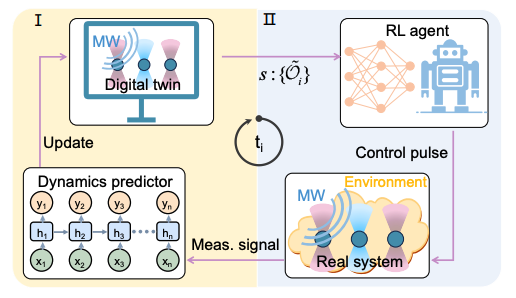
Researchers have developed a new technique, leveraging a “digital twin” protocol, to dramatically improve the precision of quantum sensors, surpassing limitations imposed by environmental noise. Traditional quantum sensors strive for the Heisenberg limit, achieving the highest possible precision, but are easily disrupted by external disturbances that cause rapid decoherence. This new approach overcomes this challenge by creating a virtual copy, or digital twin, of the quantum system being measured. The digital twin learns and predicts the effects of noise on the real system, then adaptively adjusts control strategies to compensate for these disturbances in real time.
Unlike existing methods that require detailed characterization of the noise or additional quantum resources, this protocol autonomously learns from the environment and maintains high precision without needing prior knowledge of the noise itself. Demonstrations across various quantum systems, including discrete qubits, continuous variable systems, and multi-qubit circuits, show the digital twin consistently restores performance to the Heisenberg limit, even in noisy conditions. In experiments with quantum circuits, the team observed a remarkable improvement in precision, achieving double the Heisenberg limit when initialized with a specific entangled state, suggesting the digital twin not only mitigates noise but also enhances the inherent sensitivity of the sensor. Furthermore, the protocol effectively suppresses the diffusion of quantum states caused by noise, maintaining a trajectory closely aligned with an ideal, noise-free evolution.
This is a significant advancement, as many existing techniques struggle to prevent both loss of coherence and the introduction of systematic errors in measurements. The digital twin approach is particularly promising because it requires only a limited number of observable parameters to accurately model the system, making it scalable for more complex quantum sensors. By adaptively compensating for stochastic errors during decoherence, the protocol effectively learns the unique characteristics of the noise affecting each sensor, paving the way for robust and highly precise quantum measurements in real-world applications. This represents a paradigm shift towards noise-immune quantum sensing, compatible with the constraints of current and near-future quantum technologies.
Digital Twin Restores Heisenberg Limit Sensing
This research introduces a digital twin protocol, designed to overcome the limitations imposed by environmental noise on quantum sensors. The team demonstrates that the protocol effectively restores the Heisenberg limit, a benchmark for precision sensing, across diverse physical systems including single atoms, quantum circuits, and continuous variable systems. By learning the dynamics of a real system and building a digital replica, the protocol dynamically compensates for random errors arising from decoherence, thereby enhancing sensing precision. Notably, the protocol achieves this noise resilience without requiring prior knowledge of the noise characteristics or the use of additional qubits, unlike conventional error correction methods.
The protocol’s efficacy extends to scenarios where traditional error correction fails, establishing a new framework for noise suppression applicable to various quantum technologies. The authors also suggest potential applications beyond sensing, including improvements in quantum battery charging, ground state preparation, error correction codes, and entanglement preservation for quantum communication. While the current work focuses on specific systems, the researchers acknowledge that further investigation is needed to explore the protocol’s scalability and performance in more complex quantum devices.
🗞 Learning to Restore Heisenberg Limit in Noisy Quantum Sensing via Quantum Digital Twin
🧠 ArXiv: https://arxiv.org/abs/2508.11198