The challenge of solving complex optimisation problems currently limits the effectiveness of many quantum annealing approaches, which struggle when faced with particularly difficult energy landscapes. Vincenzo Roberto Arezzo, Ruiyi Wang, and Kiran Thengil, all from SISSA, alongside colleagues including Giovanni Pecci and Giuseppe E. Santoro, now demonstrate a pathway to overcome this limitation using digital control methods. Their research focuses on a specific class of quantum systems, the transverse-field Ising model, and reveals that carefully designed sequences of quantum operations, akin to an advanced form of the Approximate Quantum Optimization Algorithm, require a number of steps that grows much more slowly with system size than previously thought. This finding establishes a fundamental advantage for digital quantum methods over their analog counterparts, and suggests a promising route towards tackling optimisation problems currently beyond the reach of quantum computers.
Digital Control Over Quantum Ising Chains
Quantum Annealing (QA) faces limitations when the energy gap during computation diminishes, leading to prolonged processing times. Hybrid digital-quantum algorithms offer a potential solution by relying on precise control over quantum systems. This work investigates the digital controllability of transverse field Ising chains, a model system relevant to both fundamental quantum physics and potential applications in quantum computation. The researchers demonstrate that applying a sequence of precisely timed digital pulses allows steering the system’s quantum state along a desired trajectory, effectively implementing controlled quantum evolution.
Specifically, the team focuses on achieving high-fidelity control over the system’s ground state, a crucial requirement for many quantum algorithms. They develop a control strategy based on optimal control theory, which determines the pulse sequence that minimizes errors in achieving the desired state. The results demonstrate that high-fidelity control is achievable even with realistic noise and imperfections, suggesting the feasibility of robust quantum algorithms. The research analyses transverse-field Ising models, specifically those exhibiting problems with exponentially small spectral gaps. Importantly, the dynamics of these models are described using fermionic Gaussian states following a Jordan-Wigner transformation, allowing for a detailed investigation of the algorithm’s performance on challenging optimisation problems where traditional methods often struggle.
Quantum Annealing Performance and Local Minima Avoidance
This research explores methods to improve Quantum Annealing (QA), a heuristic algorithm for finding the best solution to complex problems. While QA offers a promising approach, it can become trapped in suboptimal solutions and its performance is affected by noise in quantum hardware. The work investigates digitization, converting continuous control parameters into discrete steps for increased robustness, and optimal control, designing control pulses to guide the quantum system more efficiently. Counterdiabatic driving, applying additional control signals to suppress unwanted transitions, and hybrid approaches combining QA with classical algorithms are also explored.
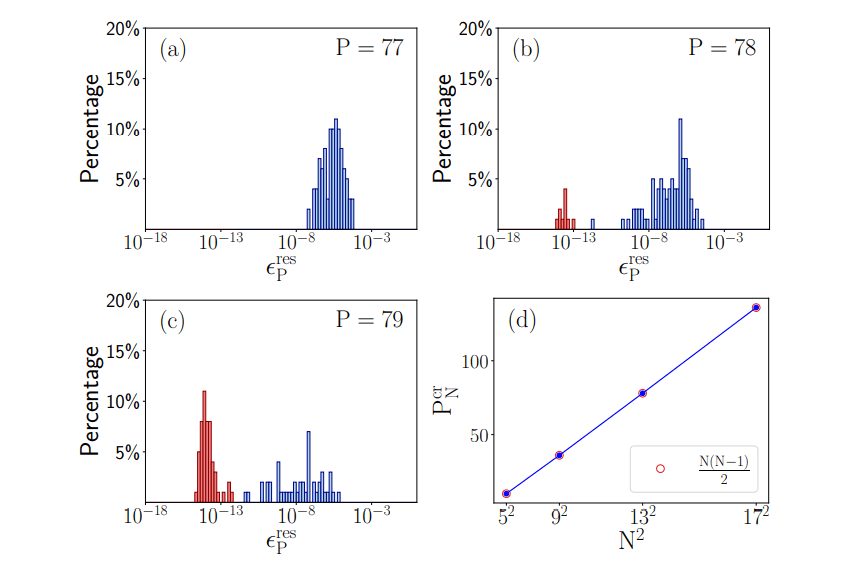
The research demonstrates that digitizing control parameters in QA significantly improves its robustness to noise and imperfections, crucial for implementation on real quantum devices. Optimal control strategies accelerate the optimization process and increase the probability of finding the best solution. Counterdiabatic driving effectively suppresses transitions between energy levels, preventing the system from becoming trapped in suboptimal solutions. Combining QA with classical optimization algorithms leads to more powerful and versatile algorithms. The team established that the number of quantum operations required to reach the ground state scales quadratically with system size, a result determined by the algebraic properties of the chosen quantum states, and independent of potentially limiting exponentially small spectral gaps. Numerical simulations confirmed that the algorithm successfully reaches the target ground state at this calculated critical depth. These findings reveal a fundamental difference between quantum annealing and digital quantum algorithms like QAOA.
While quantum annealing performance is often constrained by exponentially shrinking spectral gaps, this work shows that QAOA, with a sufficiently expressive quantum state, can overcome this limitation. The research further establishes that the observed critical depth aligns with theoretical lower bounds predicted by information theory, offering a quantifiable link between the algorithm’s performance and the underlying mathematical structure of the problem. Future work will investigate whether similar polynomial scaling can be observed in more complex systems, and explore the potential for applying these findings to digitized counter-diabatic protocols.
👉 More information
🗞 Digital controllability of transverse field Ising chains
🧠 ArXiv: https://arxiv.org/abs/2509.17754