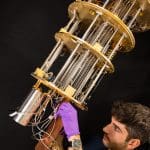
Quantum Transistors has achieved a world-record fidelity rate of 99.9988% utilizing diamond-based quantum processors, marking a crucial step toward broader access to quantum computing. This milestone was accomplished by the company, a pioneer in advanced quantum processor development, and addresses limitations of qubit technologies reliant on expensive, low-Kelvin cryogenic cooling. By employing diamonds as its base quantum material, Quantum Transistors simultaneously achieved improved performance and reduced reliance on cryogenic systems, potentially making scalable, fault-tolerant quantum computers more cost-effective and accessible across industries.
Diamond Processors Enhance Quantum Computing Fidelity
Quantum Transistors has achieved a record-breaking fidelity rate of 99.9988% using diamond-based quantum processors. This advancement is crucial because high fidelity rates are essential for building fault-tolerant quantum machines, paving the way for improved performance and easier deployment across industries. The company’s technology addresses a major challenge in quantum computing – environmental noise that leads to errors and increases costs associated with error correction.
A novel technique developed by Quantum Transistors, called “PUDDINGs” (Power-Unaffected, Double-Detuning-Insensitive Gates), is central to this achievement. PUDDINGs reshape control pulses to protect quantum information, cancelling multiple types of noise simultaneously. This approach drives errors down quadratically, rather than linearly, allowing for significantly faster improvements in fidelity. It also marks the first demonstration of error-protected two-qubit gates in a solid-state system.
Quantum Transistors’ diamond-based processors aim to reduce reliance on expensive cryogenic cooling systems, a significant barrier to wider quantum computing adoption. This technology was recognized with up to €17.5 million in funding from the European Innovation Council, selected from a highly competitive pool of applicants. The company believes this approach will make quantum computing more accessible and practical, boosting computational power without extensive infrastructure requirements.
Reducing Cryogenic Cooling with Diamond-Based Qubits
Quantum Transistors is developing diamond-based quantum processors to address limitations of other qubit technologies. A key challenge in quantum computing is environmental noise, which leads to high error rates and necessitates expensive, low-Kelvin cryogenic cooling for error correction. By utilizing diamonds as a base material, Quantum Transistors aims to reduce this reliance on extensive cryogenic systems while simultaneously achieving the performance needed for scalable quantum computers.
A significant breakthrough is the achievement of a 99.9988% fidelity rate, a nine-fold improvement that eases the path to building more scalable systems. This advancement is enabled by a novel technique called “PUDDINGs” (Power-Unaffected, Double-Detuning-Insensitive Gates). PUDDINGs reshape control pulses, providing layered protection that cancels multiple types of noise, driving errors down quadratically—a more efficient improvement than linear methods.
The company’s technology is designed to boost computational power without requiring extensive cryogenic refrigeration. This is expected to reduce costs and simplify infrastructure requirements for quantum computing. Quantum Transistors was awarded up to €17.5 million by the European Innovation Council, reflecting the potential of their diamond-based approach to make quantum computing more accessible and practical.
This 9-fold improvement in fidelity makes it easier to build more scalable systems that are needed to handle real world challenges.
Shmuel Bachinsky, CEO & Co-Founder of Quantum Transistors
PUDDINGs Technique Protects Quantum Information
Quantum Transistors has achieved a fidelity rate of 99.9988% using diamond-based quantum processors, a crucial step towards scalable quantum computing. This advancement addresses a major challenge in the field: environmental noise that causes errors and necessitates costly error correction. By leveraging diamonds as its base quantum material, the company simultaneously improves performance and reduces reliance on expensive, low-Kelvin cryogenic cooling systems – a significant benefit given over $55 billion has already been invested in quantum computing.
A novel technique called “PUDDINGs” (Power-Unaffected, Double-Detuning-Insensitive Gates) is central to protecting quantum information. PUDDINGs reshape control pulses to operate qubits, offering layered protection that cancels multiple noise types simultaneously. This approach drives errors down quadratically instead of linearly, meaning each refinement yields significantly sharper gains. Notably, it’s the first experimental demonstration of error-protected two-qubit gates within a solid-state system.
The company was awarded up to €17.5 million by the European Innovation Council, selected from a competitive pool of applicants. Quantum Transistors aims to make quantum computing more accessible through its diamond-based processors, potentially reducing infrastructure requirements and costs by minimizing the need for cryogenic refrigeration. This breakthrough places diamond-based qubits on a path toward scalable, fault-tolerant quantum computers.
Source: https://quantumtransistors.com