Researchers are increasingly focused on harnessing the unique properties of diamond to build hybrid quantum systems, and a team led by Hyunseok Oh, Viraj Dharod, and Carl Padgett at the University of California, Santa Barbara, has made a significant advance in this field. They demonstrate a novel optomechanical resonator crafted from diamond, embedding a spin centre to create a promising platform for quantum networking and computing. This device achieves an exceptionally high mechanical quality factor, exceeding one million, and maintains spin coherence for an impressive duration, even while operating across a wide range of optical power levels. This breakthrough, enabled by a new method for growing high-quality diamond, represents a crucial step towards building robust and scalable hybrid quantum systems that effectively couple light, motion, and spin.
Diamond Optomechanical Crystals Fabricated and Characterized
Researchers have successfully created high-quality diamond optomechanical crystal (OMC) resonators, significantly improving the fabrication process with a refined “smart-cut” method. This technique enhances device yield and reduces manufacturing time. Detailed measurements reveal exceptional optical and mechanical properties, including high mechanical quality factors and low mechanical damping, highlighting the potential of diamond for advanced quantum optomechanics applications.
Smart-Cut Fabrication of Single-Crystal Diamond Films
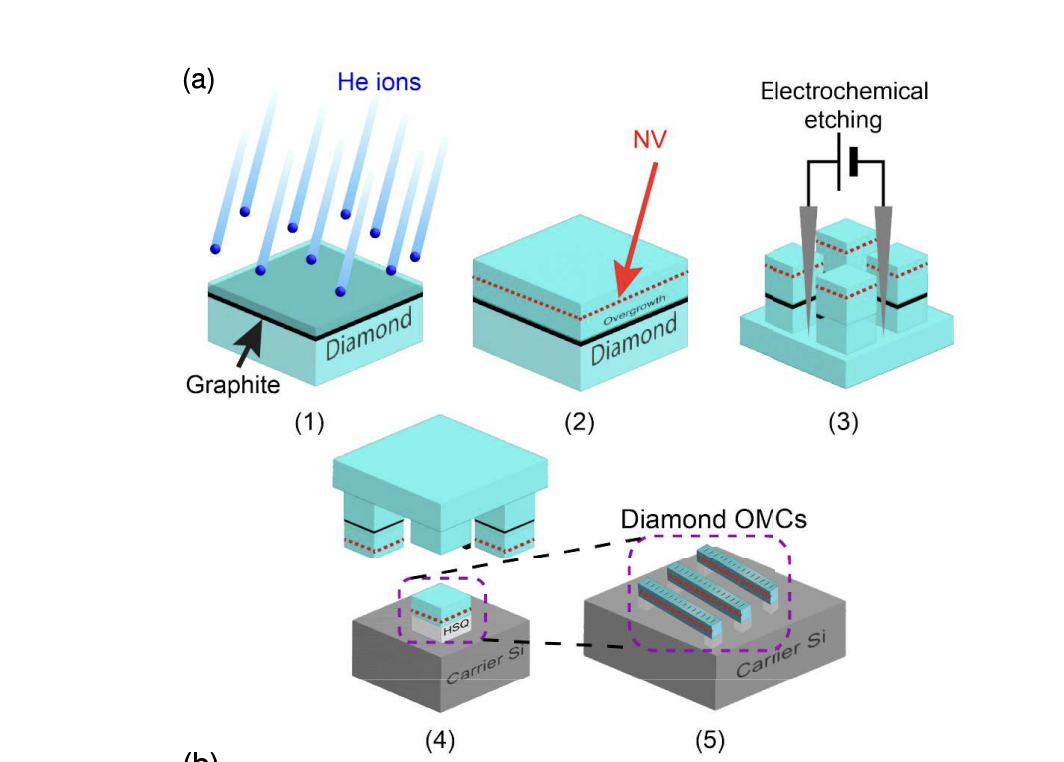
Researchers developed a novel approach to fabricate diamond-based devices integrating optical, mechanical, and spin properties, paving the way for advancements in quantum technologies. Recognizing diamond’s exceptional characteristics and its ability to host coherent defect-center spins, the team focused on creating high-quality, uniform thin films of single-crystal diamond. They employed a refined “smart-cut” technique to separate a thin, uniform layer of diamond from a bulk crystal, providing a pristine foundation for device fabrication. This process strategically introduces a subsurface damaged layer, which is then selectively removed, allowing for the clean separation of a consistently thin diamond membrane crucial for high-throughput manufacturing.
Following the smart-cut process, the researchers utilized chemical vapor deposition (CVD) to grow additional diamond material onto the thin membrane, further refining its structure and properties. This combination of techniques overcomes limitations of previous methods, such as variations in membrane thickness, and enables the creation of large-area, uniform films suitable for nanoscale device fabrication. The resulting diamond membranes were then engineered into optomechanical crystals (OMCs), structures designed to co-localize optical and mechanical modes with high quality factors, essential for controlling mechanical motion at the quantum level. By carefully designing the OMC structure, the team maximized the interaction between light and mechanical vibrations, achieving a high optomechanical cooperativity, a key metric indicating the strength of this interaction. This strong coupling, combined with the long coherence times of embedded spin centers, positions these devices as promising platforms for quantum sensing, quantum memories, and quantum transduction, potentially enabling new avenues for quantum information processing and networking.
Long-lived Mechanical Coherence in Diamond Crystals
Researchers have achieved a significant advance in the development of hybrid quantum systems by creating diamond-based optomechanical crystals (OMCs) with exceptional mechanical properties and long-lived quantum coherence. These devices combine the strengths of solid-state spins with the precisely controlled motion of nanoscale mechanical oscillators, opening new possibilities for quantum networking and sensing. The team successfully engineered structures exhibiting mechanical motion that persists for an unusually long time, exceeding 270 microseconds, a crucial factor for maintaining quantum information. A key innovation lies in the fabrication process, which utilizes a “smart-cut” method to create thin, high-quality diamond membranes, followed by diamond overgrowth using chemical vapor deposition.
This approach allows for the creation of uniform, large-area structures essential for consistent device performance and high-throughput manufacturing. The resulting OMCs demonstrate mechanical quality factors exceeding one million, indicating minimal energy loss and sustained mechanical oscillations, and optical quality factors of over thirty-seven thousand. This combination of properties places these devices firmly in the “resolved-sideband regime”, where mechanical and optical modes can be individually controlled and strongly coupled. The high mechanical quality factor and long coherence times are particularly noteworthy, as they significantly outperform previous diamond-based devices and approach the performance of silicon-based OMCs.
Importantly, the team demonstrated robust performance across a wide range of optical power levels, indicating the devices are capable of handling substantial energy without degradation. The resulting optomechanical cooperativity is sufficiently high to enable strong, coherent interactions essential for many quantum protocols. These advancements pave the way for creating complex quantum systems where information can be stored in the spin of defects within the diamond, transferred to the mechanical motion of the crystal, and then potentially coupled to photons for long-distance communication. The ability to precisely control both the optical and mechanical properties of these devices, combined with the long coherence times, positions them as promising building blocks for future quantum technologies, including highly sensitive sensors and secure quantum networks.
Diamond Nanocrystals Couple Light, Motion, and Spin
The research demonstrates the successful fabrication of diamond optomechanical crystal (OMC) devices with high mechanical quality factors, exceeding 1. 9 million, and optical quality factors that allow operation in the resolved-sideband regime. These devices embed nitrogen-vacancy (NV) centers, enabling coherent interactions between mechanical motion, optical photons, and electron spins. Crucially, the team achieved these results while preserving the long coherence times, up to 227 microseconds, of the embedded NV centers, a significant challenge in the field. This advance stems from a robust method combining diamond smart-cut techniques with chemical vapor deposition to create uniformly thin, high-quality nanoscale diamond membranes.
The resulting devices exhibit a high optomechanical cooperativity of 54, even with substantial intracavity optical power, and demonstrate operation at exceptionally high circulating photon numbers. This combination of properties positions diamond OMCs as promising platforms for mediating interactions in hybrid quantum systems and advancing applications in networking and computing. Further investigation is needed to fully understand and mitigate sources of mechanical damping and coherence, particularly those related to surface imperfections and the device’s thermal environment. Future work will focus on pulsed measurements to explore these loss mechanisms and improve the performance of diamond OMCs for quantum sensing applications.
🗞 A spin-embedded diamond optomechanical resonator with mechanical quality factor exceeding one million
🧠 ArXiv: https://arxiv.org/abs/2508.05906