

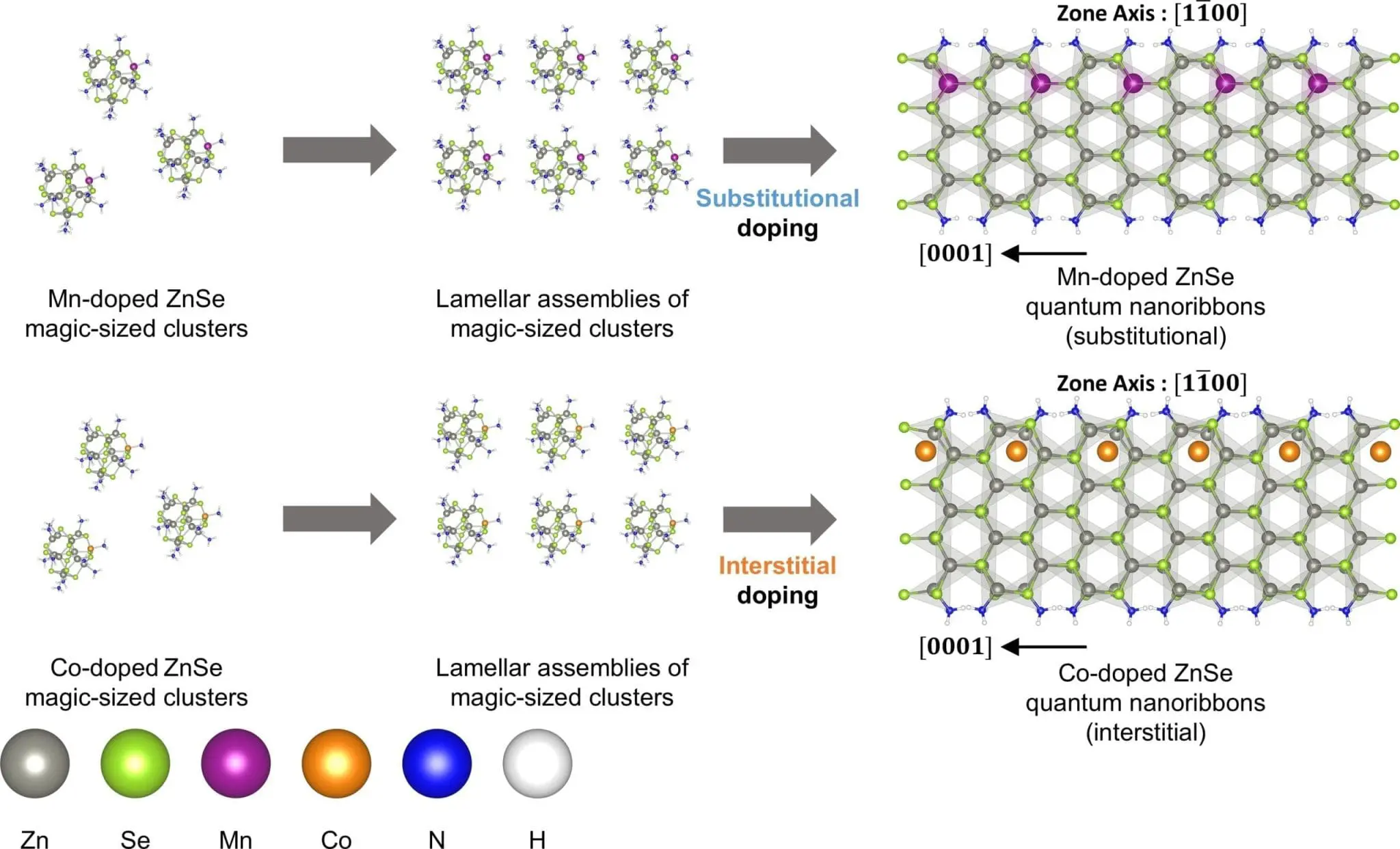
Researchers at the Daegu Gyeongbuk Institute of Science and Technology, led by Professor Jiwoong Yang, have made a crucial advancement in semiconductor technology. In collaboration with Stefan Ringe’s team at Korea University, they developed a new method to control doping in semiconductor nanocrystals, which is expected to enhance the performance of advanced electronic devices such as displays and transistors.
This breakthrough was achieved by inducing doping at the nucleus phase, allowing for stable and precise doping in ZnSe semiconductor nanocrystals. Professor Yang’s work has significant implications for the design and fabrication of optoelectronic devices, including next-generation displays and transistors.
The study, funded by the National Research Foundation of Korea and the Ministry of Trade, Industry and Energy, was published in the renowned journal Small Science, and paves the way for the development of innovative devices with precise doping control technology, potentially replacing heavy metals like cadmium with more environmentally friendly alternatives.
Introduction to Semiconductor Nanocrystals and Doping Technology
The development of advanced technologies, such as displays and transistors, has sparked significant interest in precise doping control in nanoscale semiconductors. Semiconductor nanocrystals, particularly those based on II-VI materials, have been extensively studied due to their exceptional optical and electrical properties. However, one major challenge in semiconductor technology is the low doping efficiency in small semiconductors, such as nanocrystals. This issue arises because dopants tend to be absorbed onto the surface of a semiconductor during its growth, rather than penetrating its interior effectively.
To address this problem, researchers have been exploring new methods for controlling doping in semiconductor nanocrystals. Recently, Professor Jiwoong Yang and his research team at the Department of Energy Science and Engineering, Daegu Gyeongbuk Institute of Science & Technology (DGIST), developed a novel technology to control doping at the nucleus phase, which increases the performance of semiconductor nanocrystals. This study was conducted in collaboration with a research team led by Stefan Ringe at the Department of Chemistry, Korea University. The research revealed how the doping process and location differ depending on the type of doping element used.
The developed technology is expected to have a significant impact on the production of advanced electronic devices, such as displays and transistors. By enabling precise control over doping in semiconductor nanocrystals, this technology can help improve the performance and efficiency of these devices. Furthermore, the study demonstrated the potential for practical applications while also addressing environmental concerns by eliminating the use of heavy metals. The findings of this research will serve as important foundational data for designing and fabricating optoelectronic devices, such as next-generation displays and transistors.
The study was funded by several organizations, including the National Research Foundation of Korea’s Excellent New Research Project, the Ministry of Trade, Industry and Energy’s Korea-US International Joint Technology Development Project, and the DGIST Sensorium Institute. The findings were published in January 2025 in Small Science, a renowned journal in the field of materials science. The research paper, titled “Nucleation-Controlled Doping of II-VI Semiconductor Nanocrystals Mediated by Magic-Sized Clusters,” provides a detailed account of the study’s methodology and results.
Understanding Doping in Semiconductor Nanocrystals
Doping is a critical process in semiconductor technology, as it allows for the introduction of impurities into a semiconductor material to modify its electrical properties. In the context of semiconductor nanocrystals, doping can be used to control the conductivity, luminescence, and other properties of these materials. However, doping in small semiconductors, such as nanocrystals, is challenging due to the low doping efficiency. This issue arises because dopants tend to be absorbed onto the surface of a semiconductor during its growth, rather than penetrating its interior effectively.
To overcome this challenge, researchers have been exploring new methods for controlling doping in semiconductor nanocrystals. One approach is to use a controlled nucleation doping method, which induces doping at the “nanocluster” phase, a stage preceding nanocrystal growth. This technique allows for stable and precise doping in semiconductor nanocrystals, enabling the control of their electrical properties. The research team led by Professor Yang developed such a method, which involves the use of magic-sized clusters to mediate the doping process.
The study revealed that the doping process and location differ depending on the type of doping element used. This finding is significant, as it provides insight into the mechanisms underlying doping in semiconductor nanocrystals. By understanding how different dopants interact with the semiconductor material, researchers can design more effective doping strategies for specific applications. Furthermore, the study demonstrated the potential for practical applications while also addressing environmental concerns by eliminating the use of heavy metals.
The use of magic-sized clusters to mediate the doping process is a key aspect of the developed technology. Magic-sized clusters are small, stable clusters of atoms that can be used to control the growth of semiconductor nanocrystals. By using these clusters to introduce dopants into the semiconductor material, researchers can achieve precise control over the doping process. This approach enables the production of high-quality semiconductor nanocrystals with tailored electrical properties.
Controlled Nucleation Doping Method
The controlled nucleation doping method developed by Professor Yang’s research team involves the use of magic-sized clusters to mediate the doping process. This technique allows for stable and precise doping in semiconductor nanocrystals, enabling the control of their electrical properties. The method involves the introduction of dopants into the semiconductor material during the growth of the nanocrystals.
The use of magic-sized clusters is a critical aspect of this method. These clusters are small, stable clusters of atoms that can be used to control the growth of semiconductor nanocrystals. By using these clusters to introduce dopants into the semiconductor material, researchers can achieve precise control over the doping process. This approach enables the production of high-quality semiconductor nanocrystals with tailored electrical properties.
The controlled nucleation doping method has several advantages over traditional doping methods. One major advantage is the ability to achieve precise control over the doping process, enabling the production of high-quality semiconductor nanocrystals with tailored electrical properties. Another advantage is the potential for practical applications while also addressing environmental concerns by eliminating the use of heavy metals.
The study demonstrated the effectiveness of the controlled nucleation doping method using II-VI semiconductor nanocrystals. The research team used this method to produce high-quality nanocrystals with tailored electrical properties. The findings of this study provide insight into the mechanisms underlying doping in semiconductor nanocrystals and demonstrate the potential for practical applications.
Applications and Future Directions
The developed technology has significant implications for the production of advanced electronic devices, such as displays and transistors. By enabling precise control over doping in semiconductor nanocrystals, this technology can help improve the performance and efficiency of these devices. Furthermore, the study demonstrated the potential for practical applications while also addressing environmental concerns by eliminating the use of heavy metals.
The findings of this research will serve as important foundational data for designing and fabricating optoelectronic devices, such as next-generation displays and transistors. The controlled nucleation doping method developed by Professor Yang’s research team can be used to produce high-quality semiconductor nanocrystals with tailored electrical properties, enabling the creation of advanced electronic devices with improved performance and efficiency.
Future studies can build on this research by exploring the application of the controlled nucleation doping method to other types of semiconductor materials. Additionally, researchers can investigate the use of different dopants and magic-sized clusters to further optimize the doping process. The development of new technologies and methods for controlling doping in semiconductor nanocrystals will continue to play a critical role in advancing the field of electronics and optoelectronics.
The study’s findings also highlight the importance of interdisciplinary research collaborations. The collaboration between Professor Yang’s research team and Stefan Ringe’s research team at Korea University demonstrates the value of combining expertise from different fields to tackle complex research challenges. Such collaborations can lead to innovative solutions and breakthroughs in various areas of science and technology.
External Link: Click Here For More


