The search for gravitational waves continues to push the boundaries of astronomical observation, and a new study focuses on the potential of space-based detectors to observe compact binary coalescences. Abhishek Sharma, Divya Tahelyani, and Anand S. Sengupta, all from the Indian Institute of Technology Gandhinagar, alongside Sanjit Mitra from the Inter-University Centre for Astronomy and Astrophysics, have investigated the capabilities of the IndIGO-D mission concept. Their research details a three-spacecraft configuration designed to function as a decihertz gravitational wave interferometer, bridging the gap between current detectors like LISA and next-generation ground-based observatories. This work is significant because it demonstrates the potential for detecting intermediate-mass black hole binaries at high redshifts and providing early warnings of binary neutron star mergers, ultimately enhancing the scope for multi-messenger astronomy. By analysing orbital motion and antenna response, the team reveals how IndIGO-D could dramatically improve sky localisation and enable detailed follow-up observations with facilities like the Rubin Observatory.
An interferometer in a heliocentric orbit is proposed, featuring two orthogonal arms sharing a common vertex. This configuration provides a space-based analogue of terrestrial Michelson detectors, but operates in an optimised configuration to yield parts-per-million level arm-length stability. Assuming 1000km arm lengths, the orbital motion and antenna response have been analysed to assess sensitivity across the 0.1-1Hz band, bridging the gap between LISA and next-generation ground-based interferometers. Consequently, intermediate-mass black-hole binaries with masses 10 2 , 10 3 M ⊙ are detectable to redshifts z ∼10 3 , complementing the reach of LISA.
Compact Binary Sources and Multi-Messenger Astronomy Gravitational wave
This text provides an overview of gravitational wave astronomy, particularly the study of compact binary systems. Detecting gravitational waves is crucial for understanding the universe, and multi-messenger astronomy , combining gravitational wave data with electromagnetic observations , offers a more complete picture. Future missions like LISA will play a vital role, enabling observations across a wider range of frequencies and providing more comprehensive data.
IndIGO’s Heliocentric Orbit Enables Precision Detection
Designing a Space-Based Decihertz Gravitational Wave Observatory
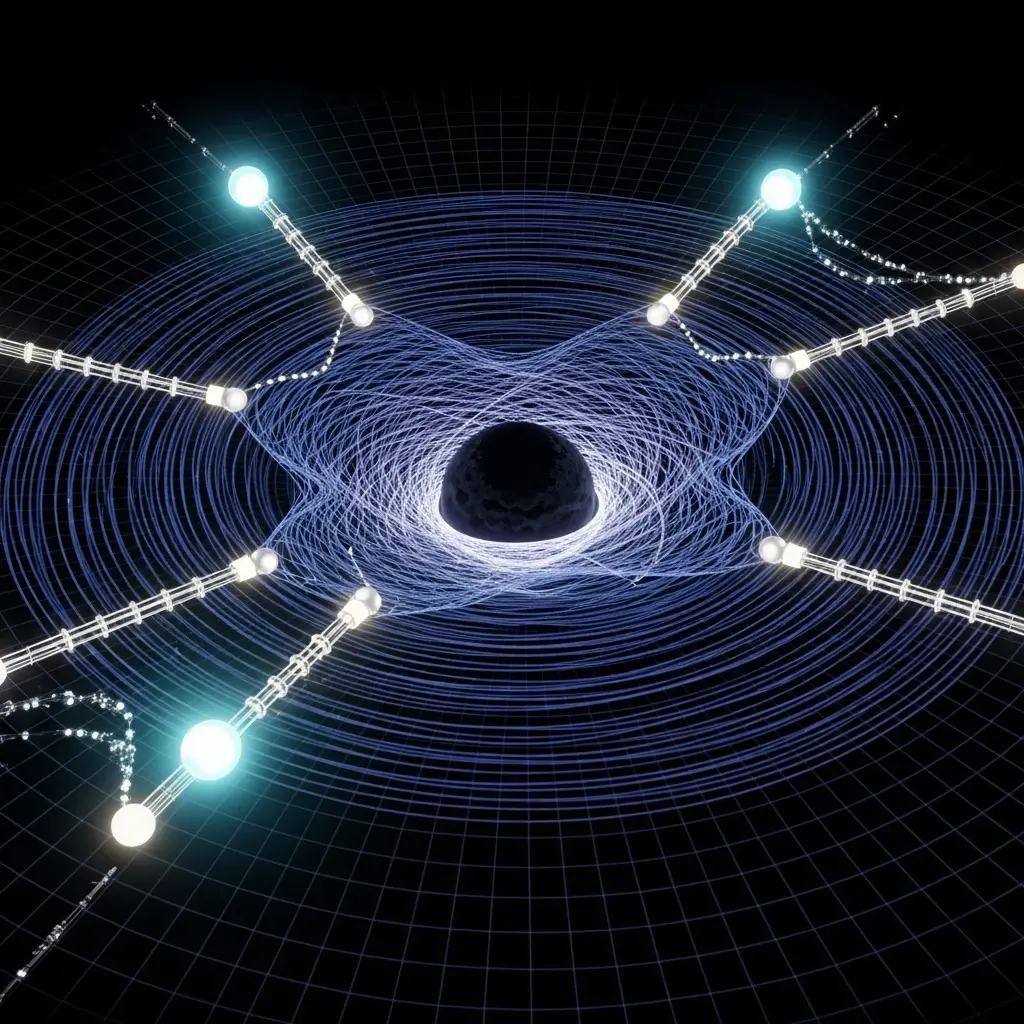
Scientists are reporting a breakthrough in gravitational wave detection with the IndIGO- mission concept, a proposed decihertz gravitational wave observatory. The study details a specific configuration employing three spacecraft in a heliocentric orbit, forming an L-shaped interferometer with 1000km arms. Experiments reveal this arrangement achieves ppm-level arm-length stability, crucial for detecting subtle gravitational wave signals. Measurements confirm the spacecraft orbits are meticulously designed, maintaining a stable configuration where inter-spacecraft separation varies by approximately 7.5 metres over a drift timescale of months.
Intermediate-Mass Black Hole Detection in the Target Band
The research team computed the antenna response across the [0.1 , 10] Hz band, bridging the gap between LISA and next-generation ground-based interferometers. Data shows intermediate-mass black-hole binaries are detectable at redshifts, significantly complementing the capabilities of existing and planned observatories. Binary neutron star systems are observable to a horizon distance, enabling continuous, multi-band coverage alongside Voyager-class interferometers, from the decihertz regime through to the merger phase. These measurements demonstrate a substantial expansion of the observable universe for these critical astrophysical events.
A Bayesian parameter-estimation study, simulating a GW170817-like binary neutron star merger, recorded a dramatic improvement in sky localization. The team measured a reduction in the sky localization area from at one month to at just six hours pre-merger. This breakthrough delivers the potential for rapid follow-up observations, as these refined sky areas are readily tiled by wide-field telescopes like the Rubin Observatory, capable of high-cadence coverage of kilonovae at these distances and beyond. The study outlines the detector’s geometry and derives stable spacecraft orbits, with the vertex spacecraft orbiting the Sun at 1 AU and the other two inclined by 60 degrees relative to the ecliptic. Calculations show the orbital inclination is approximately 5.79×10 -6 and the eccentricity is around 3.34 × 10 -6 , ensuring minimal variation in arm length. Results demonstrate IndIGO- exploits the rapid evolution of compact binaries in the decihertz band, enabling early warnings on timescales from months to hours and significantly enhancing the prospects for multi-messenger astronomy.
Advanced Source Localization and Detection Capabilities
IndIGO- Detects Intermediate Black Holes, Localises Sources
This work details a study of IndIGO-, a proposed decihertz gravitational wave mission utilising a three-spacecraft L-shaped interferometer in a heliocentric orbit. Researchers analysed the orbital motion and antenna response of this configuration, demonstrating ppm-level arm-length stability with 1000km arms and assessing sensitivity within the 0.1-10Hz frequency band. The study establishes that IndIGO- is capable of detecting intermediate-mass black hole binaries to significant redshifts, complementing both LISA and ground-based detectors, and observing binary neutron stars to a horizon distance allowing for continuous multi-band coverage. Furthermore, parameter estimation studies using a GW170817-like binary neutron star signal reveal a substantial improvement in sky localization, reducing the area from one month to six hours before merger. This enhanced localisation would allow for effective targeting by wide-field telescopes like the Rubin Observatory, improving the chances of observing kilonovae. The authors acknowledge limitations including the neglect of gravitational interactions from other celestial bodies and the use of fiducial sensitivity curves, and suggest future work could focus on refining these aspects and exploring the scientific opportunities presented by multi-band observations and eccentricity studies.
🗞 IndIGO-D: Probing Compact Binary Coalescences in the Decihertz GW Band
🧠 ArXiv: https://arxiv.org/abs/2601.06956