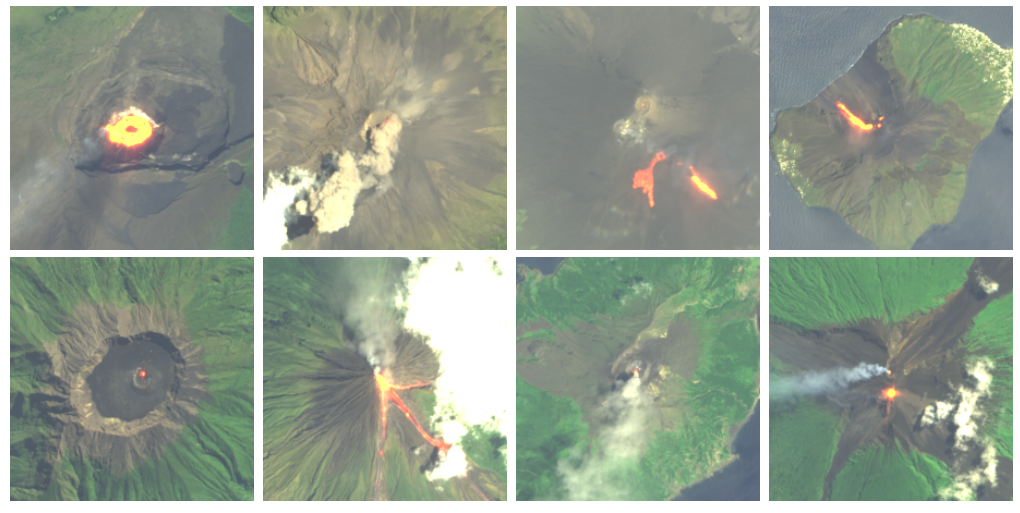
Volcanic eruptions represent a persistent threat to communities and economies worldwide, yet current monitoring systems often struggle to provide timely warnings. Darshana Priyasad, Tharindu Fernando, Maryam Haghighat, and colleagues at Queensland University of Technology address this challenge by introducing a comprehensive dataset and benchmark for detecting volcanic activity directly on board small satellites. This work overcomes a critical limitation in the field, the lack of annotated data necessary to train robust detection systems, and encompasses a diverse range of volcanic phenomena including temperature changes, eruptions, and ash plumes. By demonstrating the feasibility of onboard detection using specialised hardware, the team establishes a pathway towards significantly reduced response times and the development of advanced early warning systems, promising a transformative impact on volcanic disaster management.
Satellites, capable of constellation-based operations, offer unparalleled opportunities for near-real-time monitoring and onboard processing of volcanic events. A major bottleneck remains the lack of extensive annotated datasets capturing volcanic activity, hindering the development of robust detection systems. This research introduces a novel dataset explicitly designed for volcanic activity and eruption detection, encompassing diverse volcanoes worldwide. The dataset provides binary annotations to identify volcanic anomalies or non-anomalies, covering phenomena such as temperature anomalies, eruptions, and volcanic ash emissions. These annotations offer a foundational resource for developing and validating algorithms designed to automatically identify and characterise volcanic unrest. By providing a standardised and readily available dataset, researchers can now focus on refining detection methodologies and enhancing our understanding of volcanic processes.
Onboard Artificial Intelligence for Earth Observation
This work details a research project focused on deploying onboard artificial intelligence for Earth observation, specifically for volcanic eruption detection, wildfire monitoring, and cloud/water body identification. The core idea is to move AI processing onto satellites, rather than relying solely on ground-based processing, to enable faster response times, reduce data transmission requirements, and facilitate real-time analysis. Traditional Earth observation systems send large volumes of data to ground stations for processing, creating latency and bandwidth bottlenecks. This project overcomes these limitations by implementing AI algorithms directly on satellites to perform initial data analysis and identify events of interest.
The research explores several AI applications, including identifying thermal anomalies indicative of volcanic activity, detecting and tracking wildfires using hyperspectral imagery, and segmenting satellite images to identify clouds and water bodies. The team utilizes various deep learning models, including convolutional neural networks for image analysis, Swin Transformers for hierarchical vision processing, and MobileNetV3 for efficient model deployment on resource-constrained satellites. They also employ knowledge distillation, a technique to compress large models into smaller, more efficient ones without significant performance loss. This cutting-edge effort aims to bring the power of AI directly to space, enabling more responsive and efficient Earth observation capabilities.
Volcanic Anomaly Dataset for Satellite Monitoring
This research presents a novel dataset designed for detecting volcanic activity and eruptions, addressing a critical need for annotated data in this field. Researchers compiled 3,383 images from 35 volcanoes across six continents, capturing diverse volcanic behaviours and geographic locations. The dataset includes both SWIR-augmented RGB images and 9-channel MSI cubes, providing a comprehensive resource for model training and benchmarking. Images were acquired at three distinct Ground Sampling Distances (GSD): 10m, 20m, and 75m, mirroring the capabilities of next-generation small-satellites like Kanyini.
The dataset’s composition includes 2,153 non-anomaly images and 1,230 anomaly images, sourced from the selected volcanoes. Researchers meticulously processed Sentinel-2 Level-1C data, normalising and clipping bands to manage saturated pixels and preserve spectral information. Manual inspection and annotation were performed to identify volcanic anomalies, excluding images where volcanic fumes were indistinguishable from clouds to maintain data consistency. The resulting dataset was then split into training, validation, and test sets containing 2,343, 311, and 729 samples, respectively. To demonstrate the feasibility of onboard volcanic activity detection, the team tested optimised deep convolutional neural networks on the Intel Movidius Myriad X Vision Processing Unit (VPU), the processing hardware used in the Kanyini satellite. This testing confirms the potential for real-time analysis and early warning systems, significantly reducing latency and enhancing response times.
Volcanic Anomaly Detection Onboard Next-Generation Satellites
This research demonstrates the potential for real-time detection of volcanic activity directly on next-generation satellites, addressing a significant limitation in current monitoring capabilities. Scientists have developed a novel dataset, based on Sentinel-2 satellite imagery, covering 35 volcanoes across six continents, and used it to train and benchmark deep learning models for anomaly detection. Results validate the effectiveness of these models under various imaging conditions, achieving high accuracy in identifying volcanic anomalies and eruptions. Furthermore, the team successfully tested the deployment of these models on the Intel Movidius Myriad X VPU, confirming the feasibility of onboard implementation and paving the way for reduced latency and faster response times in early warning systems. This achievement represents a substantial step towards robust and scalable satellite-based volcanic monitoring solutions. Future work will focus on extending this research to include volcanic event forecasting and the implementation of real-time monitoring within constellations of small satellites, ultimately improving impact mitigation and disaster response.
🗞 Transforming volcanic monitoring: A dataset and benchmark for onboard volcano activity detection
🧠 ArXiv: https://arxiv.org/abs/2510.22889