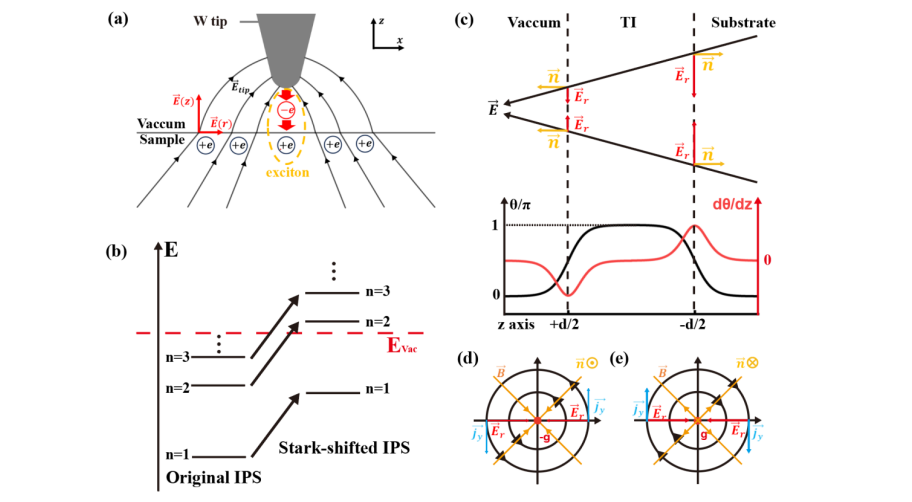
The search for magnetic monopoles, isolated magnetic charges predicted by advanced theoretical physics, continues to challenge scientists, as direct experimental evidence remains elusive. Now, Yang Zhan, Huaiyu Zhang, Yu Wang, and colleagues demonstrate a groundbreaking method for both inducing and detecting these monopoles on the surface of a specific three-dimensional insulator. The team successfully observes electric field-dependent splitting of image potential states on the surface of bismuth(111), a high-order topological insulator, revealing the signature of orbital magnetic moments interacting with a magnetic field generated by the induced monopoles. This achievement not only advances our understanding of fundamental field theory and exotic materials known as axion insulators, but also establishes a new pathway for detecting and manipulating these elusive particles, potentially paving the way for novel electronic devices.
by theories beyond the standard model but remain elusive in experimental detection. In this study, researchers demonstrate a novel method to induce and detect magnetic monopoles on the surface of three-dimensional topological insulators using scanning tunneling microscopy. By applying a radially distributed electric field via the STM tip, they induce image magnetic monopoles using the topological magnetoelectric effect, observing electric field-dependent splitting of image potential states on the surface of Bi(111). These splitting phenomena originate from the interaction between orbital magnetic moments and the magnetic field created by the induced monopole.
Detecting Magnetic Monopoles with Scanning Tunneling Microscopy
Scientists pioneered a novel method to induce and detect magnetic monopoles on the surface of three-dimensional topological insulators using scanning tunneling microscopy. The study harnessed the topological magnetoelectric effect, applying a radially distributed electric field via the STM tip to generate image magnetic monopoles, and then observed the resulting effects on image potential states on the surface of a bismuth crystal. This approach overcomes previous limitations in applying sufficiently strong electric fields and developing appropriate characterization techniques. Researchers meticulously investigated image potential states, which represent Rydberg-like energy levels formed by electron-hole pairs, and observed how these states respond to the induced electric field.
The team engineered a vacuum-topological insulator-substrate structure, leveraging the distinct topological properties of each layer to facilitate monopole generation and detection. Specifically, the STM tip created a tunneling junction, allowing electrons to traverse the vacuum barrier and form a current when a voltage was applied. By precisely controlling the tip’s position and voltage, scientists generated a radially distributed electric field on the Bi(111) surface, inducing the formation of image magnetic monopoles. The orbital magnetic moment of the image potential states then coupled with the magnetic field generated by these monopoles, resulting in a measurable Zeeman splitting of the energy levels. The team validated their findings through theoretical modeling, demonstrating a strong correlation between the predicted image potential state behavior and the experimental results, providing compelling evidence for the successful detection of magnetic monopoles and opening new avenues for exploring exotic magnetic fields.
Topological Monopoles and Bismuth Surface States
This research details the observation and theoretical explanation of monopole-like behavior and image potential states on the surface of bismuth and bismuth selenide thin films. The researchers used scanning tunneling microscopy to investigate these surface states and propose a mechanism linking topological properties with the emergence of monopole-like excitations. Key findings reveal unique features in STM data, interpreted as evidence of monopole-like excitations arising from the topological surface states of bismuth, directly linked to the material’s inherent topological properties. The researchers developed a theoretical model to explain the observed phenomena, connecting the topological surface states with the emergence of monopole-like excitations and the behavior of image potential states. By comparing the image potential state behavior on Bi(111) and Bi₂Se₃, they highlighted key differences and similarities, demonstrating the ability to map image potential states by utilizing the Stark shift and precisely controlling the tip-sample distance with the STM feedback loop. This research provides new insights into the interplay between topology, surface states, and electronic properties of bismuth-based materials, potentially impacting the development of novel electronic devices and the exploration of topological phenomena.
Magnetic Monopoles Detected on Topological Insulators
This research successfully demonstrates a novel method for generating and detecting magnetic monopoles on the surface of three-dimensional topological insulators using scanning tunneling microscopy. By applying a radially distributed electric field, the team observed electric field-dependent splitting of image potential states, originating from the interaction between orbital magnetic moments and the magnetic fields generated by the induced monopoles. These experimental observations, supported by theoretical modeling, strongly suggest the successful detection of these magnetic monopole fields within a solid-state system, representing a significant advancement in understanding topological insulators and magnetic monopole research. The findings not only confirm the existence of magnetic monopoles in this specific system but also establish a promising platform for investigating their properties and exploring potential applications. The authors acknowledge that extending this method to other topological insulator systems and exploring magnetic doping or heterojunctions could provide further routes for modulating and interacting with these monopoles, potentially paving the way for advancements in quantum computing and novel electronic devices.
🗞 Detection of magnetic monopole in image potential states of topological insulators
🧠 ArXiv: https://arxiv.org/abs/2509.24648