

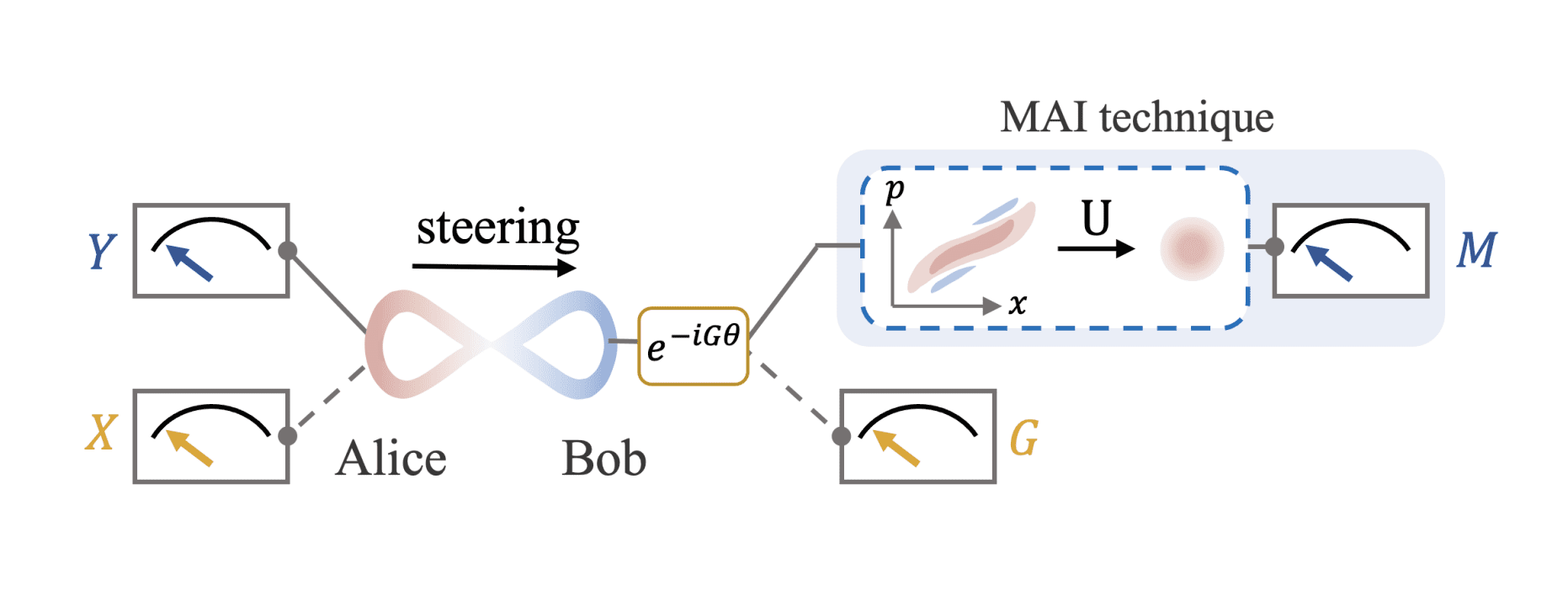
Detecting subtle quantum correlations remains a central challenge in quantum physics, with implications for secure communication and advanced quantum technologies. Jiajie Guo, Feng-Xiao Sun, and Matteo Fadel, from Peking University and ETH Zurich, alongside Qiongyi He, now demonstrate a significant advance in this field. Their research reveals that employing measurement-after-interaction protocols, additional steps performed before measurement, dramatically improves the ability to detect specific quantum phenomena, namely Einstein-Podolsky-Rosen steering and mode entanglement, even in states that don’t follow simple Gaussian distributions. This innovative approach not only enhances detection capabilities but also provides a substantially more robust method against noise, paving the way for more reliable and practical quantum applications.
Detecting Non-Gaussian Correlations with Interactions
Researchers are improving the detection of non-Gaussian quantum correlations, a crucial step for advancing quantum technologies. This study demonstrates that measurement-after-interaction protocols effectively detect these correlations, even with noise, a common challenge in real-world quantum systems. The research builds upon existing methods, specifically targeting correlations arising from non-Gaussian states, which are more complex than Gaussian states. The team developed a theoretical framework to analyse the performance of these protocols, allowing optimisation of experimental parameters to maximise detection efficiency. The results show these protocols outperform traditional methods with weak or noisy correlations, providing a new understanding of how to detect and quantify these correlations, essential for developing advanced quantum communication, computation, and sensing technologies. This work offers a practical guide for implementing these protocols in experiments.
Driven-Dissipative System Enhances Parameter Estimation
This research demonstrates a new protocol that exploits the unique properties of a driven-dissipative system to achieve enhanced precision in parameter estimation. The experimental setup uses a superconducting qubit strongly coupled to a high-quality microwave resonator, which serves as a sensitive probe of the qubit’s state. The qubit is continuously driven with a microwave tone, and the resulting steady-state population is carefully controlled to optimise measurement sensitivity. To implement the protocol, the qubit undergoes a series of carefully timed interactions with the microwave drive before a final readout measurement. Analysing the statistics of these measurements allows for high-precision estimation of the parameter of interest, performed at cryogenic temperatures to minimise thermal noise.
Measurement-Assisted Interrogation Enhances Steering Detection
Researchers have demonstrated that Measurement-Assisted Interrogation (MAI) significantly improves the detection of EPR steering and entanglement in split spin squeezed states. The team investigated several criteria, including Reid’s Criterion and a criterion based on Quantum Fisher Information. The team showed that applying a squeezing operation improves the sensitivity of the steering and entanglement criteria, making them more robust to detection noise. This work provides a mathematically rigorous analysis of the problem and demonstrates that MAI consistently improves sensitivity. Potential areas for further exploration include experimental verification and applications in quantum communication, sensing, and computation.
Enhanced Detection of Quantum Steering and Entanglement
Researchers have developed a technique to significantly improve the detection of subtle quantum correlations, specifically Einstein-Podolsky-Rosen steering and mode entanglement. This advancement centres on performing additional evolutions of the quantum state before measurement, a process known as a measurement-after-interactions protocol. The research establishes a clear advantage for this technique in identifying non-Gaussian correlations, crucial for many quantum technologies. By applying this method, scientists can achieve improved detection capabilities without requiring changes to existing experimental setups. This makes the technique readily applicable to current experiments utilising atomic ensembles and electromagnetic fields. Future work could potentially extend this approach to the detection of more complex quantum phenomena.
👉 More information
🗞 Detection of non-Gaussian quantum correlations through measurement-after-interaction protocols
🧠 ArXiv: https://arxiv.org/abs/2510.26760

