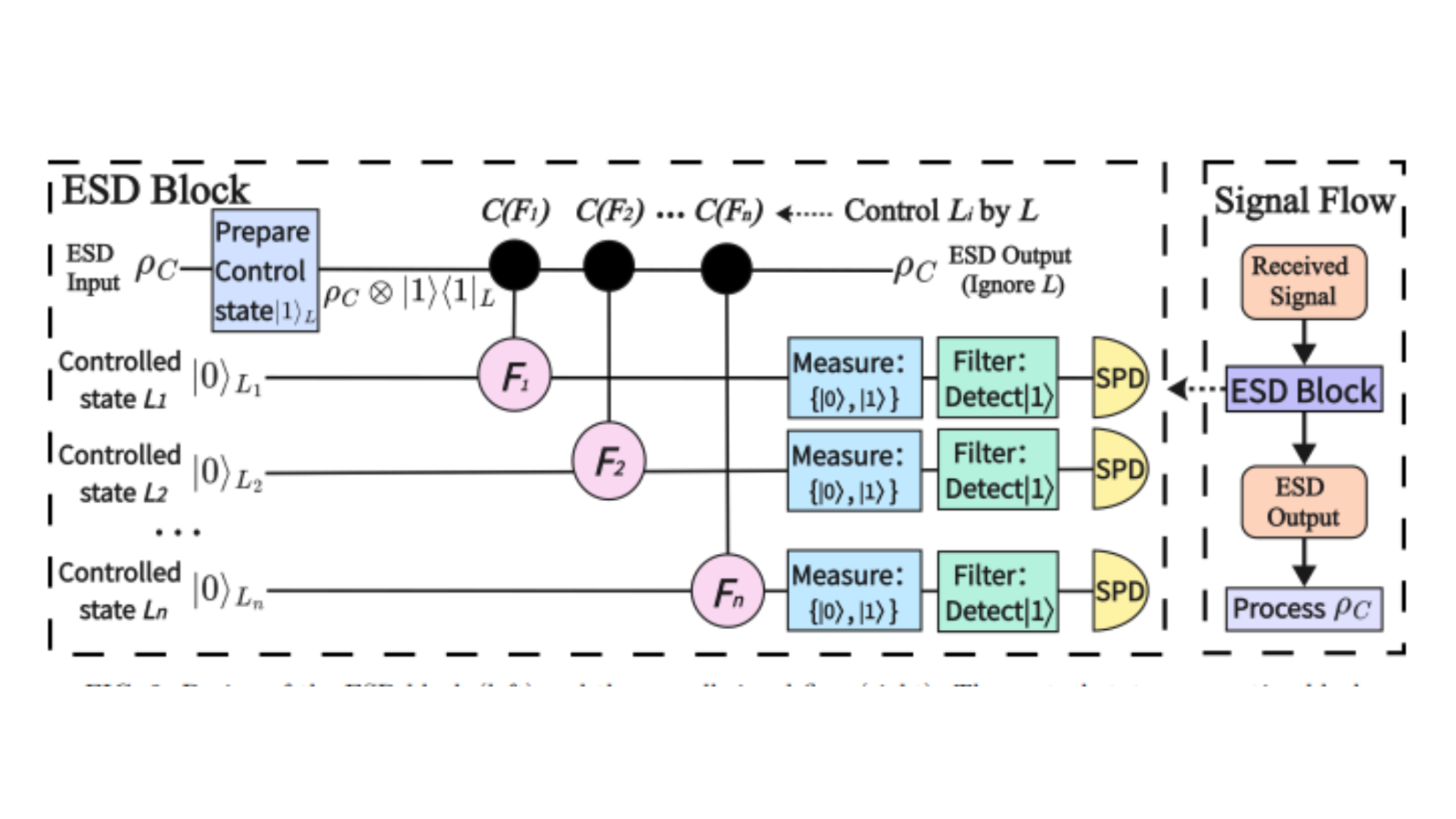
Quantum communication, particularly the secure distribution of encryption keys, has long promised unhackable networks, but practical implementation faces a fundamental limit, the increasing error rate over long distances. Hao Shu from Sun Yat-Sen University and colleagues demonstrate a breakthrough in overcoming this limitation with a novel approach called empty-signal detection. The team introduces a method that identifies and eliminates spurious signals, which typically overwhelm receivers and corrupt data, without disturbing the actual message being transmitted. This innovative technique encodes information about the presence of a photon onto a separate, independent channel, allowing receivers to verify signal validity before processing it. The achievement represents a significant step towards truly long-distance quantum communication, potentially enabling networks that are not limited by signal loss and paving the way for secure communication across vast distances using existing technology.
Eliminating Dark Counts For Quantum Communication
Secure quantum communication, particularly quantum key distribution (QKD), attracts significant attention, but unavoidable dark counts in single-photon detectors constrain achievable transmission distances. This research presents a novel protocol, termed empty-signal detection, which effectively eliminates the impact of dark counts, removing this distance limitation. The method encodes information not on the presence of a signal, but on the absence of a signal within a specific time window, inverting the conventional detection paradigm. This approach leverages the statistical properties of dark counts, assuming they are random and independent, to distinguish genuine signal absences from those caused by detector noise.
The team demonstrates that careful calibration of the detection window and appropriate data processing techniques maintain a low quantum bit error rate (QBER), regardless of transmission distance. Researchers developed a theoretical framework to analyse the protocol’s performance, considering noise and imperfections in the quantum channel, revealing comparable secure key rates to conventional QKD over short distances, with a significant advantage over long distances. The team proposes a practical implementation using commercially available detectors and optical components, demonstrating the feasibility of the approach. This represents a significant step towards realising unconditionally secure, long-distance quantum communication.
Error Suppression Boosts Quantum Key Distribution
This research explores techniques to improve the performance of quantum key distribution (QKD) systems, addressing limitations imposed by imperfect detectors and noisy channels. The core problem lies in vulnerabilities to errors caused by detector imperfections, such as dark counts, and disturbances in the communication channel that cause photon loss. The proposed solution involves error suppression via auxiliary systems and optimized detection. The method leverages auxiliary quantum systems, such as photons, to create a more robust signal, performing controlled operations in conjunction with the primary signal.
The focus is on correctly identifying valid signals, those containing at least one photon, and suppressing invalid signals, like vacuum states or dark counts, achieved through careful design of the detection scheme and post-processing of the data. Key concepts include error suppression, aiming to reduce the error rate for longer transmission distances and higher key rates, and auxiliary system efficiency, the probability that the auxiliary system successfully performs the controlled operation. The research also considers post-selection and valid/invalid signal discrimination. This research contributes to the advancement of QKD technology by providing a practical and effective method for improving system performance, potentially enabling secure communication over longer distances and with higher key rates.
Empty Signal Detection Enables Quantum Communication
This research presents a new strategy for quantum communication that addresses a long-standing limitation caused by unavoidable noise in single-photon detectors. Scientists have developed an empty-signal detection (ESD) block, integrated into the receiver, which effectively filters out spurious signals that contribute to errors and limit communication distance. The core innovation lies in encoding information about the presence of a photon onto an auxiliary degree of freedom, independent of the message itself, allowing verification of signal validity without disturbing the transmitted data. By excluding these empty signals, the team demonstrates a pathway to overcome the rapid increase in error rates that typically plague long-distance quantum communication. The method relies on currently available technology and establishes a theoretical framework where a lossy communication channel can be treated as effectively lossless, paving the way for arbitrarily long communication distances. This simplifies the analysis of quantum communication protocols and provides a concrete foundation for future advancements in the field.
🗞 Empty-Signal Detection: Proof-of-Principle Scheme for Arbitrarily Long-Distance Quantum Communication
🧠 ArXiv: https://arxiv.org/abs/2509.15884