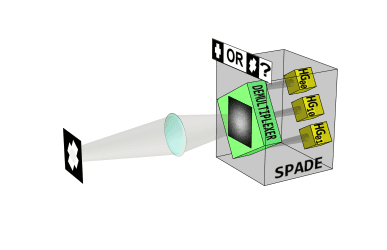
The fundamental limit to how clearly we can distinguish objects using light, known as the Rayleigh diffraction limit, presents a significant challenge in fields ranging from astronomy to bioimaging. Danilo Triggiani and Cosmo Lupo investigate how to overcome this barrier, exploring methods to identify faint, incoherent light sources even when they appear blurred together. Their work develops a comprehensive model for analysing light collected by optical systems, and reveals a surprising nuance in a technique called spatial demultiplexing (SPADE). The researchers demonstrate that while SPADE can significantly improve resolution, it doesn’t always achieve the absolute theoretical limit for distinguishing sources, and that achieving optimal performance requires careful consideration of the source characteristics, potentially necessitating more complex measurement strategies. These findings represent a crucial advance in the theory of optical discrimination, with potential applications in diverse areas such as medical diagnostics, automated image analysis, and the identification of distant galaxies.
Quantum Imaging and Signal Discrimination
This collection of research explores the boundaries of optical imaging, focusing on techniques that surpass the traditional diffraction limit and enhance the detection of faint signals. A central theme is super-resolution imaging, achieved through innovative quantum methods, and the application of quantum hypothesis testing to discriminate between different scenarios, such as identifying the presence of a weak signal. Researchers are investigating how to optimally distinguish between different quantum states of light, often leveraging Gaussian states due to their ease of manipulation, and exploiting quantum coherence and correlations, including entanglement, to enhance imaging performance. Increasingly, machine learning algorithms are being integrated with these quantum imaging techniques to improve image reconstruction, signal processing, and pattern recognition.
A strong emphasis exists on applying these advancements to astronomical observations, particularly for detecting faint objects like exoplanets and resolving fine details in distant galaxies. Researchers are also actively addressing the challenges of implementing these techniques in real-world experiments, accounting for noise, detector limitations, and imperfections in optical components. Further advancements include super-resolution imaging of high-redshift galaxies to understand the early universe, integrating quantum imaging with automated microscopy, and developing classical algorithms inspired by quantum principles. The ultimate goal is to create multi-aperture telescopes that operate at the quantum limit, achieving unprecedented resolution and sensitivity, representing a vibrant and rapidly evolving field with the potential to revolutionize astronomy, biology, materials science, and beyond.
Incoherent Light Modelling with Thermal States
Researchers have developed a comprehensive model for describing incoherent light, overcoming limitations imposed by the diffraction limit and enabling improved discrimination of optical sources. The team formulated a general description of incoherent light with arbitrary intensity distributions, representing it as a combination of thermal states and utilizing a mathematical function to characterize the source’s properties. This approach allows for detailed analysis of light emitted from various sources, ranging from faint emissions to bright, intense signals. Scientists then employed this model to analyze the problem of distinguishing between arbitrary incoherent sources, evaluating a mathematical benchmark to establish a limit on achievable performance.
The team propagated the initial light state through a linear optical system, accurately capturing how the system modifies the light’s characteristics and enabling precise calculations of the observed output. Experiments focused on the subdiffraction regime, where the team surprisingly discovered that a measurement technique called SPADE does not always achieve optimal performance. The analysis reveals that SPADE’s effectiveness is contingent upon specific compatibility conditions, such as the commutativity of matrices associated with the light’s intensity distributions. When these conditions are not met, achieving peak performance requires collective detection strategies that leverage quantum phenomena like entanglement or multi-photon counting. Despite these limitations, the team demonstrated a method for numerically determining the best SPADE measurement configuration in the subdiffraction regime, achieved through a rotation of specific modes of light, representing a significant advancement in incoherent-source subdiffraction discrimination with potential applications in automated diagnostics and galaxy identification.
Subdiffraction Imaging Challenges Optimal Measurement Bounds
Researchers have developed a comprehensive model for incoherent light, accounting for arbitrary intensity distributions collected by linear optical systems and the effects of diffraction. This model allows for detailed analysis of quantum discrimination problems, evaluating a mathematical benchmark to establish a limit on achievable performance, in both general scenarios and specific cases involving faint sources and compatible intensity distributions. Experiments reveal that SPADE measurements do not always achieve the ultimate performance limit in the subdiffraction regime; optimality is contingent upon specific compatibility conditions between the intensity distributions of the sources being discriminated. When these conditions are not met, achieving peak performance may necessitate collective detection strategies that leverage quantum phenomena like entanglement or multi-photon counting. The research provides a method for numerically determining the best SPADE configuration for subdiffraction imaging, generally achieved through a rotation of specific modes of light. These findings represent a significant advancement in subdiffraction discrimination of incoherent sources, with potential applications in diagnostics, automated image interpretation, and galaxy identification.
SPADE Optimality and Incoherent Source Limits
This work presents a general theoretical framework for modelling incoherent light sources subject to diffraction, utilizing a mathematical representation of Gaussian states. The research demonstrates that spatial demultiplexing (SPADE) measurements, while effective, do not universally achieve the ultimate performance limit for identifying incoherent sources, particularly in the subdiffraction regime. Optimality with SPADE is shown to depend on specific compatibility conditions. The analysis identifies that achieving quantum-limited performance may require more than just SPADE; collective measurements may be necessary to fully saturate the performance limit.
However, the research successfully defines the optimal SPADE strategy, assuming Gaussian point-spread functions, as a rotation of specific modes of light. Future research directions include extending the approach to partially coherent sources, exploring machine-learning-assisted measurement strategies, and accounting for practical experimental limitations. This work advances the understanding of subdiffraction identification tasks, highlighting both the capabilities and limitations of SPADE for bright and generic sources.
👉 More information
🗞 Achieving quantum-limited sub-Rayleigh identification of incoherent sources with arbitrary intensities
🧠 ArXiv: https://arxiv.org/abs/2509.03511