

The search for physics beyond the Standard Model presents formidable computational challenges, particularly as experiments like the High-Luminosity Large Hadron Collider generate increasingly complex data. Miranda Carou Laiño, Veronika Chobanova, and Miriam Lucio Martínez, from the University of A Coruña and the Instituto de Física Corpuscular, are investigating novel approaches to anomaly detection using qutrits, quantum bits with three possible states. Their work explores whether qutrit-based models outperform traditional qubit systems in terms of accuracy, scalability, and computational efficiency when analysing data from high-energy particle collisions. By benchmarking this new architecture, the team aims to establish whether qutrits can provide a significant advantage in identifying exotic physical phenomena and meeting the analytical demands of future collider experiments.
The work centers on qutrits as an alternative to more common qubits, offering potentially greater information density and resilience to noise. Researchers aim to develop quantum machine learning algorithms that can more effectively identify anomalies in LHC data, potentially leading to new discoveries in particle physics.
This involves encoding particle physics data into qutrit states and leveraging the geometric interpretation of the Majorana representation to simplify quantum computations. The ultimate goal is to demonstrate a quantum advantage, showing that quantum machine learning algorithms can outperform classical algorithms on specific tasks. The study emphasizes the mathematical underpinnings of qutrits, the Majorana representation, and the linear algebra involved. Concepts such as the SU(3) group, Bloch sphere generalizations, geometric phase, and quantum gates are explored. The team utilizes the Pennylane quantum machine learning library for simulations and experiments.
Qutrit Encoding of Particle Momentum for Anomaly Detection
Scientists developed a novel approach to anomaly detection in high-energy physics data by harnessing the capabilities of qutrits, addressing the increasing computational demands of future collider facilities. The team engineered a method to represent particle momentum within the expanded state space of qutrits. To achieve this, researchers implemented a “One Particle, One Qutrit” scheme, encoding particle kinematics directly into individual qutrits without prior classical data compression, allowing for a more faithful representation of collision events. The core of the study involves a Quantum Autoencoder (QAE), a structure comprising an encoder and a decoder implemented through variational quantum circuits, compressing input data into a reduced latent representation.
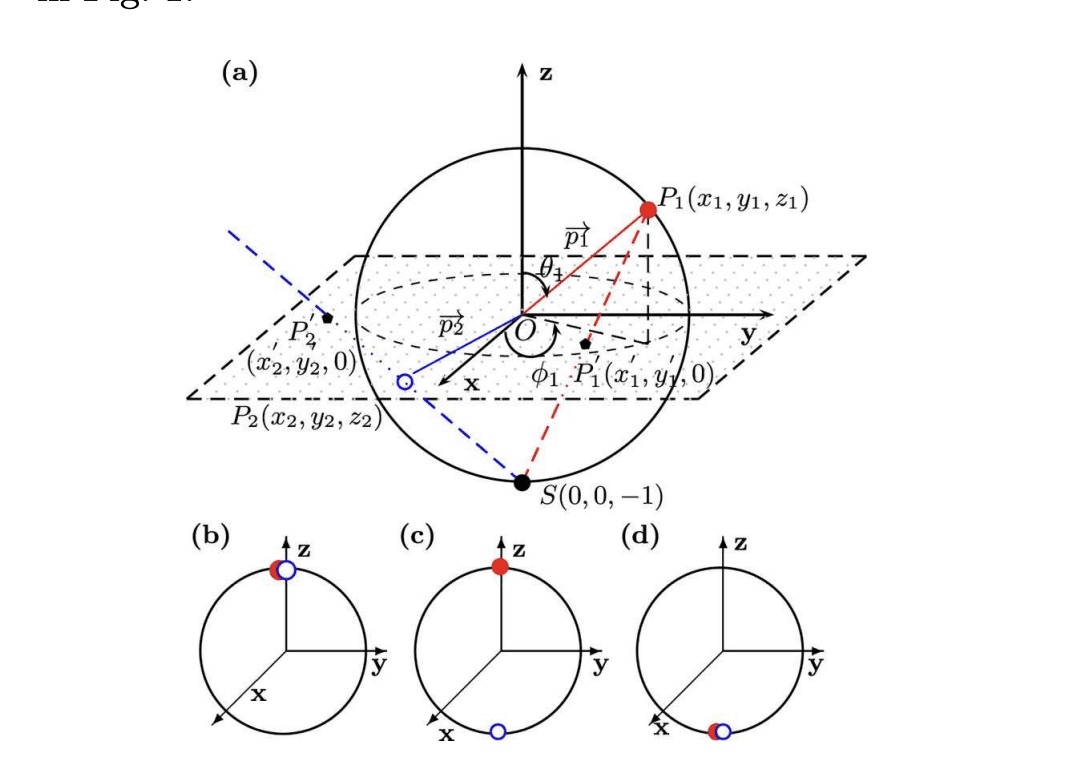
Crucially, the team established a geometric representation of qutrits on a unit sphere, utilizing the Majorana sphere to generate all possible states through transformations. By defining a canonical state and applying rigid rotations, scientists obtained all pure states of the qutrit. Researchers developed and benchmarked a quantum-enhanced anomaly detection model using qutrits, successfully implementing a qutrit-based Quantum Autoencoder (QAE). Initially, a qubit-based QAE was replicated and validated, establishing a robust baseline for comparison. The core innovation lies in adapting the model to utilize qutrits, requiring modifications to rotation gates and encoding schemes based on Gell-Mann matrices, and integrating new logic gates leveraging PennyLane’s capabilities. The qutrit-based model incorporated a novel encoding scheme utilizing Majorana encoding, extended with parameters related to jet energy, mass, and impact parameters. Researchers established a method for representing qutrit information on unit spheres, utilising Majorana encoding, and implemented generalized gates to ensure robust performance. The team’s findings suggest qutrit architectures offer a promising alternative for tackling the complex computational demands of future collider experiments, potentially aiding in the discovery of physics beyond the Standard Model. While acknowledging limitations in current simulation tools, the study highlights the potential of qutrit systems, supported by recent advances in trapped ion qudit implementation and quantum error correction. Future research will focus on evaluating the model’s performance with data from additional LHC experiments and exploring the application of higher-level systems.
👉 More information
🗞 Qutrits for physics at the LHC
🧠 ArXiv: https://arxiv.org/abs/2510.14001


