The quest for more sensitive and efficient detectors drives innovation in cosmology and astrophysics, and a new approach utilising graphene-insulator-superconductor junctions promises significant advances in this field. Leonardo Lucchesi and Federico Paolucci, from the University of Pisa and the INFN Section of Pisa, demonstrate a novel thermoelectric bolometer that directly converts incoming power into a voltage, eliminating the need for external modulation and simplifying device operation. Their detector, modelled through detailed numerical simulation, exhibits a remarkably low Noise Equivalent Power, a fast response time, and a high Signal-to-Noise Ratio, making it particularly well-suited for large-array cosmological experiments, while also offering advantages in fabrication and thermal management. This achievement represents a substantial step towards building more powerful and streamlined detectors for observing the universe.
Cryogenic Bolometers and Transition Edge Sensors
Bolometers detect incoming radiation by measuring temperature changes in an absorbing material, and extensive research has focused on optimizing their design, materials, and noise performance. Transition Edge Sensors (TES) operate as extremely sensitive thermometers at the critical point between superconducting and normal states, while Kinetic Inductance Detectors (KIDs) detect photons by monitoring changes in the kinetic inductance of superconducting resonators, offering significant potential for multiplexing. All these detectors require ultra-low operating temperatures, presenting challenges in maintaining thermal stability and minimizing sources of noise, including Johnson noise, shot noise, Two-Level System (TLS) noise, and thermal fluctuations from the detector environment. TES devices benefit from strong electrothermal feedback, which stabilizes the operating point and enhances sensitivity.
Material selection is critical, focusing on substances with high transition temperatures, low intrinsic noise, and strong thermal conductivity. Multiplexing strategies allow large TES arrays to be read out efficiently using a limited number of channels. Novel detector designs explore graphene-based bolometers and TES, leveraging graphene’s high conductivity and unique electronic properties. Other approaches include Normal-Insulator-Superconductor (NIS) junctions as sensitive thermometers and KIDs as an alternative detection paradigm. Researchers also study nonlinear thermoelectric effects in superconducting tunnel junctions to further improve sensitivity and actively investigate techniques to mitigate TLS noise.
On the theoretical side, foundational work provides frameworks for understanding and minimizing noise in all superconducting detectors. Notable contributions include:
-
Federico Paolucci – graphene-based devices and nonlinear thermoelectric effects.
-
L. S. Kuzmin – cold-electron bolometers and the application of electrothermal feedback in TES.
-
Jonas Zmuidzinas – development of KIDs and related superconducting detectors.
-
Tero T. Heikkilä – mesoscopic thermometry and refrigeration.
-
Ya. M. Blanter & M. Büttiker – theory of shot noise in mesoscopic conductors.
Kuzmin’s work on electrothermal feedback underpins many TES designs, while Paolucci’s research on graphene-based detectors builds on superconducting tunnel junctions and thermoelectric effects. Zmuidzinas’s contributions to KIDs complement TES research by offering alternative, multiplexable detection approaches.
Superconducting Bolometer Achieves Low Noise, Fast Response
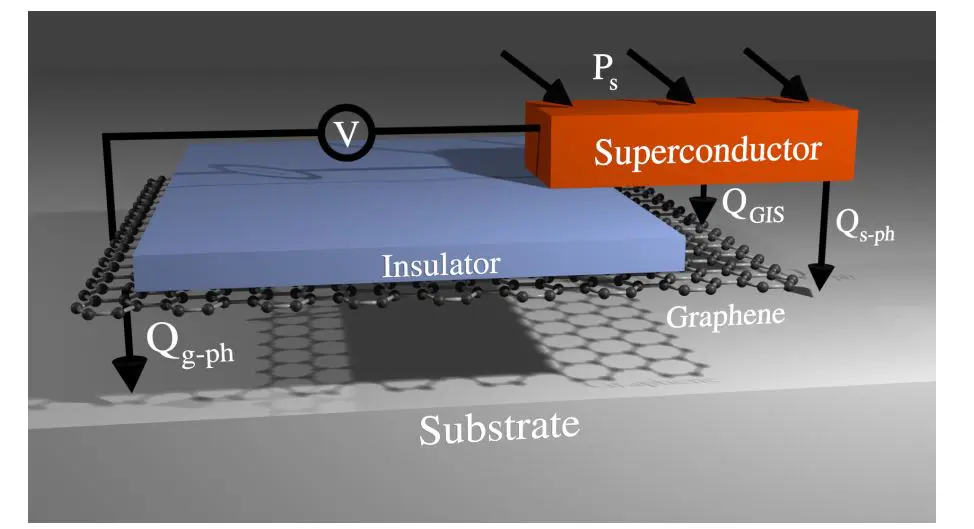
Researchers have developed a superconducting thermoelectric bolometer, a device capable of directly converting incoming radiation into a voltage signal without the need for external modulation. The detector employs a tunnel junction combining an insulator and a superconductor, offering advantages for fabrication and thermal management, particularly in large-array cosmological experiments.
The team characterized the bolometer using numerical simulations of its thermal dynamics, modeling heating on both sides of the junction and deriving new expressions for noise contributions arising from temperature differences. Experimental results demonstrate the device’s sensitivity to weak signals, with measurements of Noise Equivalent Power (NEP) and response time, as well as the integration time required to achieve a given Signal-to-Noise Ratio (SNR).
To model the device’s behavior, the researchers solved a system of coupled nonlinear differential equations describing the time-dependent temperatures of the superconductor and graphene layers. They optimized the design using a geometry with a graphene area of 100 μm², a superconductor volume of 0.5×10⁻³ μm³, and an overlap area of 0.01 μm³, maximizing the thermal gradient between layers.
Results reveal that the responsivity—the change in open-circuit voltage per unit change in input power—varies non-linearly with input power, a behavior attributed to saturation effects not captured by simpler linear models. The device’s performance is particularly sensitive to the temperature difference between the superconductor and graphene, with experiments showing that connecting the antenna to the graphene layer reduces the thermal gradient and influences the detector’s response.
This study highlights the potential of superconducting thermoelectric bolometers for high-sensitivity radiation detection, offering a scalable approach for cosmology and other applications requiring precise measurement of faint signals.
Graphene Bolometer Detects Ultralow Power Signals
This work presents a novel superconducting thermoelectric bolometer constructed from a graphene-insulator-superconductor tunnel junction. Researchers successfully demonstrated a passive detector design, directly converting input power into a voltage without external modulation, achieving a noise equivalent power of approximately 4x 10⁻¹⁷ W/√Hz for input powers around 10⁻¹⁶ W at 100 mK. The device exhibits a large responsivity, reaching up to 10¹¹ V/W for input powers below 1 fW, and a thermal response time as low as 200 nanoseconds for input powers of 10⁻¹³ W. Importantly, the integration time required to achieve a signal-to-noise ratio of one improves with increasing input power, decreasing to around 100 microseconds for powers of 10⁻¹³ W.
While acknowledging that the achieved noise equivalent power is somewhat higher than values reported in existing literature, the team highlights the potential advantages of this passive design, particularly its reduced heat budget and simpler fabrication, which could be crucial for large-array cosmological experiments. This detector’s characteristics make it suitable for investigations of phenomena such as cosmic microwave background polarization, especially in applications where power consumption is a critical constraint, like balloon or satellite-based cosmology. The authors note this study represents a preliminary investigation, suggesting further optimization could enhance the device’s noise performance.
🗞 Graphene-Insulator-Superconductor junctions as thermoelectric bolometers
🧠 ArXiv: https://arxiv.org/abs/2512.14493