The search for dark matter, which constitutes a significant portion of the universe, receives a boost from new research exploring the potential of chiral phonons as highly sensitive detectors. Marek Matas, Filip Krizek, and Carl P. Romao, from the Czech Technical University in Prague and the Czech Academy of Sciences, investigate metal-organic frameworks (MOFs) as materials capable of hosting these unique acoustic vibrations with large magnetic moments. This work establishes that MOFs, due to their specific structural properties and tunability, offer a promising pathway towards detecting extremely faint dark matter interactions, even at energies below those accessible to current technologies. By proposing a prototype detection setup utilising surface-integrated magnetometry, the team demonstrates the feasibility of directly reading out these chiral phonons, potentially opening a new era in the quest to understand the nature of dark matter.
Chiral phonons in metal-organic frameworks represent a novel quantum sensor for dark matter direct detection, offering sensitivity to particles with extremely low mass. This research focuses on exploiting the unique properties of these phonons to achieve unprecedented sensitivity in the search for weakly interacting massive particles. Researchers investigate metal-organic frameworks as a means of generating and controlling chiral phonons, which exhibit a helical motion and strong coupling to dark matter particles. This approach offers a distinct advantage over conventional detectors by enabling the direct observation of dark matter interactions through the excitation of these phonons, potentially revealing signals previously obscured by background noise.
Materials that host chiral phonons with large magnetic moments represent a promising avenue for direct readout using an external magnetometer. The research focuses on metal-organic frameworks (MOFs) as candidate materials for single chiral phonon detection, owing to their noncentrosymmetric structure, tunability, and ability to host these excitations in stable acoustic bands. Several promising candidates are identified, and their projected dark matter detection sensitivity is compared for all possible interactions identified within effective field theory. The research establishes that detector sensitivity does not strongly depend on the specific choice of the MOF, thereby enabling tailoring of the final material composition.
Phonon Angular Momentum and Magnetic Responses
This research details computational methods and results related to phonon properties of various materials, with a focus on their potential use in dark matter detection. The core of this work lies in understanding phonons, which are quantized vibrations within a crystal lattice and crucial for understanding a material’s thermal and acoustic properties. A key aspect is phonon angular momentum, describing the rotational motion within the vibration, and the associated magnetic moment created by the movement of charged atoms. This is important because dark matter particles might interact with these magnetic moments.
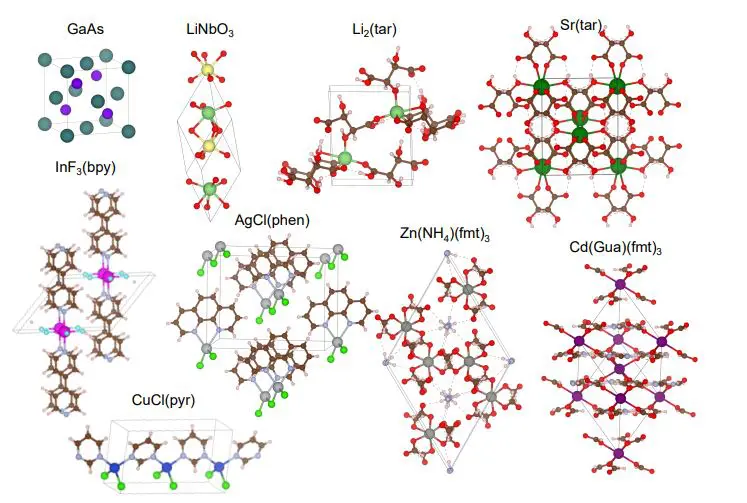
The central hypothesis is that certain types of dark matter particles, those interacting weakly with electrons, could be detected by observing their interactions with phonons possessing angular momentum and magnetic moments. The goal is to identify materials where these properties are maximized to enhance the sensitivity of dark matter detectors. The calculations are based on density functional theory, a quantum mechanical method used to calculate the electronic structure of materials. The research focuses on several materials, including silver chloride coordinated with phenanthroline, copper chloride coordinated with pyridine, strontium tartrate, and gallium arsenide.
These materials are chosen because they exhibit specific structural and vibrational properties that might be favorable for dark matter detection. The authors have calculated the phonon band structures, angular momentum, and magnetic moments for each material, presenting the results visually to identify phonon modes with high angular momentum or magnetic moment. The calculations suggest that certain phonon modes in these materials could be sensitive to interactions with dark matter particles. This research is particularly relevant to the search for light dark matter particles, those with sub-GeV mass, that interact weakly with electrons. The angular momentum of phonons could potentially allow for directional detection of dark matter, meaning the detector could determine the direction from which the dark matter particles are coming. Understanding the phonon properties of detector materials is crucial for reducing background noise and improving the sensitivity of dark matter experiments.
Chiral Phonons Enable Dark Matter Detection
This research presents a novel approach to dark matter detection, focusing on the potential of metal-organic frameworks (MOFs) to host chiral phonons with measurable magnetic moments. The team investigated several MOF candidates, demonstrating that detector sensitivity does not strongly depend on the specific material chosen, allowing for optimisation based on magnetic readout feasibility. Their modelling indicates this chiral phonon sensing paradigm offers significant advantages over existing and proposed dark matter detection designs. The work establishes a pathway towards directly measuring the magnetic moments of these phonons, a feat not yet achieved experimentally.
The researchers propose a prototype setup involving a surface-integrated magnetometer and an asymmetric superconducting quantum interference device (SQUID) loop, a relatively simple nanofabrication process compatible with current measurement techniques. While calculations of a key parameter, phonon coupling, relied on assumptions due to computational limitations, the team demonstrated this parameter has a linear effect on detector sensitivity, minimising the impact of these assumptions. The authors acknowledge that current experimental reports on phonon magnetism primarily focus on optical phonons, and further theoretical and methodological development is needed to accurately model detector sensitivity. Future work will focus on refining these models and exploring techniques for sensing phonon magnetism, paving the way for a new generation of dark matter detectors based on chiral phonon detection.
🗞 Chiral phonons in metal-organic frameworks as quantum sensors for the direct detection of dark matter
🧠 ArXiv: https://arxiv.org/abs/2511.20461