

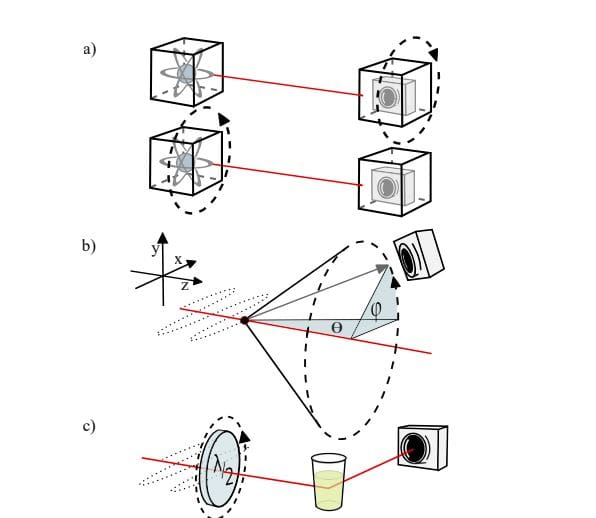
Detecting entanglement, a key resource for quantum technologies, presents ongoing challenges for researchers, and a new approach focuses on measurements defined by rotational symmetry. Marlene Funck, Ilija Funk, and Tizian Schmidt, all from Leibniz Universität Hannover, along with René Schwonnek, demonstrate that any device adhering to this symmetry is characterised by a single parameter, opening new avenues for entanglement detection. The team develops a method for certifying entanglement using complete measurement data, even in scenarios where device settings are not fully trusted, and reveals that while traditional Bell tests are impossible with these measurements, a related phenomenon, EPR steering, remains detectable. Remarkably, their work extends to practical applications, showcasing the potential of everyday materials, specifically, they find that detectors based on lemonade exhibit suitable properties for entanglement detection, offering a novel and accessible platform for quantum information science.
The research establishes that any such detection setting can be fully characterized by a single real parameter, simplifying the analysis of entanglement detection and moving beyond the demanding requirements of complex tests. Scientists derived explicit mathematical tools, termed positive operator-valued measures, to formulate the well-known Klein, Nishina formula, which describes Compton scattering of polarized photons. This formulation provides a robust framework for analyzing photon correlations and distinguishing between entangled and separable states in scattering setups.
Measurement Choices Reveal Entanglement Information
This research explores how the choice of measurement devices and their symmetry impacts our ability to detect entanglement. The authors demonstrate that circular symmetry can obscure entanglement, making it difficult to verify using standard methods. However, they also show how to optimize measurement devices to reveal entanglement even in these scenarios. They connect these findings to the mathematical framework of positive operator-valued measures and local hidden variable models, highlighting the importance of careful measurement choices. The study establishes a clear link between the symmetry of measurement devices and the detectability of entanglement. By carefully designing measurement settings, scientists can overcome the limitations imposed by circular symmetry and reveal the underlying quantum correlations. This work provides a deeper understanding of the interplay between measurement, symmetry, and entanglement, with implications for quantum technologies.
Rotational Symmetry Simplifies Entanglement Detection
Scientists have developed a novel method for detecting entanglement in polarized photons, focusing on measurement devices exhibiting rotational symmetry. The research establishes that any such detection setting can be fully characterized by a single real parameter, simplifying the analysis of entanglement detection and moving beyond the demanding requirements of complex tests. Scientists derived explicit mathematical tools, termed positive operator-valued measures, to formulate the well-known Klein, Nishina formula, which describes Compton scattering of polarized photons. This formulation provides a robust framework for analyzing photon correlations and distinguishing between entangled and separable states in scattering setups.
The team also created a semi-device independent entanglement certification method, operating on complete measurement statistics to provide tight bounds on entanglement. Importantly, they demonstrated that while traditional Bell inequality tests are not possible with rotationally symmetric measurements, entanglement can still be confirmed through EPR steering. To showcase the method’s practicality, scientists conducted an experiment analyzing the scattering of polarized light through various soft drinks, suggesting that lemonade-based detectors are particularly suitable for entanglement detection, exceeding known limits for Compton scattering of electron, positron annihilation photons. Measurements confirm that the contrast obtained using lemonade surpasses previously established benchmarks. Although a fully conclusive experiment requires entangled photon pairs and larger sample sizes, this work illustrates the power of reducing complex systems to their fundamental symmetries for comprehensive analysis.
Rotational Symmetry Simplifies Entanglement Certification
This research presents a new approach to detecting entanglement, focusing on measurement devices exhibiting rotational symmetry. The team derived specific mathematical tools, termed positive operator valued measures, demonstrating that the characteristics of such devices can be fully described by a single measurable parameter. This framework successfully reformulates the well-known Klein-Nishina formula, originally developed for Compton scattering of polarized photons, within this new context. Furthermore, the researchers developed a method, based on semi-definite programming, to certify entanglement using complete measurement statistics, even when limited assumptions are made about the measurement devices. Importantly, they demonstrated that while traditional Bell inequality tests are not possible with rotationally symmetric measurements, entanglement can still be confirmed through EPR steering.
👉 More information
🗞 Entanglement Detection with Rotationally Covariant Measurements – From Compton Scattering to Lemonade
🧠 ArXiv: https://arxiv.org/abs/2512.03984


