Multipartite entanglement, a powerful resource for emerging technologies such as quantum computing and secure communication, presents a significant challenge for experimental verification as the number of entangled particles increases. Dian Wu, Fei Shi from The University of Hong Kong, and Jia-Cheng Sun from East China Normal University, alongside Bo-Wen Wang, Xue-Mei Gu, and Giulio Chiribella, now demonstrate a new method for detecting this entanglement using correlations from a minimal number of simultaneous measurements. This innovative approach overcomes limitations of traditional methods, which become increasingly susceptible to errors with larger systems, and successfully certifies genuine multipartite entanglement even when direct observation fails. The team’s results represent a crucial step forward in the pursuit of scalable quantum technologies, paving the way for the experimental detection of entanglement in increasingly complex quantum states.
Entanglement, Discrimination, and Quantum Witnesses
This extensive list details research in quantum information science, specifically focusing on entanglement, quantum state discrimination, and related concepts like Bell inequalities and witness operators. The collection covers both theoretical foundations and experimental implementations, charting the evolution of the field. Key themes include demonstrating the non-classical nature of quantum mechanics, understanding the limits of distinguishing between quantum states, and developing mathematical tools to prove entanglement without fully characterizing a quantum state. The list encompasses research into experimental work using photons, ions, and superconducting qubits to create and manipulate entangled states, as well as applications in secure communication, precision measurements, and quantum computing.
It also delves into finer distinctions between different types of quantum correlations, such as quantum steering and contextuality, and explores methods for performing quantum tasks without relying on the internal workings of quantum devices. Specific areas covered include various forms of entanglement, methods for quantifying entanglement, techniques for creating and purifying entanglement. Furthermore, the bibliography includes research on protecting quantum information from noise, overcoming the limitations of long-distance quantum communication, and applying entanglement in quantum computing and sensing. In summary, this is a comprehensive resource for anyone working in quantum information science, reflecting the field’s progress from theoretical beginnings to practical applications. It provides a broad overview of the key concepts, techniques, and experimental advancements that define this rapidly evolving area of research.
Minimal Particle Measurement Certifies Multipartite Entanglement
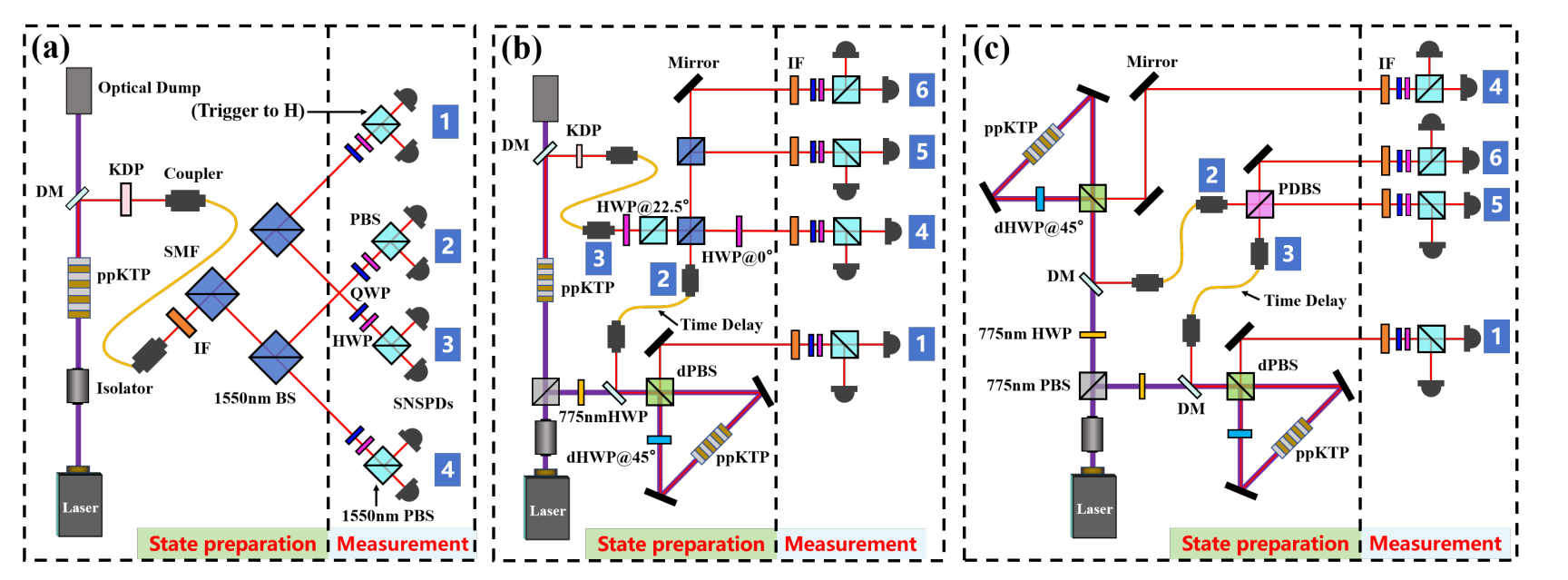
Scientists have made a significant advance in detecting multipartite entanglement, a crucial resource for emerging quantum technologies, by developing a method that minimizes the number of simultaneously measured particles. Recognizing that traditional approaches become increasingly susceptible to experimental errors as the number of particles increases, the team pioneered a technique focused on detecting entanglement with the fewest possible measurements. This work demonstrates entanglement detection at the entanglement detection length (EDL), representing the minimum number of particles needed to reliably confirm genuine multipartite entanglement. The study utilized a photonic platform to prepare and analyze three- and four-qubit states, including W states, Dicke states, and cluster states.
High-fidelity preparation of these states was essential, and the team rigorously verified genuine multipartite entanglement through few-particle measurements performed at the EDL limit. This innovative approach avoids the need for large-scale entangled measurements, which are difficult to implement and highly sensitive to errors. Crucially, the researchers demonstrated that their EDL witness, a measurement strategy based on minimal particle correlations, is more robust to measurement errors compared to traditional methods. For a four-qubit Dicke state, the EDL witness proved more reliable, marking the first experimental demonstration of the advantage of EDL-sized measurements for entanglement detection. This method identifies a minimal set of subsystems on which measurements must be performed to certify genuine multipartite entanglement, establishing a new benchmark for scalable and robust entanglement detection in complex quantum systems.
Minimal Measurements Confirm Multipartite Entanglement
Scientists have achieved the first experimental demonstration of detecting multipartite entanglement using measurements on a minimal number of particles, reaching the entanglement detection length (EDL) limit. This breakthrough addresses a significant challenge in quantum information science, where verifying genuine multipartite entanglement becomes increasingly difficult as the number of entangled particles grows. The research team successfully detected entanglement in W states, Dicke states, and cluster states, using a photonic platform and demonstrating high-fidelity preparation of three- and four-qubit states. The core achievement lies in minimizing the number of simultaneous particle measurements required for entanglement detection, thereby reducing sensitivity to experimental imperfections.
Researchers defined and implemented EDL witnesses, which are observables designed to detect entanglement based on measurements performed on a collection of subsets containing the minimum number of particles necessary. For example, the team demonstrated that for a four-qubit Dicke state, the EDL witness exhibits greater robustness to measurement errors compared to traditional methods. Experiments confirm that this approach allows for certification of genuine multipartite entanglement in scenarios where direct detection methods fail, establishing a new benchmark for entanglement detection and paving the way for scalable quantum technologies.
Multipartite Entanglement Detection via Correlation Length
Researchers have achieved the first experimental demonstration of a new approach to detecting multipartite entanglement, utilizing the entanglement detection length framework. This method successfully identifies entanglement by examining correlations derived from measurements performed on only a subset of particles within a larger entangled state, representing a significant advancement over traditional methods that require simultaneous measurement of all particles. The demonstrated method exhibits increased robustness to imperfections in measurement alignment, as reducing the number of measured particles minimizes the impact of these errors. This achievement constitutes a proof-of-principle, indicating a scalable, tomography-free, and noise-robust pathway for verifying multipartite entanglement in increasingly complex quantum systems. Future work will likely focus on extending this technique to even larger entangled states and exploring its potential applications in quantum technologies, promising to simplify the verification of entanglement in complex quantum systems and paving the way for more robust and scalable quantum technologies.
🗞 Experimental Multipartite Entanglement Detection With Minimal-Size Correlations
🧠 ArXiv: https://arxiv.org/abs/2510.22918