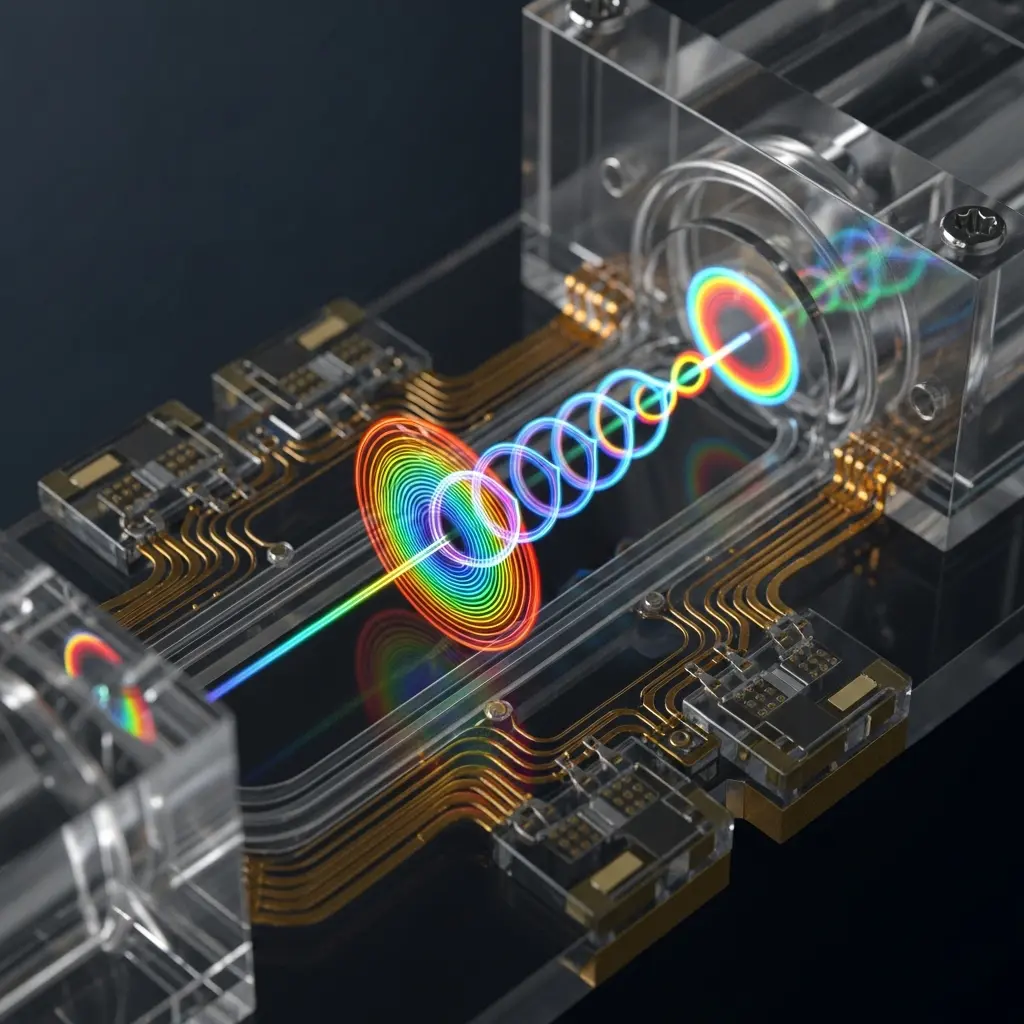
Researchers are tackling a major challenge in optical communications , efficiently detecting and utilising the angular momentum of light. Guanyu Zhang, Xianghan Meng, and Zini Cao, from Peking University, alongside colleagues including Hai Lin and Shuxin Huang, have developed an on-chip silicon photodetector capable of directly converting optical orbital angular momentum (OAM) into electrical signals. This innovative device bypasses the need for cumbersome optics, offering a compact and scalable solution for harnessing the immense information-carrying potential of OAM in future high-capacity networks and quantum technologies , achieving a record-high responsivity of 226 nA/W and detecting a broad range of topological charges from -9 to +9.
The research team achieved this by leveraging momentum-matched plasmonic coupling to map vortex beams onto surface plasmon polaritons (SPPs), creating OAM-dependent splitting angles that uniquely encode the topological charge as photocurrents. By ingeniously incorporating a surface dielectric lens and a split-electrode architecture, they enhanced mode resolution and enabled the discrimination of chirality, paving the way for more sophisticated OAM-based systems.
The study reveals a wide topological charge detection range extending from m = -9 to 9, demonstrating the device’s ability to handle a substantial number of orthogonal OAM modes simultaneously. Crucially, the fabricated device achieves a record-high average OAM responsivity of 226 nA/W, significantly surpassing the performance of previously reported OAM detectors. This enhanced sensitivity is attributed to the efficient coupling of vortex beams into SPPs and the optimized design of the photodetector architecture. Experiments show that the device effectively translates the helical phase front of vortex beams into spatially separated SPP modes, each corresponding to a specific OAM state, and then converts these modes into measurable electrical currents.
The incorporation of a surface dielectric lens plays a vital role in refining the spatial separation of SPP modes, improving the accuracy of OAM detection and enabling precise determination of the topological charge. Furthermore, the split-electrode architecture allows for chirality discrimination, distinguishing between clockwise and counterclockwise vortex beams, which is essential for applications in quantum information processing. This work establishes a scalable platform for on-chip OAM direct detection, bridging the gap between vortex beams and electronic readout, and opening up exciting possibilities for next-generation high-capacity optical networks. This innovative photodetector overcomes limitations of conventional OAM detection methods, which typically rely on bulky interferometric or imaging optics, making them unsuitable for on-chip integration.
Unlike previous approaches that often depend on scarce two-dimensional materials, this device is fabricated using silicon, a readily available and cost-effective material, facilitating large-scale production. The research demonstrates a noise-equivalent OAM resolution down to 0.05Hz -1/2, ensuring robust and reliable detection even in noisy environments. By achieving multi-mode detection with direct electrical readout, this breakthrough promises to accelerate the development of advanced optical technologies for sensing, communication, and quantum information processing.
Silicon Chip Detects Orbital Angular Momentum States
Scientists have developed a silicon-based integrated photodetector capable of directly converting optical orbital angular momentum (OAM) into distinguishable electrical signals. This breakthrough addresses a key limitation in harnessing the potential of OAM for high-capacity optical communications and quantum processing, circumventing the need for bulky interferometric or imaging optics. By employing momentum-matched plasmonic coupling, the device maps vortex beams onto surface plasmon polaritons (SPPs) with OAM-dependent splitting angles, uniquely encoding the topological charge into measurable photocurrents. Experiments revealed a wide topological charge detection range from m = -9 to 9, demonstrating the device’s ability to resolve a substantial spectrum of OAM states.
The team measured a record-high average OAM responsivity of 226 nA/W, significantly outperforming all previously reported studies in direct OAM photodetectors. This exceptional responsivity was achieved through the incorporation of a surface dielectric lens and a split-electrode architecture, which enhance mode resolution and enable chirality discrimination, the ability to distinguish between clockwise and counterclockwise vortex beams. Results demonstrate that the orbital angular momentum of light, characterized by its quantized OAM order ‘m’, is directly linked to the in-plane component of the wave vector. As ‘m’ increases, the phase winding rate accelerates, leading to a larger in-plane wave vector and consequently, a greater SPP propagation angle.
The device architecture features input and output coupling gratings on a planar silicon platform, with a dielectric lens integrated to expand the detectable OAM range. During testing, a focused vortex beam excited SPPs satisfying the momentum-matching condition, generating four SPP branches propagating in distinct directions. The researchers recorded photocurrent amplitudes that decreased with increasing ‘m’, but this decrease was exploited to discriminate vortex beams from |m| = 1 to 9. Measurements confirm that the OAM responsivity, calculated as ∆Iph/∆P, reached 226 nA W−1, a substantial improvement over existing technologies. With a noise-equivalent OAM resolution down to 0.05Hz−1/2, this work establishes a solid foundation for robust on-chip OAM detection and opens promising avenues for next-generation high-capacity optical technologies in sensing, communication, and quantum information processing. The input grating period of 610nm was selected to ensure optimal coupling at a 633nm excitation wavelength, while simulations confirmed maximum coupling efficiency with a slot width of 80nm and a depth of 120nm.
🗞 Electrical detection of high-order optical orbital angular momentum
🧠 ArXiv: https://arxiv.org/abs/2601.13691