Hyperspectral imaging in the mid-infrared offers powerful molecular identification capabilities, with significant potential for applications ranging from medical diagnostics to environmental monitoring, but current techniques often damage sensitive samples with intense light. Yijian Meng, Asbjørn Arvad Jørgensen, and Andreas Næsby Rasmussen, working at Dansk Fundamental Metrologi A/S with colleagues including Lasse Høgstedt and Søren M. M. Friis from NLIR Aps, now present a new single-photon hyperspectral imaging platform that overcomes this limitation. Their innovative approach combines advanced light conversion techniques with readily available silicon detectors, enabling high-contrast, label-free imaging at extremely low light levels. By suppressing noise and operating at room temperature, the system delivers a significant improvement over existing mid-infrared technologies and promises to unlock scalable imaging solutions for a wide range of scientific and industrial applications.
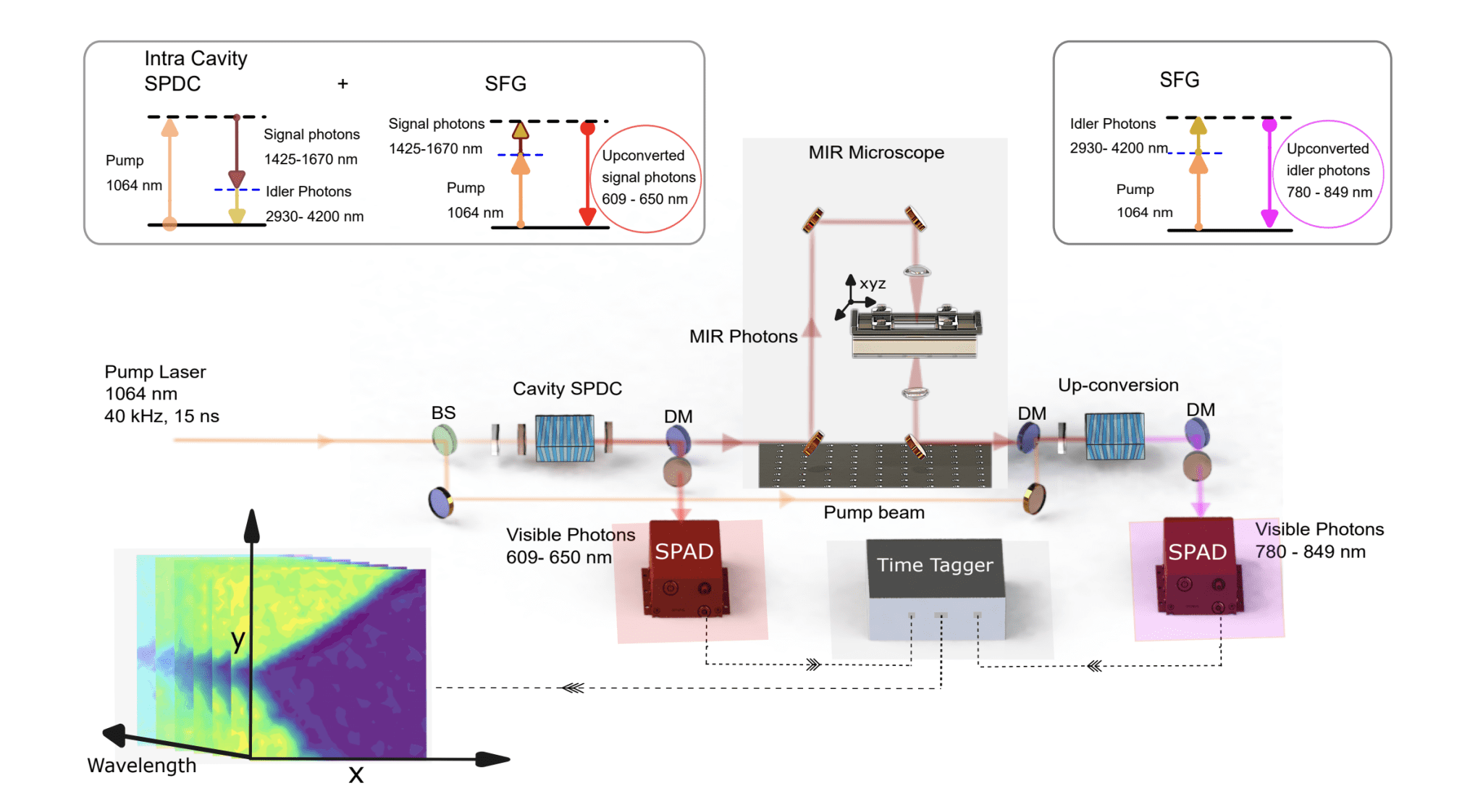
Highly valuable for biomedical and biochemical applications, conventional mid-infrared (MIR) imaging techniques often rely on high-intensity illumination that can induce photodamage in sensitive biological tissues. Single-photon MIR imaging offers a label-free, non-invasive alternative, yet its adoption is hindered by the lack of efficient, room-temperature MIR single-photon detectors. This work presents a single-photon hyperspectral imaging platform that combines cavity-enhanced spontaneous parametric down-conversion (SPDC) with nonlinear frequency up-conversion, supporting a new generation of sensitive and practical infrared imaging systems.
Single-Photon Hyperspectral Imaging in the Mid-Infrared
Researchers have developed a novel hyperspectral imaging platform that overcomes limitations of current mid-infrared (MIR) technologies by utilizing single photons and a unique upconversion process. This system enables chemically specific imaging across the \SIrange{2. 9}{3. 6}{\micro\meter} range, a spectral region crucial for identifying molecular vibrations, without inducing damage to sensitive biological samples. The breakthrough relies on generating pairs of correlated photons, then converting one photon to a visible wavelength for efficient detection with readily available silicon sensors.
The core of the system employs spontaneous parametric down-conversion (SPDC) to create these photon pairs, followed by sum-frequency generation to upconvert the signal photon to the visible spectrum. This cascaded approach achieves an internal conversion efficiency of approximately 3. 5%, while a second upconversion stage for the idler photon reaches 10. 30% efficiency. By detecting these upconverted photons with silicon single-photon avalanche diodes (Si-SPADs), the system achieves room-temperature operation with low noise and high efficiency, a significant advancement over existing MIR imaging techniques.
Experiments demonstrate a substantial reduction in noise through the implementation of time-correlated single-photon counting and a rescaling strategy. By exploiting the strong correlation between the signal and idler photons, researchers effectively suppressed excess intensity noise, achieving near shot-noise-limited hyperspectral imaging. Furthermore, the platform allows for rapid and continuous tuning of the MIR idler photon wavelength, enabling detailed hyperspectral analysis of various molecular functional groups. This capability, combined with the low-photon-flux imaging, paves the way for applications in molecular diagnostics, environmental monitoring, and biomedical research, offering a powerful new tool for non-invasive and label-free imaging of biological and polymeric samples. The demonstrated spectral calibration ensures accurate and reliable data acquisition across the imaging range, solidifying the platform’s potential for widespread adoption in diverse scientific fields.
Label-free MIR Imaging with Reduced Photodamage
The research team presents a new hyperspectral imaging platform that overcomes limitations in mid-infrared (MIR) technology by enabling label-free, non-invasive imaging with significantly reduced photodamage to biological samples. This system combines advanced techniques, cavity-enhanced spontaneous parametric down-conversion and nonlinear frequency up-conversion, to achieve single-photon detection in the MIR range using cost-effective, visible-light sensors. By detecting correlated photon pairs, the platform minimizes noise and delivers high-contrast images at extremely low light levels, a substantial improvement over conventional MIR imaging methods. Demonstrated on both biological and polymeric samples, the system successfully differentiates materials based on their unique molecular vibrational signatures. This capability highlights the potential of the platform for a range of applications, including molecular diagnostics, environmental monitoring, and broader biomedical research. Future research directions include exploring the integration of machine learning algorithms to enhance image analysis and broaden the applicability of this innovative imaging technique.
👉 More information
🗞 Hyper-spectral Imaging with Up-Converted Mid-Infrared Single-Photons
🧠 ArXiv: https://arxiv.org/abs/2508.19970