The elusive nature of fractionally charged quasiparticles, which emerge in the exotic realm of the fractional Hall effect, presents a significant challenge to condensed matter physics, and researchers are continually seeking ways to directly observe and characterise these particles. Mario Di Luca, Emily Hajigeorgiou, Zekang Zhou, et al. from École Polytechnique Fédérale de Lausanne and the National Institute for Materials Science now demonstrate a novel method for measuring the charge of these quasiparticles using a specially engineered ‘antidot’, a tiny potential hill, within a bilayer graphene device. This innovative approach overcomes limitations of previous techniques by allowing researchers to directly measure quasiparticle charge through simple conductance measurements, and importantly, the team reports the first definitive measurement of fractional charge within a graphene-based system. By establishing a straightforward and tunable platform for studying the Hall effect, this work paves the way for extending these measurements to a wider range of materials and promises to deepen our understanding of these fundamental particles and their behaviour.
The detection of fractionally charged quasiparticles, crucial for understanding their unusual quantum properties, is achieved using antidots, potential hills created within the quantum Hall system, as a valuable approach to overcome geometric limitations. These structures function as controlled impurities, providing a means to isolate and study the behaviour of these quasiparticles with greater precision.
Fractional Quantum Hall States in Tunneling Systems
Researchers investigate the behaviour of electrons confined to a two-dimensional system in a strong magnetic field, leading to the formation of fractional quantum Hall states characterized by exotic quasiparticles possessing fractional charge and unique statistical properties. A small quantum dot acts as a sensitive probe of these states, allowing scientists to infer quasiparticle properties by measuring the flow of electrons through it. The primary experimental technique involves tunneling spectroscopy, where the current flowing through the quantum dot is measured as a function of voltage and magnetic field, revealing information about energy levels within the dot and the surrounding fractional Hall states. The goal is to directly observe evidence of fractional charge, detecting tunneling events corresponding to the addition of a fractional number of electrons to the dot.
Recent experiments demonstrate the observation of tunneling events consistent with the addition of quasiparticles with fractional charge to the quantum dot. At a specific filling factor, researchers observe distinct oscillation periods in the tunneling current, corresponding to charges of two-thirds and one-third of an electron, suggesting the presence of both types of quasiparticles. These oscillations strongly correlate with the fractional quantum Hall plateaus observed in resistance measurements, confirming that the tunneling events occur within the fractional Hall states.
Fractional Charge Measured in Graphene Quasiparticles
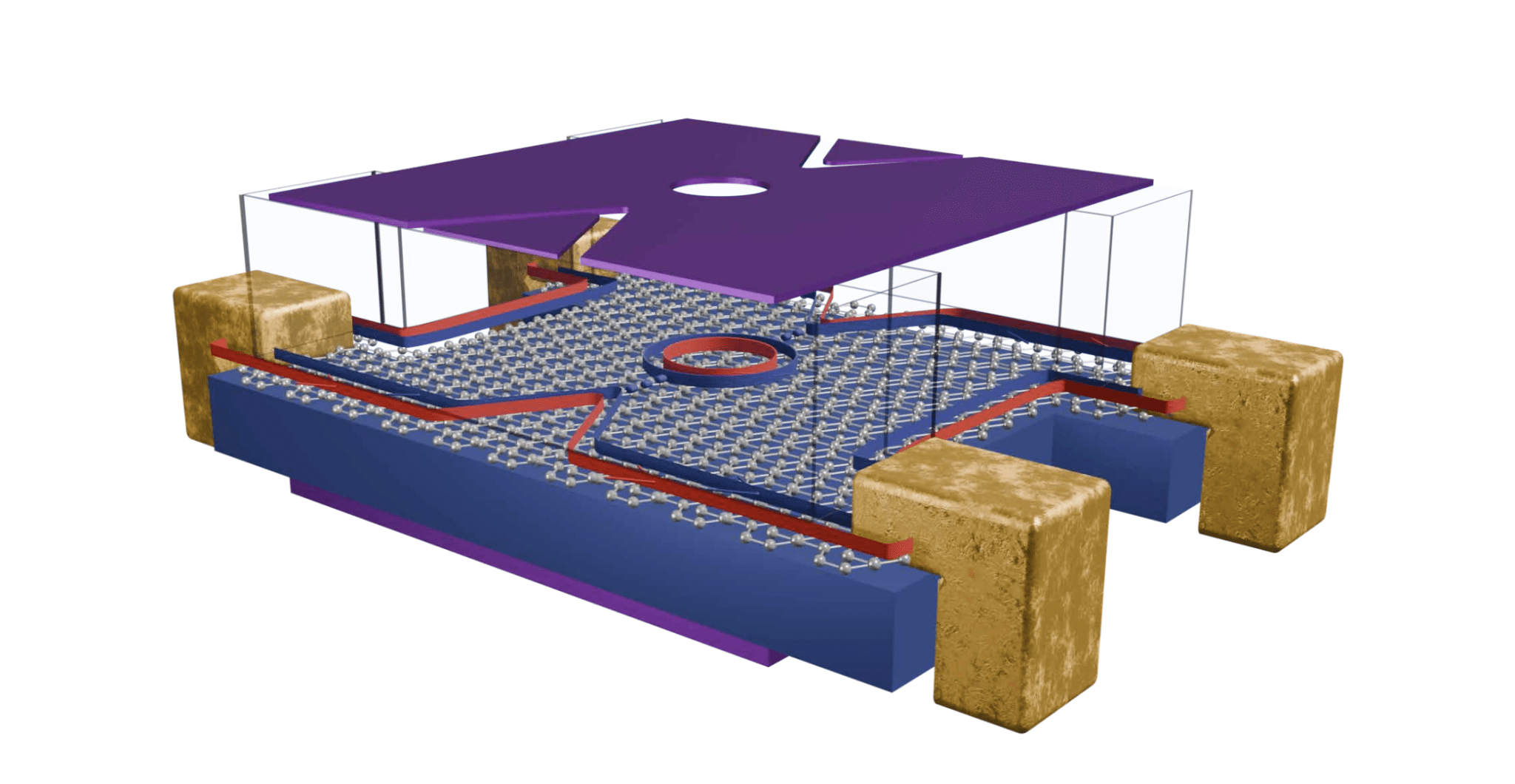
Researchers have achieved a breakthrough in understanding exotic quasiparticles found in the fractional quantum Hall effect, directly measuring their fractional charge within a bilayer graphene device. This work overcomes limitations of previous experiments by employing a novel gate-defined antidot design to precisely control and study quasiparticle tunneling, successfully demonstrating the ability to measure their charge and confirm their fractional nature. The experiment centers on a meticulously fabricated antidot device, where the antidot is fully electrostatically defined and controlled by multiple gates, allowing for unprecedented tunability. By operating the antidot in a regime dominated by Coulomb interactions, researchers observed clear oscillations in conductance as they varied the magnetic field and carrier density, directly revealing the charge of the tunneling quasiparticles.
The data demonstrates that the energy splitting around the antidot is related to the velocity of the edge mode and the diameter of the antidot, allowing for precise control and measurement of the confined charge carriers. This innovative approach offers a significant advantage over previous methods, which often suffered from complications arising from interactions between the bulk and edge states of the material. The simplicity of the design makes it readily adaptable to other van der Waals materials, opening pathways to explore quasiparticle charge in a wider range of fractional Chern insulators, and paving the way for future investigations into their potential applications in quantum computing and other advanced technologies.
Graphene Antidot Measures Fractional Charge e/3
This research demonstrates a new method for measuring fractional charge in the quantum Hall regime using a gate-defined bilayer graphene antidot. The team successfully measured a charge of one-third of an electron, representing the first such measurement in a graphene-based device, and established a practical technique for determining the charge of tunneling quasiparticles through straightforward conductance measurements. This approach simplifies quasiparticle charge detection by utilizing antidots as controlled impurities within a point contact. The simplicity and tunability of this platform offer a significant advantage, allowing for potential extension to other van der Waals materials and the study of charge measurements in more complex quantum Hall states. While the study acknowledges that changes in the size of the antidot can influence the measurements at higher filling factors, the results largely indicate that changes in electron density are the primary driver of the observed oscillations. Future work could explore applications of this technique to investigate anomalous quantum Hall states in rhombohedral graphene or twisted transition metal dichalcogenides, further expanding the understanding of exotic quasiparticles and their properties.
👉 More information
🗞 Quantum Hall Antidot as a Fractional Coulombmeter
🧠 ArXiv: https://arxiv.org/abs/2509.04209