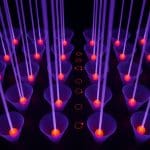
The manipulation of light’s structure offers exciting possibilities for advanced optical technologies, and researchers are now exploring light that carries both spatial and temporal twists, known as spatiotemporal optical vortices. Jinxin Wu, Dan Wang, and Qingqing Liang, working with Jianhua Hu, Jiahao Dong, and Jijun Feng, have created a flexible, two-dimensional mesh of these complex light structures, offering unprecedented control over their properties. This achievement overcomes previous limitations that restricted vortex creation to single dimensions, and importantly, allows for programmable control of dark spots within the light field. By demonstrating this mesh and extending its spectral range through second-harmonic generation, the team establishes a fundamental platform for designing more complex optical fields and paves the way for high-capacity optical communication systems based on these twisted light waves.
Epackets hold significant potential for optical trapping, analog optical computing, and studying photonic symmetry and topology. Scientists have now demonstrated the creation of two-dimensional flexible meshes of spatiotemporal optical vortices, termed M-STOV, with programmable intensity nulls. This work establishes a foundational framework for designing higher dimensional spatiotemporal vortex fields and promises a high-capacity information carrier based on these unique light fields. The team successfully generated M-STOVs and analyzed their diffraction patterns, revealing that the total topological charge corresponds to the sum of phase windings from each singularity.
Metasurface Fabrication and Spatiotemporal Vortex Control
Experiments demonstrate the ability to generate and control single spatiotemporal optical vortices. Phase patterns are loaded onto a spatial light modulator to create the vortices, and simulated and experimentally measured diffraction patterns show strong agreement, confirming the ability to create the desired vortex structures. Researchers also developed a technique to manipulate the sidelobes of the diffraction pattern by shifting the singularity in the frequency domain, providing a method for fine-tuning the energy distribution. By combining multiple STOVs, scientists created more complex patterns through a process called superposition, resulting in patterns that combine the characteristics of the individual vortices.
Observations of second harmonic generation of the M-STOVs reveal that the topological charge is doubled in the process, demonstrating the potential for nonlinear optical applications. The research utilizes spatiotemporal optical vortices, which are vortices with a phase singularity existing in both space and time, and relies on metasurfaces, artificial materials with subwavelength structures that manipulate light. Topological charge measures the twist of the vortex phase, and second harmonic generation converts light to twice its original frequency. A spatial light modulator dynamically controls the phase and amplitude of light, while a phase singularity represents a point where the phase of light is undefined.
Programmable Spatiotemporal Vortex Meshes Demonstrate Control
Experiments with singularity displacements produced multi-lobe diffraction patterns, where the number of lobes directly correlates with the total topological charge. Notably, the M-STOV diffraction patterns often exhibit spectral peaks shifted away from conventional STOVs, demonstrating a key distinction in their spectral energy distribution. Researchers explored the flexibility of topological charge order and singularity position, generating M-STOVs with irregularly arranged singularities and higher topological charges. Analysis of the detection process revealed that the intensity pattern on a detector can be viewed as a combination of tilted Hermite-Gaussian distributions corresponding to the topological charge orders.
To illustrate this combination effect, the team generated an M-STOV with a specific topological charge arrangement, resulting in a “butterfly” shaped detection pattern. This pattern is primarily comprised of the detection pattern for one element, with the lower-right wing modulated by the diffraction pattern of another element. Furthermore, scientists expanded the spectral range of M-STOV through second-harmonic generation, demonstrating that each phase singularity in the resulting field carries a topological charge twice the original value. Results confirmed that the total topological charge is also doubled in the second harmonic, opening possibilities for nonlinear optical applications and angular momentum transfer.
Programmable Spatiotemporal Optical Vortex Mesh Demonstrated
This research demonstrates the successful creation and characterization of a flexible, two-dimensional mesh of spatiotemporal optical vortices, termed M-STOV, with programmable orbital angular momentum. Scientists generated these complex light structures and extended their spectral range using a nonlinear process called second-harmonic generation, observing a doubling of the total angular momentum during this conversion. The team validated their approach by analyzing the diffraction patterns produced by the M-STOV, confirming the programmable nature of the generated vortices and their topological charges. This achievement broadens the range of available spatiotemporally structured light fields, offering potential advancements in areas such as optical communication, optical trapping, and light-matter interactions. While the current characterization method effectively reveals the topological charge, the authors acknowledge its limitation in fully retrieving the phase information of these complex wavepackets. Future work will likely focus on developing more advanced diagnostic tools to achieve complete characterization of these intricate spatiotemporal optical structures, further unlocking their potential for diverse applications.
👉 More information
🗞 Mesh of Spatiotemporal Optical Vortices with Programmable Intensity Nulls
🧠 ArXiv: https://arxiv.org/abs/2511.18087