

The behaviour of electrons in low-dimensional materials governs the operation of many modern electronic devices, and understanding how these electrons interact is crucial for developing new technologies. Nitin Kumar, Nicholas Jerla, and colleagues from the University at Buffalo-SUNY, alongside researchers from Texas A and M University, ETH Zurich, and G. Sambandamurthy, investigate the electronic properties of a vanadium oxide compound, -NaV₂O₅, to explore the mechanisms behind resistive switching. Their work reveals a strong connection between the arrangement of atoms within the material and its electrical behaviour, demonstrating a dramatic change in resistance accompanied by a significant reduction in noise at low temperatures. This discovery not only advances our understanding of electron interactions in these materials, but also suggests potential applications in low-noise, cryogenic memory and devices due to the material’s stable resistive states and substantial resistance changes.
Sodium Vanadate Exhibits 1/f Noise and Switching
Researchers investigate the origins of low-frequency noise and resistive switching observed in β-Na0. 33V2O5, a material with potential applications in energy storage. Experiments combine electrical characterisation with detailed analysis of current fluctuations to reveal the underlying physics governing these phenomena. The team employs current-voltage measurements and spectral analysis of current noise to characterise the material’s electrical behaviour. They demonstrate that the low-frequency noise exhibits a 1/f dependence, consistent with a superposition of numerous fluctuating processes.
Further investigation reveals that resistive switching is associated with the formation and rupture of conductive filaments within the material, involving the migration of sodium ions to create pathways for enhanced conductivity. The researchers establish a correlation between current noise and the stability of resistive states, suggesting fluctuations in ion distribution play a critical role in switching dynamics. This work provides insights into charge transport and switching behaviour in this layered vanadium oxide, potentially guiding the development of improved energy storage devices.
Charge Ordering and Resistive Switching Dynamics
This study investigates the interplay between charge ordering and macroscopic electrical transport in low-dimensional materials, crucial for understanding resistive switching mechanisms. Using electrical transport, low frequency noise spectroscopy, and X-ray diffraction, the team examines the material’s response to electrical stimuli and the underlying mechanisms driving changes in resistance. Electrical transport measurements characterise current-voltage relationships and overall conductivity, providing a baseline for understanding electrical behaviour. Low frequency noise spectroscopy probes fluctuations in resistance at very low frequencies, revealing information about charge ordering dynamics and defects. X-ray diffraction confirms the structural characteristics of the material and monitors changes in the crystal lattice accompanying resistive switching.
Vanadium Oxide Electrical Properties and Phase Transitions
This research details a comprehensive investigation into the electrical behaviour of vanadium oxides, particularly β-Na1/3V2O5. Researchers investigate key properties including the metal-insulator transition, charge ordering, and various conductivity mechanisms, including variable range hopping, polaron transport, and small polaron hopping. The importance of 1/f noise, a common type of noise in condensed matter systems, and its connection to charge dynamics and disorder is also highlighted. The research demonstrates that β-Na1/3V2O5 exhibits a rich phase diagram with multiple transitions related to charge ordering, the metal-insulator transition, and structural changes.
Disorder plays a significant role in electrical properties, influencing conductivity and the magnitude of 1/f noise. The material exhibits non-equilibrium behaviour under applied electric fields, leading to phenomena like threshold switching and hysteresis. The crystal structure and arrangement of vanadium and oxygen atoms are crucial in determining electrical properties, as confirmed by X-ray diffraction studies. Electric fields induce significant changes in conductivity, leading to the metal-insulator transition, threshold switching, and non-linear transport. 1/f noise serves as a sensitive probe of charge dynamics, disorder, and localized states.
Researchers explore theoretical models, including variable range hopping theory and polaron hopping models, to explain observed behaviour. Experimental techniques employed include X-ray diffraction to determine crystal structure, electrical transport measurements to characterise conductivity, and noise spectroscopy to measure 1/f noise. Future research directions include understanding threshold switching, controlling disorder, exploring new materials with similar properties, and developing device applications such as memristors, sensors, or switches. Theoretical modelling and further study of non-equilibrium dynamics are also crucial for advancing the field.
Polaron Dynamics Drive Resistive Switching Behaviour
This research details a comprehensive investigation into the electronic behaviour of a specific vanadium oxide compound, revealing a strong connection between charge ordering and resistive switching capabilities. Scientists demonstrated that charge carriers behave as small polarons, transitioning from thermally activated hopping to variable-range hopping as temperature decreases and charge ordering emerges. This transition coincides with a significant reduction in electrical noise, indicating the onset of collective charge dynamics within the ordered state. Crucially, the team established that applying an electric field disrupts the charge-ordered insulating phase, inducing a reversible transition to a highly conductive state, a phenomenon known as resistive switching.
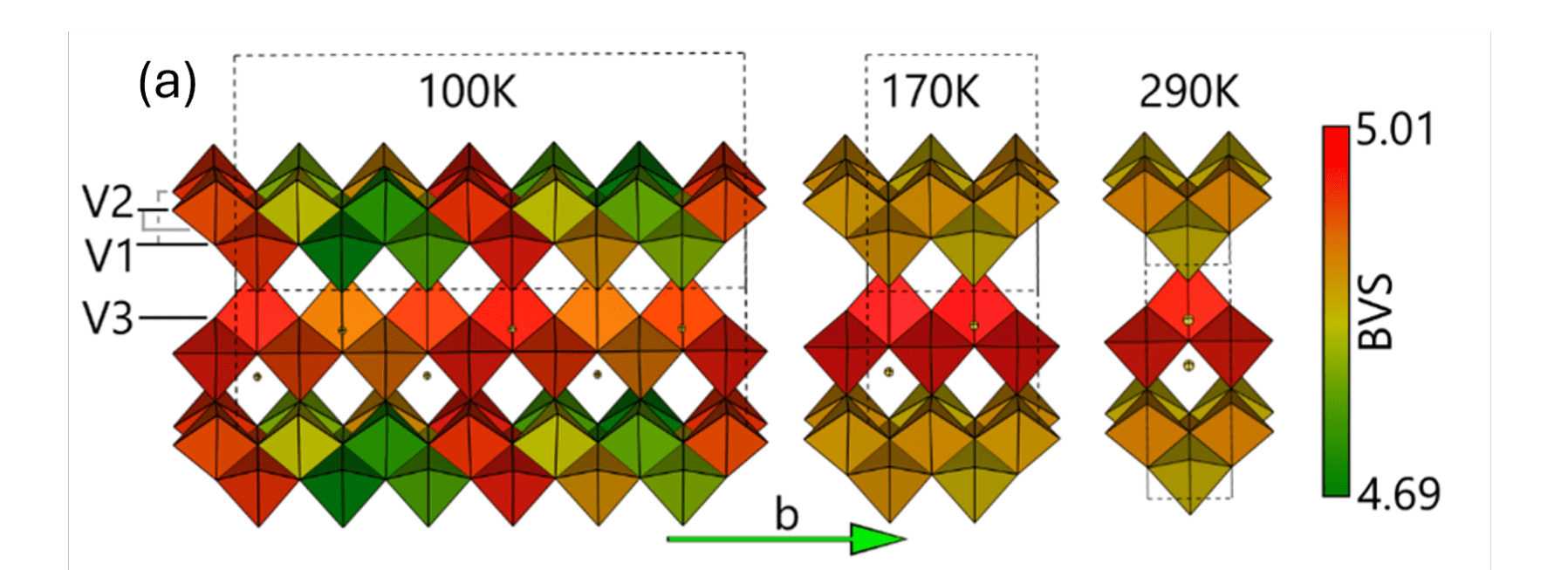
This switching behaviour, observed across a wide temperature range and characterised by substantial resistance changes, is primarily driven by electronic mechanisms rather than simple heating effects. Structural analysis using X-ray diffraction confirmed the development of a modulated structure consistent with the ordering of ions alongside charge ordering. These findings offer new insight into the interplay between localization, correlation, and non-equilibrium transport in low-dimensional oxides. The authors acknowledge that the precise mechanisms governing the electric field-induced switching require further investigation. However, the reproducible and temperature-dependent nature of the observed transitions highlights the potential of this material for cryogenic memory and neuromorphic computing applications. Future research will likely focus on optimising material properties and exploring device architectures to fully realise these technological possibilities.
👉 More information
🗞 Low-Frequency Noise and Resistive Switching in -Na V O
🧠 ArXiv: https://arxiv.org/abs/2511.00376

