Quantum computing could provide innovative solutions to complex problems in engineering structural design, such as weight optimization of laminated composite materials. Researchers from Delft University of Technology in the Netherlands have targeted stacking sequence retrieval with lamination parameters, mapping possible sequences onto a quantum state space. They also incorporated manufacturing constraints as penalty terms in the Hamiltonian. The team used a classical tensor network algorithm to validate their approach, demonstrating a tradeoff between accuracy and runtime. As quantum computing matures, it could significantly benefit complex engineering problems, particularly in the design of laminated composite materials.
What is the Role of Quantum Computing in Laminate Design?
Quantum computing, a rapidly developing field, may offer innovative solutions to complex and computationally intensive problems frequently encountered in engineering structural design. A prime example of such a problem is the weight optimization of laminated composite materials. This task remains challenging due to the exponentially large configuration space and nonlinear constraints. However, before applying any quantum algorithm to a problem, it must be translated into a form compatible with the underlying operations on a quantum computer.
In this context, the work of Arne Wulff, Boyang Chen, Matthew Steinberg, Yinglu Tang, Matthias Möller, and Sebastian Feld from the Faculty of Aerospace Engineering and the Faculty of Electrical Engineering, Mathematics, and Computer Science at Delft University of Technology in the Netherlands, specifically targets stacking sequence retrieval with lamination parameters. This is typically the second phase in a common bilevel optimization procedure for minimizing the weight of composite structures. To adapt stacking sequence retrieval for quantum computational methods, the team maps the possible stacking sequences onto a quantum state space. They further derive a linear operator, the Hamiltonian, within this state space that encapsulates the loss function inherent to the stacking sequence retrieval problem.
How are Manufacturing Constraints Incorporated in Quantum Computing?
The Delft University of Technology team also demonstrates the incorporation of manufacturing constraints on stacking sequences as penalty terms in the Hamiltonian. This quantum representation is suitable for a variety of classical and quantum algorithms for finding the ground state of a quantum Hamiltonian. For a practical demonstration, they chose a classical tensor network algorithm, the DMRG algorithm, to numerically validate their approach. For this purpose, they derived a matrix product operator representation of the loss function Hamiltonian and the penalty terms. Numerical trials with this algorithm successfully yielded approximate solutions while exhibiting a tradeoff between accuracy and runtime.
What is the Potential of Quantum Computing in Engineering?
The rapidly evolving field of quantum computing could offer crucial breakthroughs in addressing complex and computationally intensive problems across various engineering disciplines. As this technology continues to mature, the potential benefits it offers to complex engineering problems are becoming more apparent. However, the challenge lies in accurately identifying those scenarios where quantum computing holds an advantage and crafting algorithms to harness this potential. To address this, initiating the development of quantum algorithms for engineering applications now, in parallel with quantum hardware advancements, is essential. Such an approach positions us to immediately harness the full capabilities of quantum computing in engineering as soon as it becomes available.
How Can Quantum Computing Benefit the Design of Laminated Composite Materials?
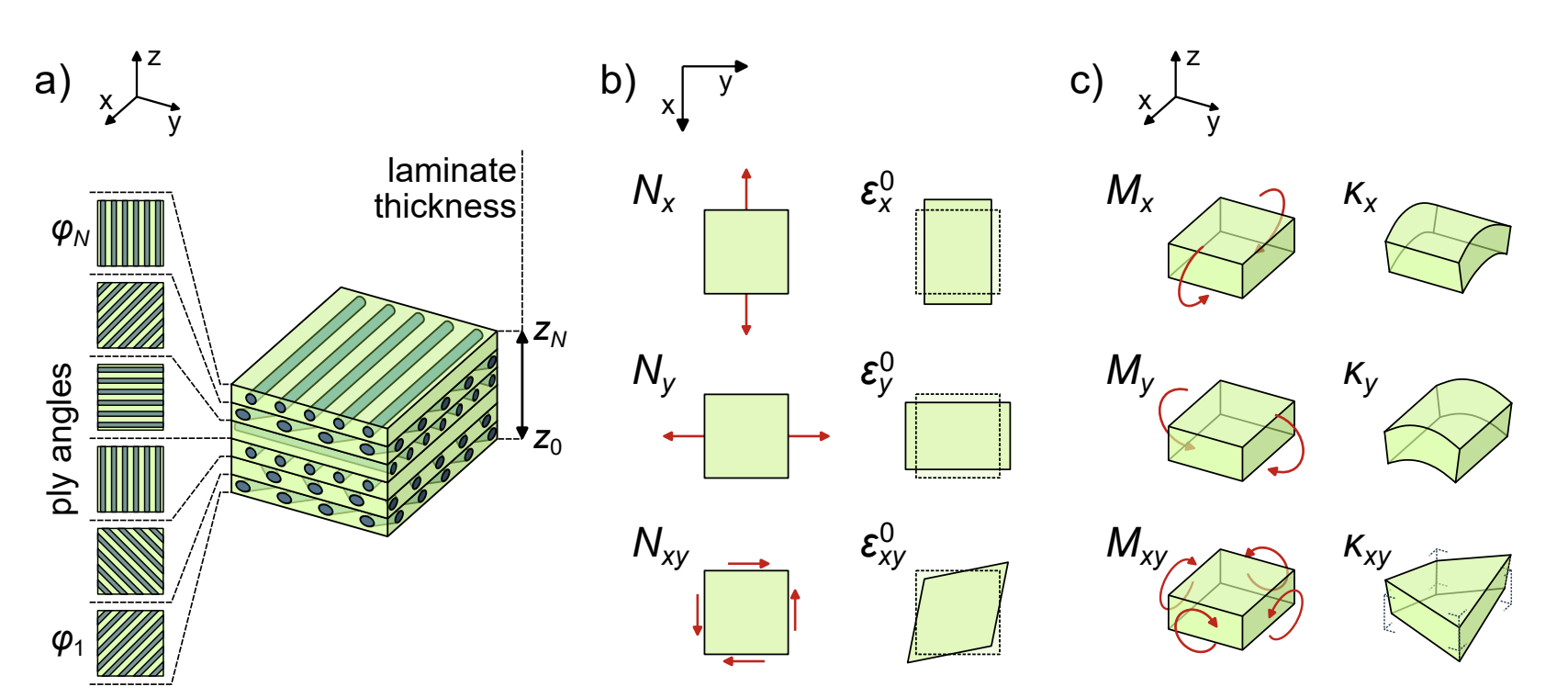
The design of laminated composite materials is an example of a complex engineering challenge that could benefit from a quantum-based approach. These materials are extensively used in aerospace applications for their high strength-to-weight ratio. These materials consist of many configurable layers, each impacting the overall stiffness. The stiffness characteristics of the whole material can, therefore, be tailored to the specific requirements of a structure. However, determining the optimal arrangement for specific applications from the exponentially large configuration space is a significant challenge, positioning laminated composites as a suitable candidate for quantum computing applications.
What is the Role of Quantum Computing in Optimizing Stacking Sequences?
A widely used method in designing composite structures involves a bilevel optimization procedure. The initial phase focuses on optimizing the material’s thickness and stiffness characteristics, expressed through lamination parameters. Subsequently, the second phase involves finding a feasible stacking sequence that aligns with the lamination parameters determined earlier. While the first phase typically employs continuous gradient descent methods, the second stage, stacking sequence retrieval, constitutes an intricate combinatorial optimization problem, particularly when incorporating manufacturing considerations. Quantum computing may offer a unique approach to effectively managing these complex, high-dimensional scenarios.
Approach to Stacking Sequence Retrieval”
Publication Date: 2024-02-09
Authors: Arne Wulff, Boyang Chen, Matthew P. Steinberg, Yanqiong Tang et al.
Source: arXiv (Cornell University)
DOI: https://doi.org/10.48550/arxiv.2402.06455