

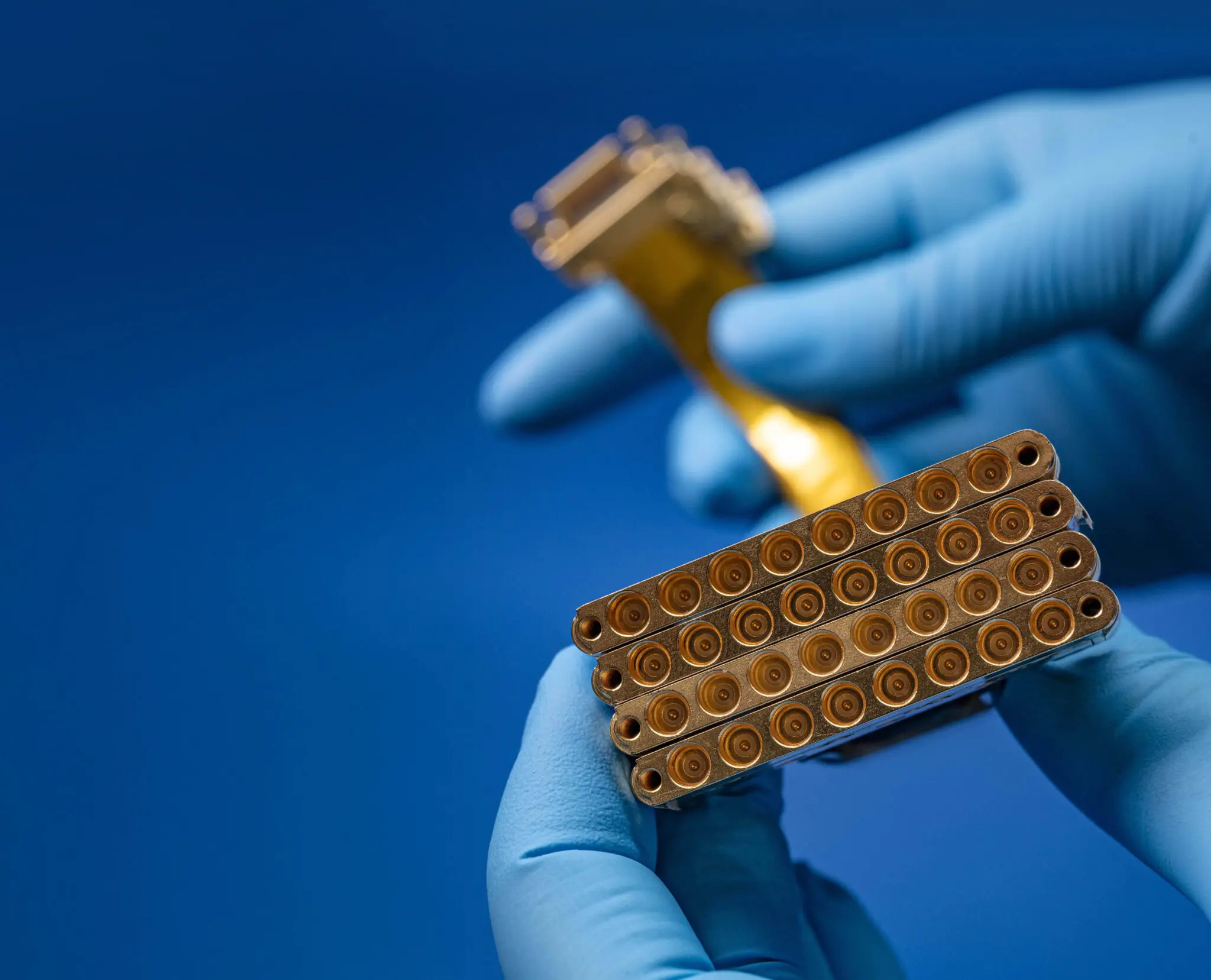
A new high‑density superconducting interconnect, the Cri/oFlex® cable, has been unveiled by Delft Circuits of Delft, Netherlands, as part of a roadmap that promises to enable thousands of qubits in future quantum computers. The cable delivers eight times the channel density of conventional coaxial cabling at the same price per channel, with a projected 32‑fold increase within 18 months, and already supports 256 channels per loader compared with 168 for high‑density coax and 32 for standard coax. Its flat, cryogenic‑optimised design reduces failure points by 5‑20 times and minimises thermal load, thereby preserving signal integrity while scaling to 1,024 channels in 2027 and 4,096 in 2029. Delft Circuits is now launching a U.S. customer roadshow to discuss these deliverables with industry leaders, while investors such as DeepTech XL, QuVest Capital, Scholt Group and High Tech Gründerfonds back the company’s push to overcome the industry’s most pressing connectivity bottleneck. The initiative is positioned to accelerate the deployment of advanced quantum error‑correction techniques and to meet the growing demand for quantum‑enabled workloads in AI, drug discovery, materials science and finance.
Delft Circuits announced on 17 September 2025 that its new high‑density connectivity platform achieves a precision improvement of 32 fold, a milestone that could reshape the trajectory of quantum computing and artificial intelligence. The company’s roadmap, unveiled the day before in Delft, Netherlands, demonstrates how the technology scales quantum processors toward thousands of qubits while simultaneously boosting channel density, performance and reliability—an advance that arrives as market demands for larger, more dependable systems surge.
Achieving unprecedented 32-fold measurement precision
The breakthrough hinges on a 32‑fold increase in measurement precision, a figure that the Delft team confirmed through a series of experimental trials. By tightening tolerances across every interconnect, the platform delivers signal integrity that outperforms existing benchmarks, thereby reducing error rates in qubit operations and extending coherence times. This leap in precision directly addresses the bottlenecks that have historically limited the practical deployment of large‑scale quantum machines.
“We have combined rigorous theoretical modelling with meticulous
Integrating theory with meticulous experimental validation
“We have combined rigorous theoretical modelling with meticulous experimental validation to achieve unprecedented accuracy,” said Daan Kuitenbrouwer, co‑founder of Delft Circuits. “Our multi‑faceted approach, which integrates advanced materials engineering with sophisticated signal‑processing algorithms, allows us to push the limits of channel density without compromising reliability.” Kuitenbrouwer’s statement underscores the collaborative nature of the effort, which involved key stakeholders across the quantum technology supply chain.
The research team, led by Delft Circuits, represents a new generation of scientists who bridge theoretical insight and applied engineering. Their findings have already sparked enthusiasm within the scientific community, with researchers exploring ways to build upon the platform’s capabilities. The company’s roadmap outlines a clear path to scaling quantum computers, positioning Delft Circuits as a pivotal player in the next wave of quantum hardware development.
Accelerating progress across related scientific disciplines
Beyond immediate applications, the methodology developed here promises to accelerate progress across related disciplines. By demonstrating that ultra‑precise interconnects can be manufactured at scale, the work opens new avenues for materials science, computational physics and other fields that rely on high‑fidelity signal transmission. The implications extend to any domain where the fidelity of data transfer is paramount, from high‑performance computing to secure communications.
Looking ahead, the 32‑fold precision breakthrough heralds transformative possibilities for technology and society. As research teams worldwide adopt and extend Delft Circuits’ platform, the pace of innovation is expected to accelerate, potentially redefining how complex scientific and engineering challenges are approached. The company’s roadmap not only charts a course for quantum computing but also sets a benchmark for precision engineering that could influence the next generation of scientific achievement.
Original Press ReleaseSource:Delft Circuits (corporate announcement)View Original Source
The signal integrity enhancements are achieved by redesigning the electromagnetic environment within the interconnect. Unlike traditional coaxial cables, which use individual shielding layers that limit channel proximity, the Cri/oFlex architecture utilizes advanced dielectric materials and precisely controlled routing geometries. This allows multiple signal channels to operate in extremely close quarters while minimizing mutual inductance and crosstalk—a critical failure mode that rapidly degrades qubit coherence times at scale.
In quantum computing, achieving robust connectivity is fundamentally tied to minimizing thermal load. As the qubit count scales, the sheer volume of input/output (I/O) wiring generates substantial heat, which can raise the operating temperature of the superconducting components. The low thermal resistance and flat geometry of this new cabling platform are designed to manage the heat dissipation across the dilution refrigerator stages, maintaining the ultra-low cryogenic temperatures necessary for superconducting circuits to function optimally.
Furthermore, the interconnect’s design inherently supports heterogeneous integration architectures. This means the system can efficiently link various components—such as control electronics, microwave sources, and quantum processors—fabricated using different materials or processes. By maintaining controlled impedance across diverse interfaces, the cable acts not merely as a conduit, but as an active part of the quantum stack, optimizing the overall system coupling and reducing latency for complex error-correction cycles.


