The interaction between light and matter typically governs how energy flows in physical systems, but when this interaction becomes exceptionally strong, a surprising phenomenon emerges: thermodynamic decoupling. S. Palafox, M. Salado-Mejía, M. Santiago-García, and R. Román-Ancheyta investigate this decoupling in the deep-strong coupling regime, where interactions overwhelm the fundamental frequencies of light and matter. Their work moves beyond traditional measurements focused on individual components, instead examining the overall energy flow within a system, and reveals that heat current effectively vanishes as coupling intensifies. This discovery demonstrates that decoupling is a widespread characteristic of this extreme interaction regime, and carries significant implications for the development of novel thermotronics.
Existing research, focused on systems at equilibrium, proves inadequate for describing energy flow in dynamic, non-equilibrium phenomena. This research focuses on cavity quantum electrodynamics, investigating systems where light and matter exchange energy intensely. They study open quantum systems, acknowledging the impact of the surrounding environment on these interactions and developing accurate descriptions of their evolution. A key aspect of this work is understanding the role of virtual photons, particles that exist as fleeting quantum fluctuations, and how they influence behaviour in these strongly coupled systems.
Researchers are refining methods for describing open quantum systems, noting that local master equations can sometimes fail to capture the full picture. Global master equations, which consider the system and environment as a single entity, offer greater accuracy but are more complex to solve. The significance of a specific term within a foundational model increases dramatically in the strong coupling regime. Scientists are also pursuing methods to directly detect virtual photons in superconducting quantum circuits. This research aims to enhance heat transfer and create quantum rectifiers, devices that control the direction of heat flow.
The development of quantum thermal machines, such as engines and refrigerators, is a central goal, with the potential to outperform classical devices. Researchers are pushing beyond standard theoretical approximations to accurately describe systems where light and matter interact very strongly. They are also exploring how to manipulate the properties of superconducting qubits using strain, offering a new avenue for control and optimization.
Decoupling Heat Current in Deep Strong Coupling
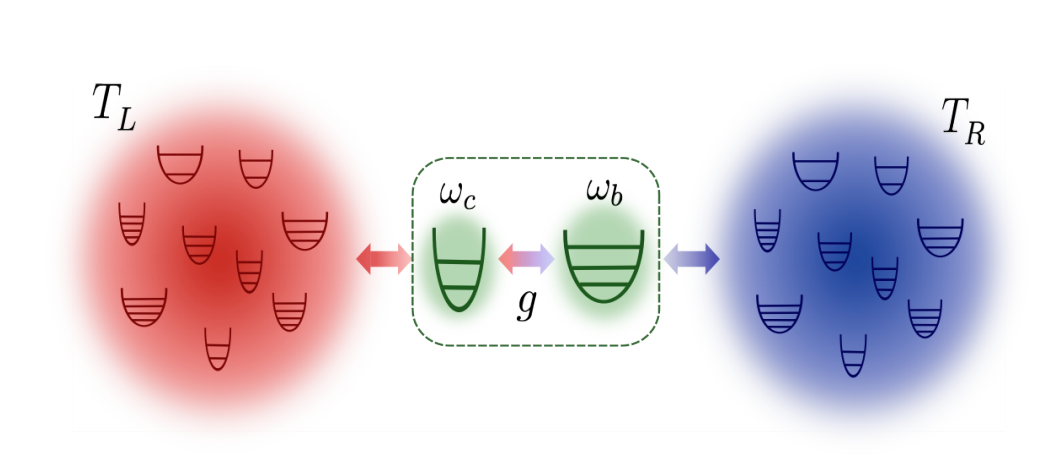
Scientists demonstrate a fundamental decoupling phenomenon in the deep-strong coupling regime, where the interaction between light and matter surpasses their inherent frequencies. This work extends previous observations to investigate energy flow in systems actively exchanging heat, a crucial step towards understanding complex, non-equilibrium phenomena. Researchers derived a consistent global master equation using a two-terminal quantum junction to model this interaction, allowing for the precise calculation of heat currents, a key measure in any quantum thermal machine. Experiments reveal that, in the deep-strong coupling regime, the heat current approaches zero, indicating a suppression of energy transfer.
This decoupling is linked to the proliferation of virtual photons, particles existing in the vacuum ground state, which become increasingly significant as the light-matter coupling strengthens. The team analytically determined the dissipation rates of both upper and lower polaritons, hybrid light-matter quasiparticles, finding these rates are independent of temperature, confirming the robustness of this decoupling effect and providing insights applicable to room-temperature experiments. The team calculated the steady-state heat current and derived compact expressions for virtual photon populations across a wide range of coupling strengths, from weak to the deep-strong coupling regime.
Results demonstrate that the heat current diminishes proportionally to the inverse of the coupling strength in the deep-strong coupling regime, irrespective of resonant conditions. This suppression occurs as the virtual photon population increases linearly with the coupling strength, a finding with significant implications for quantum thermodynamics and the design of efficient quantum thermal machines where precise control of heat currents is essential. The study introduces the concept of thermodynamic decoupling, describing the suppression of heat current between two thermal baths connected by coupled systems in the deep-strong coupling regime. Researchers diagonalized the Hopfield Hamiltonian, revealing the frequencies of the upper and lower polaritons, providing a foundational understanding of energy transfer in strongly coupled systems and paving the way for innovative applications in quantum technologies.
Strong Coupling Diminishes Heat Current Flow
Scientists demonstrate a thermodynamic decoupling in the deep-strong coupling regime, where the interaction between light and matter surpasses their individual frequencies. By developing a consistent global master equation to describe this interaction, the team showed that heat current, a crucial observable, diminishes as light-matter coupling strengthens. This finding highlights the role of virtual photons originating from the vacuum ground state in mediating this decoupling effect. The research utilized an open Hopfield model, resembling an atomic junction connecting thermal baths, to investigate heat flow.
Through their master equation, scientists identified temperature-independent dissipation rates for upper and lower polaritons and successfully reproduced the breakdown of the Purcell effect, a phenomenon impacting spontaneous emission. Importantly, the study revealed that the heat current always vanishes in the deep-strong coupling regime, a process termed thermodynamic decoupling, and demonstrated a relationship between the population of virtual photons and the decreasing heat current as coupling increases. The authors anticipate that their findings will contribute to ongoing quantum thermodynamics experiments, particularly those focused on controlling heat transport at the quantum level. The team hopes this work will pave the way for advancements in understanding and manipulating energy flow in quantum systems.
🗞 Thermodynamic decoupling in the deep-strong coupling regime
🧠 ArXiv: https://arxiv.org/abs/2510.20969