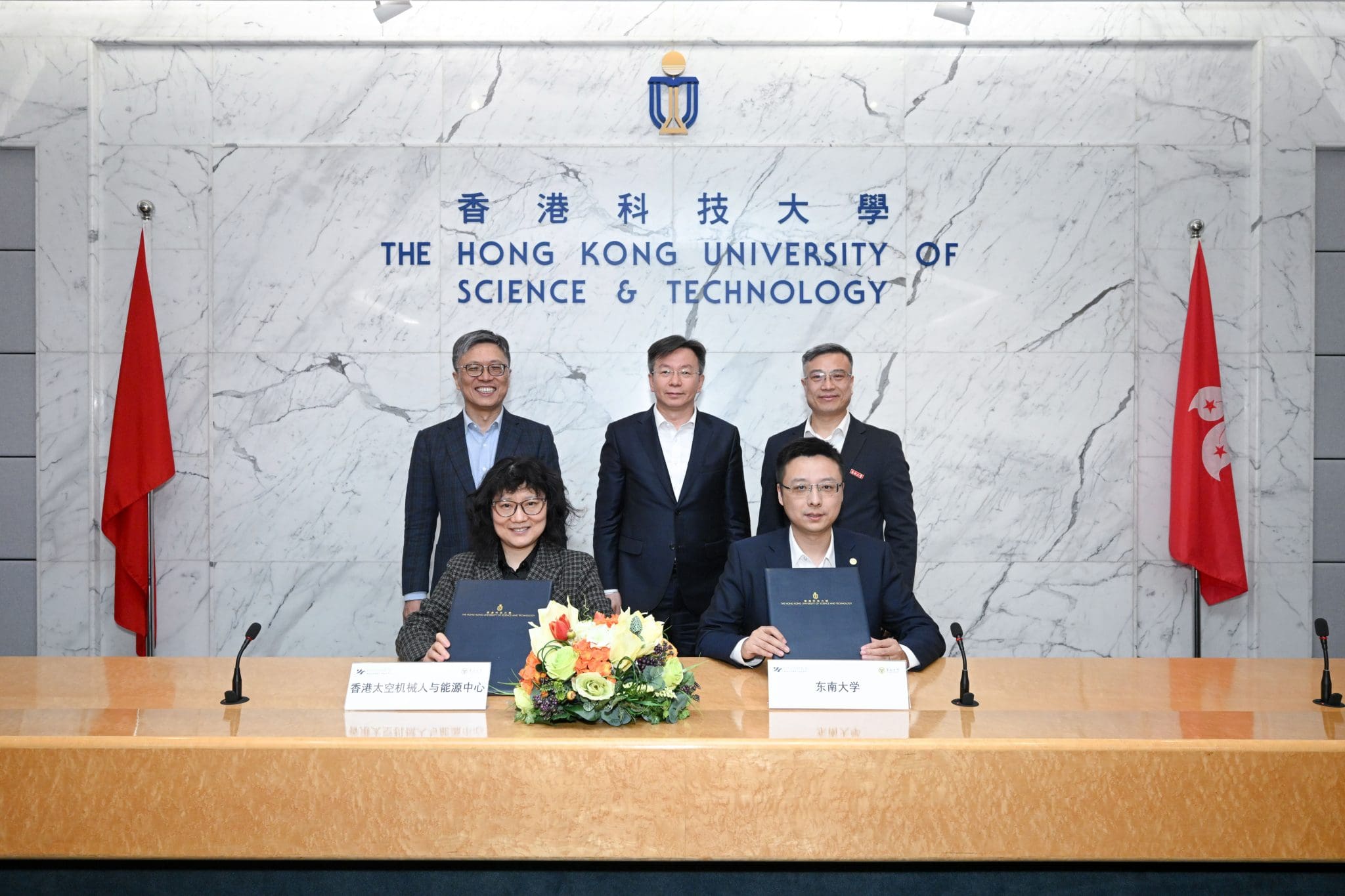
The Hong Kong University of Science and Technology (HKUST) is expanding its research into deep space exploration through a new strategic partnership with Southeast University (SEU). Led by HKUST’s Hong Kong Space Robotics and Energy Centre, the collaboration will focus on advancements in space robotics, deep space energy systems, and embodied intelligence, supporting a national goal to become a leading aerospace center. A Memorandum of Understanding (MoU) was signed by Prof. GAO Yang, Director of HKSREC, and Mr. WANG Chen, Director of the Hong Kong, Macao, and Taiwan Office at SEU, with the ceremony witnessed by Mr. LI Zhongjun, Mayor of the Nanjing Municipal People’s Government, Prof. Harry SHUM, HKUST Council Chairman, and Mr. WU Xiaocheng, Secretary of the Party Committee of SEU. “I hope to deepen collaboration with HKUST in innovation, industrial development, and talent cultivation,” said Li Zhongjun, indicating a commitment to joint progress in these fields.
HKUST & Southeast University Formalize Deep Space Exploration Partnership
This commitment to practical application is underscored by HKUST’s patent utilization rate, exceeding 30 percent, a figure comparable to leading European and American universities. The impetus for this deepened collaboration became apparent during a delegation from the Nanjing Municipal People’s Government’s visit to HKUST’s Clear Water Bay campus on March 8. Mr. LI Zhongjun, Mayor of the Nanjing Municipal People’s Government, articulated a clear vision for the partnership, stating, “Nanjing is rich in scientific and educational resources, and enhanced cooperation between HKUST and the city’s higher education institutions would help establish new innovation platforms and projects, setting a benchmark for Nanjing-Hong Kong collaboration.” He further highlighted the alignment of Nanjing’s focus on advanced manufacturing, particularly in AI and biomedicine, with HKUST’s core academic competencies, which is expected to accelerate the industrialization of new technologies and research outcomes, a key objective for both institutions.
Prof. Harry Shum, HKUST Council Chairman, emphasized the university’s commitment to translating research into societal progress, noting that HKUST’s development closely aligns with the nation’s strategic priorities. He expressed confidence that the partnership would not only advance Jiangsu-Hong Kong cooperation but also contribute to China’s broader innovation-driven endeavors. The collaboration builds upon an existing partnership established in 2024, launching a seed fund to support joint research in multiple disciplines, and SEU’s participation in the HKUST-led international “Hong Kong Operation Robot” project for Chang’E 8, the lunar surface operation robot. Wu Xiaocheng, Secretary of the Party Committee of SEU, added, “We sincerely appreciate HKUST’s dedicated support for SEU,” anticipating that the partnership will provide strategic guidance for SEU’s academic positioning and research development within the Greater Bay Area.
HKSREC Focus: Robotics, AI, and Space Energy Systems
The convergence of robotics, artificial intelligence, and space energy systems is rapidly reshaping the possibilities for deep space exploration and terrestrial technological advancement; current efforts center on enhancing robotic autonomy, improving energy efficiency in extreme environments, and translating space-derived technologies for broader applications. This collaboration is designed to bridge the gap between fundamental research and practical industrial deployment. Central to this partnership is a shared focus on several key areas, including embodied intelligence and high-precision autonomous navigation, crucial for robotic operations when satellite connectivity is unavailable. Researchers will jointly investigate efficient space-energy management systems, vital for prolonged deep-space missions, and explore how advanced materials and robotic control systems developed for space can be adapted for high-end manufacturing and smart city initiatives within the Greater Bay Area. This synergistic approach leverages HKUST’s strengths in AI, robotics, and data science with SEU’s expertise in mechanical engineering and energy systems, and will establish joint training programs for postgraduate students and researchers, fostering the development of a highly skilled workforce.
With a patent utilization rate exceeding 30% – comparable to leading universities in Europe and the United States – enterprises founded by HKUST faculty and alumni are shaping the technological innovation landscape of the Greater Bay Area (GBA) and beyond.
Nanjing Delegation Tours HKUST’s Key State Laboratories
The visit underscored a growing partnership between HKUST and Southeast University (SEU), formalized through a Memorandum of Understanding intended to accelerate advancements in space robotics and energy systems. Professor Zhiyong Fan, Chair Professor of HKUST’s Department of Electronic and Computer Engineering, personally guided the delegation through the State Key Laboratory of Displays and Optoelectronics, showcasing research projects and facilities critical to the collaboration. The partnership focuses not only on theoretical research but also on practical application, with a clear emphasis on translating innovation into tangible outcomes. He further highlighted Nanjing’s focus on building an advanced manufacturing cluster centered around AI and biomedicine, areas that align closely with HKUST’s academic strengths.
We sincerely appreciate HKUST’s dedicated support for SEU. This collaboration will strengthen the ties between the two universities while providing strategic guidance for SEU’s academic positioning and research development in the Greater Bay Area (GBA).
This is not merely an academic exercise; it’s a deliberate strategy to ensure research generates “productive forces that drive societal progress,” as stated by Prof. Harry Shum, HKUST Council Chairman. The combined expertise of both institutions, leveraging HKUST’s strengths in AI, robotics, and advanced materials with SEU’s engineering prowess, aims to address challenges in autonomous space robotics and sustainable space energy utilization, ultimately enhancing both universities’ international standing in aerospace research.
We look forward to establishing a stable cooperation mechanism with HKUST to accelerate the industrialization of new technologies and research outcomes.