Geodesic problems, which seek the most efficient paths between points while minimising distance or energy, appear across diverse fields from robotics and optics to general relativity and control theory. Conor Rowan from University of Colorado Boulder and colleagues demonstrate that these ubiquitous problems are particularly well-suited to solution using the Deep Ritz method, a technique from scientific machine learning. The team argues that the inherent simplicity and non-linearity of geodesic problems allow the Deep Ritz method to excel, and they support this claim with successful applications in path planning, light propagation, and solid mechanics. This work establishes a promising new direction for scientific machine learning research, showcasing a powerful approach to solving complex optimisation challenges.
Geodesic problems involve finding the shortest paths between points, fundamental to fields like geometry, physics, and robotics. Traditional methods can be computationally expensive or require iterative refinement. The core idea involves recasting the geodesic problem as a minimization problem, seeking the function that minimizes a specific energy functional.
A deep neural network then approximates the solution, the geodesic path itself. The network is trained by minimizing a loss function representing the energy functional, effectively forcing it to learn the geodesic path. A key advantage is the ability to directly enforce boundary conditions, specifying the starting and ending points of the geodesic, within the network architecture. This approach is well-suited for variational problems like geodesic calculations and is applicable to complex geometries, offering a versatile tool for various scientific and engineering applications. Future work will investigate performance on larger problems and rigorously compare it with traditional methods in terms of accuracy, efficiency, and scalability.
Geodesic Paths via Functional Minimization
Scientists developed a novel approach to solving geodesic problems, challenging boundary value problems encountered in diverse fields like path planning, optics, and general relativity. Recognizing the limitations of conventional methods, which often rely on iterative “shooting methods”, the team formulated the problem as a static boundary value problem. This innovative framing treats the initial and final states of the geodesic path as fixed conditions, circumventing the need to iterate initial velocities and significantly reducing computational cost. Instead of solving complex equations, the research pioneers direct minimization of the objective functional defining the geodesic path.
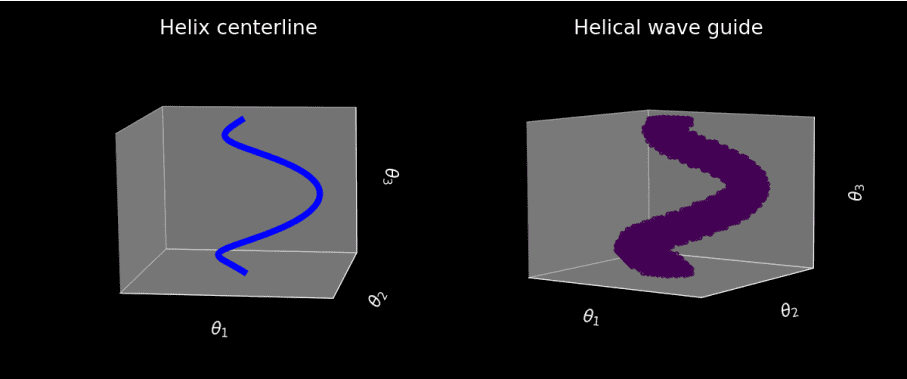
This approach leverages the inherent variational structure of geodesic problems, allowing scientists to directly compute the path minimizing distance, cost, or energy. The study demonstrates the effectiveness of this approach across three distinct applications: path planning, modeling light propagation in optics, and determining trajectories within solid mechanics. By framing the problem as a static boundary value problem and directly minimizing the objective functional, the team avoids the computational burden associated with traditional shooting methods. Researchers investigated three numerical examples, beginning with path planning, where the method efficiently determined optimal trajectories. In a waveguide problem, experiments revealed that embedding specific features significantly improved performance, likely due to the initial path geometries already exhibiting winding characteristics. The team then turned to solid mechanics, computing minimal trajectories for a linearly elastic bar.
They developed an energy functional to measure deformation, ultimately defining it as the integral of the square of the second derivative of displacement. Discretization involved representing displacement using a multi-layer perceptron with specific parameters, resulting in a network approximating the geodesic path. The initial and final states were defined to create a specific deformation scenario. Results show rapid convergence of the objective function to a minimum, indicating successful determination of the minimal deformation trajectory. The converged value of the energy functional quantified the extent of deformation required to optimally transport one function to another. Researchers established that these problems, characterized by simple geometry, a variational structure, and natural nonlinearity, are particularly well-suited for this machine learning approach. The method efficiently solves for trajectories minimizing a defined measure of distance or energy, offering a direct way to satisfy initial and final conditions without iterative adjustments. While acknowledging the effectiveness of established methods for linear problems, this research highlights the potential of machine learning approaches for specific problem types exhibiting the identified characteristics.
👉 More information
🗞 Finding geodesics with the Deep Ritz method
🧠 ArXiv: https://arxiv.org/abs/2510.15177