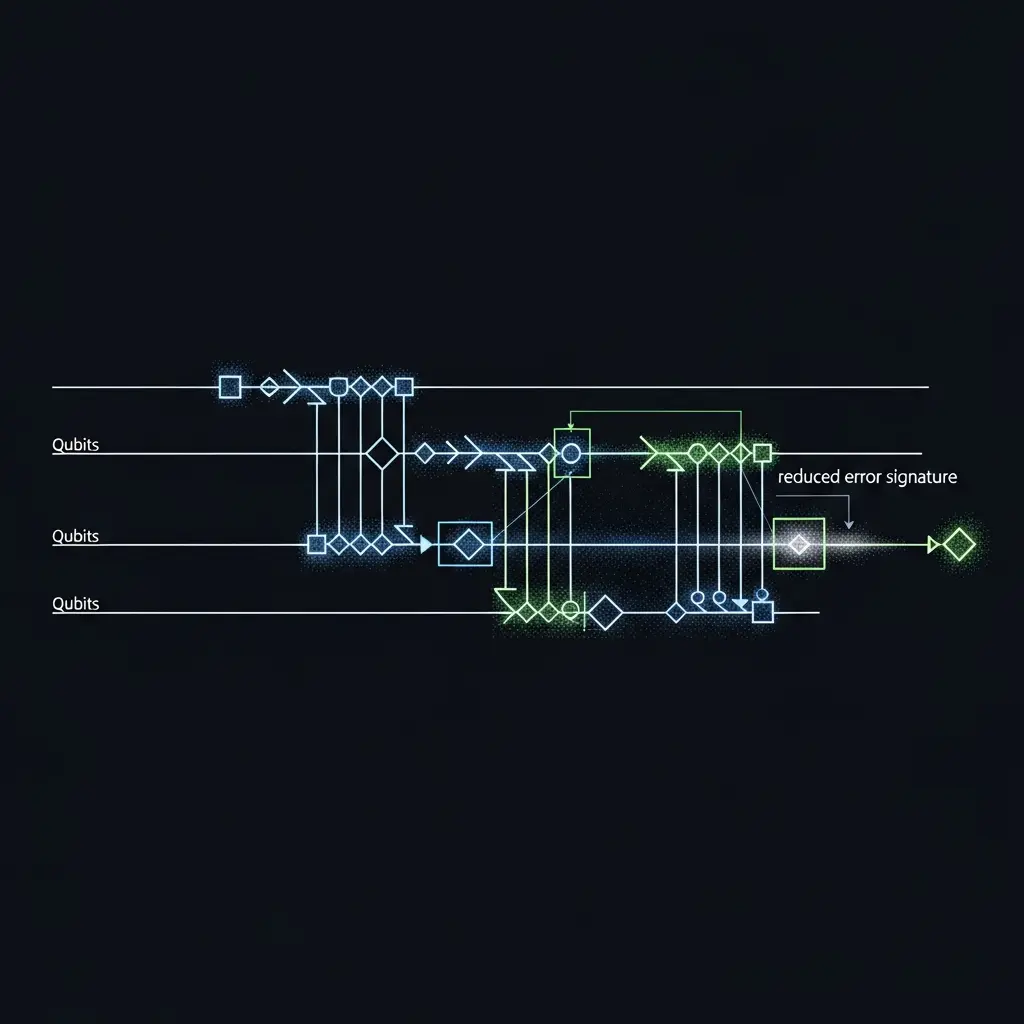
Quantum error mitigation represents a crucial step towards realising the potential of near-term quantum computers! Researchers Leonardo Placidi (Quantinuum K.K., The University of Osaka, and QIQB Center for Quantum Information and Quantum Biology), Ifan Williams and Enrico Rinaldi (both from Quantinuum Ltd. and Center for Quantum Computing, RIKEN) et al. have now systematically investigated deep learning approaches to improve the reliability of results from noisy quantum circuits. Their work demonstrates that sequence-to-sequence and attention-based models consistently outperform existing error mitigation techniques across a range of circuit depths and qubit numbers , utilising both simulated and real data from superconducting processors! This advance is significant because it offers a promising pathway to extract meaningful results from today’s imperfect quantum hardware, potentially accelerating progress in areas like materials science and drug discovery.
Deep learning boosts quantum error mitigation performance significantly
The study involved a comprehensive comparison of different deep learning architectures and training methodologies, focusing on prediction and correction models for mitigating probability distributions. Researchers trained and optimized these models using a remarkably large and diverse dataset comprising over 246,000 unique circuits, including extensive hardware data collected over several months via the Quantinuum Nexus platform. This expansive dataset allowed the models to account for time drift and noise fluctuations, a critical factor in real-world quantum systems. Two primary classes of five-qubit circuits were employed: those with random gates, inspired by random circuit sampling, and those constructed from random Pauli gadgets, motivated by dynamical simulation.
The models utilize input features including circuit encoding, noisy probability distributions, and device characterization data, with ablation studies revealing the noisy probability distribution as the most crucial input. Interestingly, removing circuit information did not significantly degrade performance for recurrent neural networks or attention-based models, suggesting they learned to mitigate noise rather than simply simulate the original circuit. This finding highlights the models’ ability to generalize and adapt to different quantum computations. Furthermore, the research establishes the effectiveness of transfer learning between different circuit classes and hardware devices. Generative attention-based models demonstrated robust performance when transferring from one QPU (IBM Algiers) to another (IBM Hanoi) without requiring complete retraining, provided the hardware characterization data remained current. This capability is crucial for practical implementation, enabling pre-trained models to be continuously refined with expanded datasets and deployed across diverse quantum hardware platforms, ultimately accelerating the development of fault-tolerant quantum computing.
Deep Learning for Quantum Error Mitigation is a
To construct their comprehensive dataset, researchers generated over 246,000 unique five-qubit circuits, incorporating both random gate circuits, inspired by random circuit sampling, and circuits built from random Pauli gadgets, motivated by dynamical simulation. The study harnessed data collected over several months using Quantinuum Nexus, facilitating the capture of time-dependent noise fluctuations and drift. Experiments employed noisy simulation data for initial model training, followed by fine-tuning using real hardware data, and further extended to transfer learning on a different QPU, showcasing the adaptability of the developed methods. The team meticulously performed a series of ablation studies to assess the impact of different input features, including circuit structure, device properties, and noisy output statistics, on overall performance.
These studies also examined cross-dataset generalization across different circuit families and the efficacy of transfer learning to a distinct QPU, revealing that generalization across similar devices with identical architectures functioned effectively without requiring complete model retraining. This innovative approach enables the creation of robust error mitigation strategies applicable across diverse quantum hardware platforms! The technique reveals a pathway towards pre-trained models continuously refined with expanding datasets, promising a scalable solution for quantum error mitigation.
Deep learning boosts quantum circuit accuracy
The team measured the performance of these models using noisy probability distributions as input, alongside circuit and device properties, demonstrating that the noisy probability distribution is the most important feature, with circuit and backend information acting as secondary conditioning factors. Data shows that removing circuit information does not significantly degrade performance for recurrent neural networks or attention-based models, indicating they haven’t simply learned to simulate the original circuit. Researchers recorded that generative attention-based models are the most robust to shifts in datasets and hardware, transferring effectively between devices like ibm algiers and ibm hanoi without full retraining, provided the hardware characterization data remains comparable. Tests prove that models trained on one device transfer effectively to another, highlighting the importance of noisy output statistics on performance.
Transfer learning between random and Pauli circuit types was less successful, demonstrating the models’ dependence on circuit type due to differences in output distributions. The study utilized two application-motivated classes of circuits: Pauli Synthetic circuits with maximum time steps of T ∈{3, }, and Random circuits with maximum time steps of T ∈{48, }. Each circuit was converted into a 3D array, Carray, of shape (nl, nqubits, |G|) = (nl, 5, 5), where nl represents the number of layers and |G| is the size of the gate set. Furthermore, the work is limited to quantum circuits with few qubits, allowing for isolation of input features, training strategy, and model architectures in a controlled setting.
Measurements confirm that this approach provides guiding principles for improving the architectural design of machine learning-based error mitigation, even as scaling challenges remain. The research team used two 27-qubit superconducting transmon devices, ibm algiers and ibm hanoi, retrieving calibrated QPU properties like qubit frequencies, T1 and T2 decay times via a public API. This detailed analysis of robustness and generalization offers a significant step towards more reliable quantum computation.
Deep Learning Outperforms Quantum Error Mitigation in certain
The findings establish that deep learning models can effectively mitigate noise in quantum computations, matching or exceeding the performance of standard baseline methods like SPAM correction, the Repolarizer, and Thresholding. Ablation studies revealed that model performance heavily relies on the input of noisy distributions, enabling effective transfer learning between similar QPUs without complete retraining. This suggests a practical pathway for deploying these models across multiple devices within the same technology generation. The authors acknowledge a limitation in focusing solely on distribution mitigation, excluding methods targeting specific observable expectation values! Future research could explore extending these models to address expectation value mitigation and scaling these techniques to larger, more complex quantum systems.
👉 More information
🗞 Deep Learning Approaches to Quantum Error Mitigation
🧠 ArXiv: https://arxiv.org/abs/2601.14226