The identification of quantum entanglement remains an open challenge in the field of quantum information protocols and algorithms, particularly for systems larger than 23 qubits. Researchers from the Institute of Theoretical Physics at Wrocław University of Science and Technology have employed deep convolutional neural networks (CNNs) to identify quantum entanglement in a 3-qubit system. By training the model on synthetically generated datasets and applying entanglement-preserving symmetry operations, the team achieved high accuracy and generalization ability, even for challenging positive under partial transposition (PPT) entangled states. This breakthrough has significant implications for the development of quantum information protocols and algorithms.
Can Quantum Entanglement Be Identified with Deep Learning?
The identification of quantum entanglement has long been a topic of interest in the field of quantum information protocols and algorithms. Despite significant progress, the problem of identifying entanglement remains an open challenge for systems larger than 23 qubits. In this study, researchers from the Institute of Theoretical Physics at Wrocław University of Science and Technology have employed deep convolutional neural networks (CNNs) to identify quantum entanglement in a 3-qubit system.
The team used a type of supervised machine learning approach to train the model on synthetically generated datasets of random density matrices, excluding challenging positive under partial transposition (PPT) entangled states. The results showed that training the model on these datasets led to good model accuracy, even for PPT states that were outside the training data. The goal was to enhance the model’s generalization ability on PPT states.
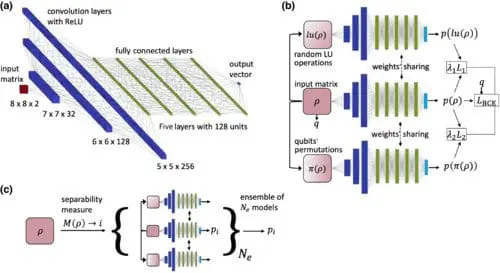
The researchers achieved this by applying entanglement-preserving symmetry operations through a triple Siamese network trained in a semi-supervised manner. This approach improved the model’s accuracy and ability to recognize PPT states. Furthermore, constructing an ensemble of Siamese models led to even better generalization, analogous to finding separate types of entanglement witnesses for different classes of states.
What is Quantum Entanglement?
Quantum entanglement is a fundamental property commonly used in various quantum information protocols and algorithms. It is a phenomenon where two or more particles become correlated in such a way that the state of one particle cannot be described independently of the others, even when they are separated by large distances.
In other words, entangled particles are connected in a way that allows them to affect each other instantaneously, regardless of the distance between them. This property has been extensively studied and applied in various fields, including quantum computing, cryptography, and teleportation.
Can Deep Learning Identify Quantum Entanglement?
The identification of quantum entanglement is a challenging problem, especially for systems larger than 23 qubits. Traditional machine learning approaches have been used to identify entangled states, but these methods are often limited in their ability to generalize to new, unseen data.
Deep convolutional neural networks (CNNs) have shown promise in identifying entangled states, particularly in the study of quantum many-body systems. The use of CNNs allows for the automatic extraction of optimal features from complex datasets, enabling the identification of subtle patterns and correlations that may not be apparent through traditional analytical methods.
How Do Siamese Networks Work?
Siamese networks are a type of neural network architecture that consists of two or more identical sub-networks that share weights. In the context of entanglement detection, a triple Siamese network was used to apply entanglement-preserving symmetry operations to the input data.
The network was trained in a semi-supervised manner, allowing it to learn from both labeled and unlabeled data. This approach enabled the model to generalize better to new, unseen data, including PPT states that were outside the training data.
What is the Significance of this Study?
The study demonstrates the potential of deep learning approaches, specifically CNNs, in identifying quantum entanglement. The use of Siamese networks and semi-supervised learning enabled the model to generalize well to new data, including challenging PPT states.
This research has significant implications for the development of quantum information protocols and algorithms, particularly in the study of quantum many-body systems. The ability to identify entangled states with high accuracy and generalization is crucial for the development of reliable and efficient quantum computing and communication systems.
Future Directions
The study highlights the potential of deep learning approaches in identifying quantum entanglement. However, there are still several challenges that need to be addressed before this approach can be widely adopted.
Future directions include exploring other neural network architectures and training methods to improve the model’s generalization ability. Additionally, the development of more robust and efficient algorithms for entanglement detection is necessary to ensure the scalability of quantum information protocols and algorithms.
Conclusion
In conclusion, the study demonstrates the potential of deep learning approaches in identifying quantum entanglement. The use of CNNs and Siamese networks enabled the model to generalize well to new data, including challenging PPT states.
This research has significant implications for the development of quantum information protocols and algorithms, particularly in the study of quantum many-body systems. The ability to identify entangled states with high accuracy and generalization is crucial for the development of reliable and efficient quantum computing and communication systems.
Publication details: “Identification of quantum entanglement with Siamese convolutional neural networks and semisupervised learning”
Publication Date: 2024-07-26
Authors: Jarosław Pawłowski and Mateusz Krawczyk
Source: Physical Review Applied
DOI: https://doi.org/10.1103/physrevapplied.22.014068