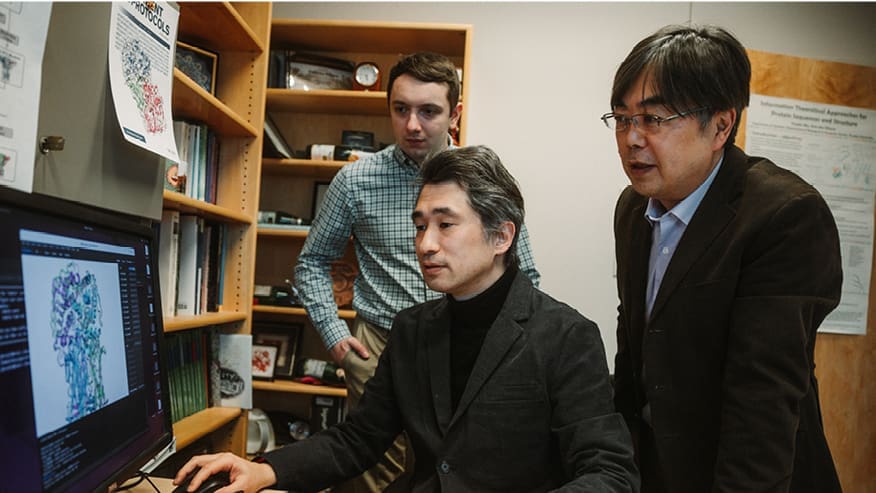
Molecular Intelligence, a software startup launched by Purdue University experts Daisuke Kihara, Charles Christoffer, and Genki Terashi, has developed innovative tools to determine the 3D structures of biomolecules from cryo-EM image data. Their solution employs deep learning to analyze low-resolution cryo-EM maps, addressing the challenges of time-consuming and error-prone manual modeling. Targeting researchers in bioengineering, medical science, and pharmaceuticals, the software automates structure determination, requiring no special training. Additionally, Molecular Intelligence offers modeling services, enhancing accessibility for users. The startup, formed in summer 2024, secured an exclusive license from Purdue Innovates in January 2025, marking a significant step in advancing cryo-EM applications and supporting drug discovery efforts.
Introduction to Molecular Intelligence
Molecular Intelligence is a software startup that specializes in determining 3D structures of biomolecules using cryo-EM data. Their innovative approach leverages deep learning to automate the process, addressing the challenges posed by traditional methods.
The company’s cryo-EM software employs advanced algorithms to analyze and interpret low-resolution data efficiently. This automation significantly reduces the time and effort required for model building, a task that is often complex and time-consuming with conventional techniques.
Molecular Intelligence’s solutions are designed to be accessible, offering options for purchase or modeling services. This makes cryo-EM more approachable without requiring specialized training. Their work is supported by publications in leading journals like Nature Methods and Structural Biology, demonstrating the robustness of their deep learning methodologies.
The Emergence and Drawbacks of Cryo-EM
Cryo-EM has become a cornerstone of structural biology, enabling researchers to study molecular structures at near-atomic resolution. Its adoption has been driven by advancements in detector technology and computational algorithms, allowing for the exploration of large complexes and dynamic processes that were previously difficult to analyze.
However, cryo-EM faces challenges such as low-resolution data, particularly for smaller proteins or less stable structures, which can lead to uncertainties in model accuracy. Additionally, traditional workflows require extensive manual adjustments and expertise, making them time-consuming and prone to human error.
The limitations of conventional cryo-EM workflows are compounded by the need for iterative rounds of model building, validation, and refinement. These processes are labor-intensive and may introduce biases into structural interpretations, especially in high-throughput settings or when working with novel systems lacking prior structural information.
Molecular Intelligence’s Software
Molecular Intelligence addresses these challenges through advanced deep learning algorithms tailored for cryo-EM data analysis. Their software automates model building, reducing the time and effort traditionally required and enhancing both speed and accuracy. This automation is particularly valuable for applications such as drug development and understanding molecular mechanisms.
The company’s work contributes significantly to advancing cryo-EM technology, facilitating faster research progress and more accurate molecular insights across various scientific domains.
More information
External Link: Click Here For More