The increasing prevalence of cyber threats demands more robust authentication methods than traditional passwords alone, and multi-factor authentication (MFA) offers a powerful solution by combining different verification layers. Abdelilah Ganmati, Karim Afdel, and Lahcen Koutti, all from Ibn Zohr University, lead a comprehensive survey exploring the integration of deep learning with biometrics and smart card technology to enhance MFA systems. This work synthesises recent advancements, demonstrating how deep learning significantly improves the accuracy and security of biometric identification, while smart cards provide a secure hardware foundation for authentication. By analysing various biometric modalities, such as facial and fingerprint recognition, alongside hardware-based approaches, the researchers highlight strategies for deploying secure and user-friendly authentication frameworks in critical sectors including banking, healthcare, and infrastructure, and also identify key challenges and future research directions in this rapidly evolving field.
Multi-Modal Biometrics, Advances and Future Challenges
This document presents a comprehensive survey of multi-modal biometric authentication, exploring the current state-of-the-art in secure identification technologies. The research focuses on systems that combine two or more biometric traits, such as facial features combined with iris patterns, to improve accuracy, reliability, and security. The study examines advancements in algorithms, datasets, and security measures, including methods to detect and prevent spoofing attacks, and identifies emerging trends in the field. Multi-modal biometrics combines multiple unique biological characteristics for enhanced authentication, offering a more robust solution than relying on a single trait.
The research highlights the importance of detecting fraudulent biometric samples, such as photographs or fake fingerprints, and demonstrates how deep learning techniques are increasingly used to address this challenge. Deep learning, a powerful form of artificial intelligence, is employed for extracting relevant features from biometric data, classifying individuals, and detecting potential attacks. Different system architectures, such as match-on-card and match-on-host, are also explored, each offering unique advantages in terms of security and performance. Behavioral biometrics, which analyzes unique patterns in user behavior like keystroke dynamics or gait, offers the potential for continuous authentication, providing ongoing verification rather than a one-time login.
The study references several key datasets used for training and evaluating biometric systems, including large-scale face datasets like Labeled Faces in the Wild and VGGFace2, which contain images with variations in pose and age. The CASIA Iris Database and FVC2004 fingerprint dataset provide valuable resources for evaluating iris and fingerprint recognition algorithms, respectively. Researchers also utilize datasets like PlusVein-FV3, which focuses on finger vein patterns, and SOTAMD, a multimodal biometric dataset. The research acknowledges the vulnerability of deep learning models to adversarial attacks, where subtle alterations to input data can fool the system.
Robust presentation attack detection techniques are crucial for mitigating this threat. The study identifies emerging trends such as explainable AI, which aims to understand why a biometric system makes a certain decision, and privacy-preserving biometrics, which protects user data while still enabling authentication. Integration with mobile devices and the Internet of Things is expanding the reach of biometric authentication, and continuous, adaptive authentication systems are combining multiple modalities and behavioral biometrics for ongoing verification. Ultimately, the research paints a picture of a rapidly evolving field where multi-modal biometrics, powered by deep learning, are becoming increasingly important for secure and convenient authentication, while also highlighting ongoing challenges related to security, privacy, and robustness.
Deep Learning Secures Multifactor Authentication Systems
Multi-factor authentication (MFA) has emerged as a critical component of secure access control in an increasingly interconnected digital world, and recent research demonstrates significant advancements in its capabilities. Academics have successfully integrated deep learning techniques with biometric modalities, including face, fingerprint, and iris recognition, and hardware tokens like smart cards and secure enclaves, to create more accurate and resilient authentication systems. Improvements in areas such as liveness detection and multimodal fusion, combining multiple biometric traits, enhance security and usability compared to traditional single-factor methods. This work highlights the potential of on-device processing, utilizing To enhance facial recognition, scientists developed and tested convolutional neural networks, training them to learn highly discriminative features from images.
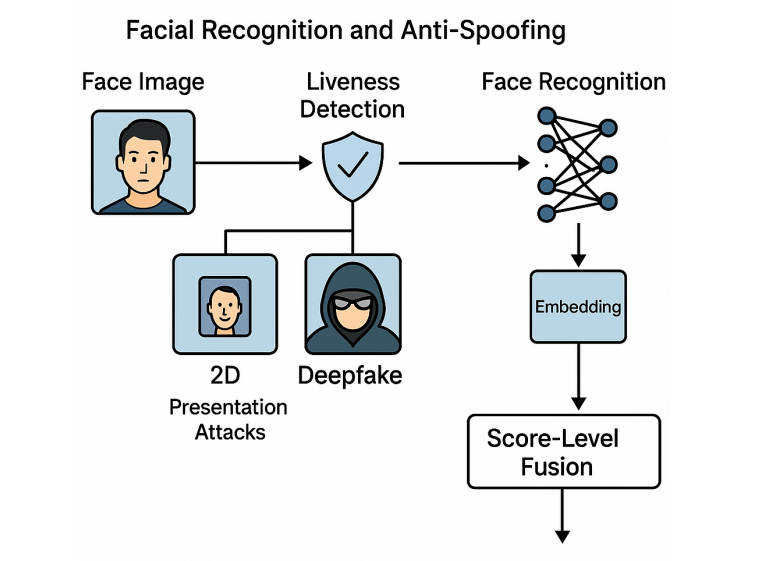
Recognizing the risk of spoofing attacks, the team engineered liveness detection networks that analyze texture, motion, and physiological signals like eye blinking and remote photoplethysmography to verify genuine presence. These networks assess whether a presented face is from a live person or a spoofed image or video. For fingerprint and iris recognition, researchers employed convolutional neural networks and attention-based models, training them on datasets like CASIA-Iris and ND-Iris to achieve robustness against varying illumination and pupil dilation. The study also explores voice and behavioral biometrics, utilizing spectrogram-based convolutional neural networks and long short-term memory embeddings to improve speaker verification.
Furthermore, scientists investigated the integration of smart cards and trusted platform modules, demonstrating how these secure hardware components can perform match-on-card verification, ensuring sensitive biometric templates remain securely stored within the device. This approach, coupled with deep learning, represents a significant advancement in multi-factor authentication, offering enhanced security, scalability, and user experience. The team systematically compared different architectures, fusion strategies, datasets, and benchmarks employed in state-of-the-art systems, analyzing potential threats and countermeasures against adversarial and spoofing attacks to identify areas for future research.
Biometric Authentication Performance Across Standard Datasets
Recent work demonstrates significant advancements in multi-factor authentication (MFA) systems leveraging deep learning and biometric technologies. Researchers have extensively evaluated performance using standardized datasets and metrics, revealing crucial insights into system accuracy and reliability. The LFW dataset, comprising 13,000 face images, and VGGFace2, with 3. 3 million images, serve as benchmarks for facial recognition algorithms, assessing performance under unconstrained conditions and varying intra-class variability. For iris recognition, the CASIA-IrisV4 dataset, containing 54,000 near-infrared iris images, provides a robust platform for evaluating algorithm performance across multiple views.
Evaluations consistently utilize key metrics to quantify system performance. False Acceptance Rate (FAR), measuring the probability of incorrectly accepting an impostor, is often reported at operating points of 10⁻³ or 10⁻⁴ to assess security levels. Conversely, False Rejection Rate (FRR), representing the probability of incorrectly rejecting a legitimate user, is critical for evaluating usability and user experience. Equal Error Rate (EER), the point where FAR and FRR are equal, provides a single scalar indicator of overall accuracy, with lower values indicating superior performance. Detailed analysis also incorporates Receiver Operating Characteristic (ROC) curves, visualizing the trade-off between FAR and True Positive Rate, and Detection Error Tradeoff (DET) curves, emphasizing low-error regions as recommended by international standards.
Researchers also measure Failure to Enroll (FTE) and Failure to Acquire (FTA) rates, crucial for assessing real-world deployment feasibility, and Authentication Latency, with practical systems aiming for completion times below 1. 5 seconds. The FVC2004 fingerprint dataset and the PLUSVein-FV3 dataset, with over 2,000 samples of dorsal hand vein patterns, are used to evaluate fingerprint and vein-based biometric verification. Evaluations of multimodal systems, combining modalities like iris, fingerprint, and face, also quantify Fusion Gain, measuring the improvement in accuracy achieved through combining multiple biometric sources.
🗞 Deep Learning-Based Multi-Factor Authentication: A Survey of Biometric and Smart Card Integration Approaches
🧠 ArXiv: https://arxiv.org/abs/2510.05163